

 Global
  United States

What are Vision Language Models?
Certain artificial intelligence (AI) and machine learning (ML) models can now take various types of input data, including text, image, audio, video, etc., and are thus classified into multimodal models. Furthermore, a specific type of multimodal model can only intake vision and text data using computer vision and image processing services (CV), agentic AI solutions, generative AI services (GenAI), and natural language processing (NLP), produce textual output, and is called a visual or vision language model (VLM). These models are developed to generate content, map, and understand image and textual queries via AI development services.
They provide a unified approach and have been useful in creating image captions, for example, Contrastive Language-Image Pre-training (CLIP), text-to-image generation like DALL-E, text-to-video like SORA, visual question answering from natural language prompts in the context of visual info such as Generative Pre-trained Transformer 4 (GPT-4), Gemini, Llama, Gemma, QLoRA, and more. Base VLM models can be parameter-efficient fine-tuned (PEFT), used in conversational mode, and feature grounding to reduce hallucinations.
The right VLM can be selected on the grounds of task-specific needs, model performance, computational resources, and available data. The current global market for vision language models is estimated to be around US $3.35 billion as of 2025 and is expected to surge and reach an approximate value of US $10.98 billion by 2030, increasing at a CAGR of 26.8% during this forecast period. Let us now go through their importance further in this blog.
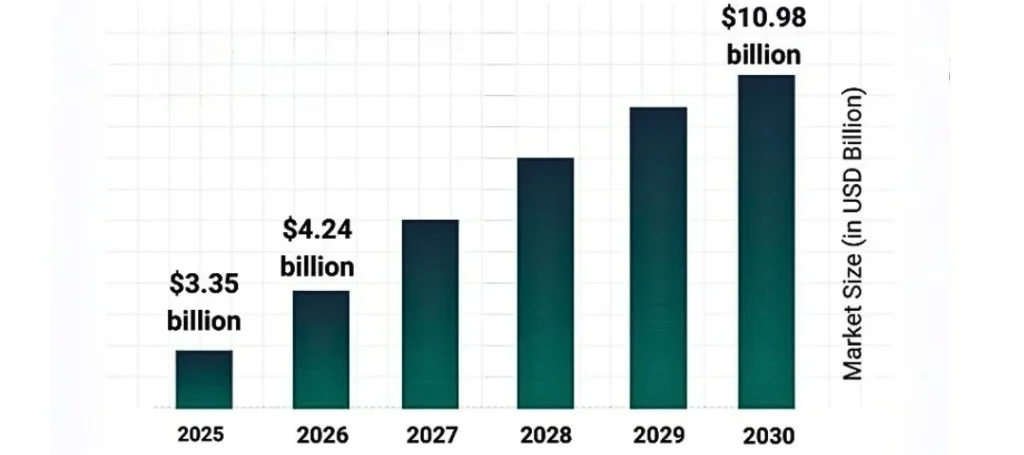
Source: The Business Research Company
Growing market size of vision language model architecture during the forecast period 2025 to 2030
How do Vision Language Models Work?
Architecture
A VLM architecture can vary according to the manner of fusion of textual and visual modalities; for instance, certain architectures involve the fusion or alignment of modalities in early, moderate, or final stages. VLMs are enhanced Large Language Models (LLMs like Llama 3 or Mistral) that combine vision models or visual ML algorithms with LLMs and can understand both textual and visual input data.
In a way, LLMs and VLMs have similar functions when it comes to converting the input into a single format like embeddings (Z(t) and Z(i)) and performing inference on the obtained combination. Here, embeddings refer to fixed-sized vectors that capture and represent the position and meaning of a token in the input sequence such that they carry semantic data in a number format.
Through optimized DL and CNN training objectives, the vectors are assigned values or meaningful data about the represented token based on factors like distributional hypothesis, similar context semantics, neighboring words, or related meaning. Some commonly known VLM architectures include dual-encoder models that use separate encoders (modular bridges) for text and images and align visual and linguistic representations in a common embedding space for retrieval tasks and scalable training.
Encoder-decoder models only encode visual inputs and then directly produce textual results, which is useful for VQA and image captioning. Then there are unified multimodal models that simultaneously process text and images within a singular transformer-enabled architecture for scalability and flexibility in handling tasks and advanced multimodal reasoning.
One may ask, is ChatGPT just a language model? To answer this, it is not, as an LM predicts and generates linguistic context, while a multimodal model (MM) can process multiple modalities. An MM showcases and generates conversations, reasoning, multimodal outputs, features, and tools that ChatGPT is capable of.
Elements
VLMs are made of two components that are a language encoder and a vision encoder, where the former projector captures contextual associations amongst words and semantic meaning, and it then converts them into embeddings so that AI models can process them. These models function on a neural network architecture named the transformer model for the language encoder component. For example, Google’s Bidirectional Encoder Representations (BERT), VisualBERT, VisualGPT, QLoRA, Claude 3.5 Sonnet, etc.
An image or vision encoder performs extraction of important visual and spatial features, including object, shape, color, and texture, from the input video or image. It then converts the same into a vector embedding format for ML models to process. Earlier, VLMs utilized deep learning (DL) for extracting features, such as convolutional neural networks (CNNs like ResNet or EfficientNet). Contemporary VLMs use a vision transformer (ViT with Q-Former bridge or connector) that can apply a transformer-based language model to process images into patches organized in grids of, say, 16×16 pixels each (early fusion).
ViT considers their sequence in a manner similar to tokens (token fusion) in the language transformer and implements a self-attention mechanism over the processed patches. It processes and transforms individual pixels within each patch into numerical vectors using a neural layer called Multilayer Perceptron (MLP). Vision language models architecture basically creates a transformer-based representation of the image that was input and passes them through the image encoder.
A transformer architecture involves encoders that transform incoming sequences into embeddings, while a self-attention mechanism allows them to be attentively focused over necessary tokens in the data sequence taken irrespective of their position. The text encoder has been fine-tuned to generate language outputs as per visual data. At times, multimodal fusing with cross-attention includes a feature called self-resurrecting activation unit (SRAU), which avoids vanishing gradients causing sigmoid loss of necessary information.
This mechanism helps decoders generate the best possible output using the encoder’s embeddings. The image encoder has multiple blocks with feedforward layers alongside attention layers within each block that perform computations for high-level feature extraction and enhance the image representation. The blocks function iteratively to encode the visual content to be used in downstream tasks and analytical processing.
They refine image representation and provide a condensed, enriched version of the original image. To summarize. To summarize, machine vision translates raw pixels of the object into lines, shapes, forms, and such representations. Multimodal LLM processes and contextualizes textual content to connect the concepts between contexts and their interactions. Ultimately, models label image parts and connect them with texts in LLMs.
Inference
As discussed, VLMs perform image analysis through an image encoder; a code is created showcasing the key features, which are taken by the text decoder, combined with text input, and processed. Embedding vectors obtained after combining image and text are passed through an LLM or tokenizer that processes the text alone and predicts the sequence and neighboring tokens as per text input and image embedded representations. One may ask what are the best vision language models? To answer this, some common VLMs are DeepSeek-VL2, Gemini 2.0 Flash, Llama 3.2, GPT-4o, NVLM, Qwen 2.5-VL, InternVL3, LLaVa 1.6 Hermes 34B, moondream2, CogVLM-Chat, KOSMOS-2, Yi-VL 34B, LongVILA, etc.
Embedding layers transform textual and visual inputs into a high-dimensional space for combination and comparison, as this process allows them to understand multimodal connections. The LLM, with its attention layers, focuses on input parts adaptively depending on the task, context, and elemental weight for relevant predictions. At the end, the fine-tuned text decoder utilizes the intricate combinatorial understanding for the versatile VLM’s coherent and contextually relevant responses.
Training
To train VLMs, one needs to align and fuse both linguistic and visual information for models to correlate text and images and render bi-modal decision-making. It mainly involves stages like visual pre-training, alignment pre-training, visual instruction training, and preference alignment. This can be done through a mixture of approaches, supervised vs. unsupervised learning, such as contrastive learning, where the text and image embeddings from both encoders are mapped into a high-dimensional shared or joint embedding space, such as in the ALIGN model.
Training occurs on image-text paired datasets for the model to learn and reduce the distance amongst matching pair embeddings and increase nonmatching pairs like Flamingo, LXMERT, VC-GPT, PaLM-E, LiT, SimVLM, and CLIP (open-source vision language models architecture that intakes 336×336 or 448×448 pixels image size). Knowledge distillation using large teacher models like in ViLD is also known.
Another technique is masking, in which the VLMs acquire knowledge and predict obscured input images or textual parts. They basically fill missing text in a given caption of an unmasked image in masked language modeling (MLM) for image-text matching (ITM). In the case of masked image modeling, these models are provided with an unmasked caption to reconstruct hidden pixels in an image, for example, Foundational Language and Vision Alignment (FLAVA). At times, Reinforcement Learning from Human Feedback (RLHF) can also be considered alongside supervised fine-tuning techniques.
It is to be kept in mind that VLMs need to capture all types of broad multimodal knowledge, task-relevant, and domain-specific relations between texts and images. So, the training data needs to include annotated datasets (scene or doc), image-text pairs, web-scale datasets, and domain-specific data, for example, medical images, product images with metadata, and clinical notes.
In the generative model training technique, VLMs learn to produce new information, such as text-to-image and image-to-text generators. In the former case, images are generated from textual prompts, while in the latter, an input image is used to create captions, descriptions, and summaries. Models like MAGIC and ASIF are typically deployed with an OpenAI REST API interface for easy interaction. One may ask, what are the big 3 AI models? This may include OpenAI GPT or ChatGPT, Anthropic Claude, and Google Gemini.
An NLP-based learning technique called PrefixLM inputs a textual part (prefix) of the image, learns to make predictions of the next sequential word. It leverages ViT for dividing the image into a sequence of single-dimensional patches where each patch represents a local image area. Linear or convolutional projection is applied by the model over processed patches, and context-relevant visual embeddings are produced. In case of text modality, patch-relative text prefix is converted to a token embedded by the model. Thereafter, the encoder-decoder blocks receive visual and token embeddings where the VLM learns their relationship.
There are also pretrained LLMs and vision encoders with an added mapping network layer that projects or aligns an image’s visual representation into the LLM’s input space. These can be used to build VLMs, as training from scratch is expensive and resource-intensive and only requires fine-tuning through TRL’s SFTTrainer for specific use cases. For example, Large Language and Vision Assistant (LLaVA) uses Vicuna LLM and CLIP ViT-L/14. Common datasets include ImageNet, COCO, Flickr30K, Visual Genome, COYO, LAION, CC3M, CC12M, YFCC100M, SBU Captions, Visual7W, VizWiz, and more.
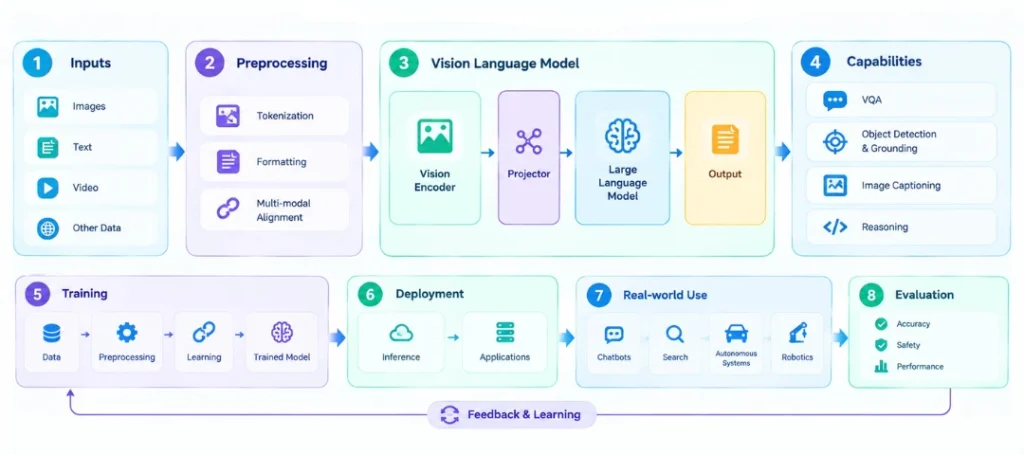
High-level workflow diagram of vision language models architecture
Evaluation
VLMs are analyzed as per certain critical metrics that include top-k response accuracy or cross-modal retrieval, computational efficiency versus constrained hardware, scalability to handle enormous real-world data, relationship quality between text-image data, and generalization or new data adoption with minimal deteriorated performance. An important benchmark for reviewing the VLMs’ performance is the Massive Multi-discipline Multimodal Understanding and Reasoning (MMMU) evaluation.
It is a comprehensive evaluation tool for testing the model’s knowledge that consists of various multimodal challenges across arts and engineering disciplines. Another is MMBench, based on CircularEval strategy, that tests the model based on its answers for multiple-choice questions related to different skills like object localization and OCR. Some other examples are Vision Arena and Open VLM Leaderboard which rank VLMs as per score, size, performance, spatial reasoning, image-text alignment, and hallucination rate.
One may think in this case, is VLM better than OCR? To answer this, the user needs to look at the application in question; per se, for extracting text from images, OCR would be preferred, but for understanding the textual and visual content, VLM works better. VLM offers a better comprehension of layout and reasoning while both can interpret relationships between different entities in a table or form. Although there are certain challenges, such as VLMs, being more expensive and possibly hallucinating during exact transcription, unlike OCR.
The Bilingual Evaluation Understudy (BLEU) evaluates tasks and computes target text precision in reference to the ground truth. Recall-Oriented Understudy for Gisting Evaluation (ROUGE) does recall computations between reference and candidate sentences. Metric for Evaluation of Translation with Explicit Ordering (METEOR) calculates the harmonic mean of recall (with weight) and precision minus the penalty. Consensus-based Image Description Evaluation (CIDEr) compares human and target sentences for average similarity computed as per Term Frequency-Inverse Document Frequency (TF-IDF) and F1 scores.
Domain-specific benchmarks like A12D, LMMS-Eval, MathVista for assessing the model’s mathematical visual reasoning, and OCRBench for VLM’s OCR abilities. Video-MME and MM-Vet are benchmarks for assessing the integration of spatial awareness, language generation, and other capabilities. VQA, GQA, BLIP-VQA, DocVAQ, OK-VQA, TextVQA, ChartQA, and ScienceQA benchmarks do assess responses to open-ended questions around respective images.
LLMs-Eval provides an evaluation command-line interface, and VLMEvaKit allows one-command VLM evaluation. One can also consider mean reciprocal rank (MRR), cross-modal similarity scores, or attribute identification, relational reasoning, and word-order sensitivity (ARO) benchmark and TTI-Eval. Further, performance metrics like latency, throughput, and resource utilization need to be evaluated as well.
CV vs. LLM vs. VLM vs. VLA
Although all these techniques fall under the umbrella of AI, they process varied data types, reason in distinct manners, and serve different applications. Conventional CV models are dependent on visual signals and count or identify objects or defects present in or features of an image. They do not convey any explanation of the observed entity using natural language. In the case of CV, speed, efficiency, and edge deployment are critical, and no language-based reasoning or explanation is required in the task.
LLMs, on the other hand, can reason with textual input but cannot infer any data from visual context unless it is provided to them. In these types of single-modal models, the problems may involve textual content generation, summarization, and visual context, which is either unnecessary or pre-encoded in the text. The applications deployed require flexible NL reasoning.
Coming to VLMs that form the bridge between LLMs and CV models to reason across textual and image modalities. AI model development requires VLMs when the application needs a comprehensive understanding of text and image simultaneously. In multimodal model-based applications and tasks, ground truth reasoning, explanations, and answers are required by users in visual content. Also, these tasks may involve visual assistance, multimodal search, and document understanding.
One may ask, is ChatGPT an LLM or generative AI? To answer this, although ChatGPT is GenAI, LLMs form the foundation of it. Generative AI applications can produce text, images, audio, video, code, and more, while LLM forms a part of it and is responsible for generating and understanding text. At the same time, ChatGPT is a conversational AI system that uses GenAI models to work across different modalities, including text, in which case it is powered by LLMs.
A vision language action (VLA) model acts on the commands developed through what is described by a VLM. Their architecture is the same as that of VLMs with an additional action output layer in the pipeline, which helps them to generate motor commands, physical movements, and system calls as perceived. VLAs trained on web-scale image-text paired data can generalize physical manipulation at times without training.
In place of producing textual descriptions, the system receives natural language instructions on visual environmental perception that helps in executing physical tasks without any manual aid. VLAs are deployed across bounded action spaces, controlled manufacturing environments, well-lit warehouses, pick-and-place robotics with predictable object placement, inspection workflows, and automation like Groot N1.
Use Cases of Vision Language Models
These models bridge the gap between textual and visual information, which eliminates the need for two separate AI models per modality. They perform multimodal logic and reasoning, document understanding, multi-image comparisons, retrieval augmented generation (RAG) multimodal searches, and parsing text and handwritten documents. Here are some other visual language tasks performed by VLMs.
Visual Question Answering
Any questions asked about videos or images can be answered and analyzed by these models, given their visual reasoning capabilities, which can also be extended to agentic AI applications. In the real world, AI agents based on VLMs are used in the transportation sector to inspect and analyze roads in videos to identify faulty traffic lights, defective road signs, potholes, and other hazards. Agentic AI architecture generates a maintenance report to provide descriptions of those hazards and outline the location in question.
Video Understanding
Vision language models can produce image captions and descriptions that are detailed and summarize any visual data in documents and videos, including medical images with multimodal AI in healthcare, manufacturing equipment and tool repair charts, and more. They are also used in content moderation to identify harmful and inappropriate video content, which is a precursor for maintaining user-friendly applications; for example, Bootstrapping Language-Image Pre-training (BLIP-2 OS) assists visually impaired users with descriptions.
Object Detection
These models perform AI pattern recognition, identify, and classify objects in the visual data or input image and generate context-relevant descriptions around the object’s location with respect to other elements in the image. This property is applied in Pegatron and Linker Vision and is useful for computer vision object detection and analytics in manufacturing robots for visual instructions and environmental understanding. It can also be used in shelf monitoring, QA, KYC, AI medical diagnostics, computer vision in autonomous vehicles perception, OCR, and even generative AI in cybersecurity.
Search & Retrieval
Visual language models can be used for searching and retrieving required videos and photos from large corpora of databases, repositories, and galleries as per the provided natural language prompt, keyword, or query. AI in retail industry enhances the user or shopper experience in navigating retail catalogs and retrieving a particular item over e-commerce websites, etc. Cross-modal retrieval models allow users to use text or images to search for other modalities, such as image search using text and text search using images. It is useful for customer support and troubleshooting, where models can interpret screenshots by users for assistance, per se, by using AI in consumer electronics.
Image Creation
VLMs act as text-to-image or art generators, which can be used by organizations to design and prototype product ideas for better visualization, for example, DALL-E, Midjourney, Imagen, and Stable Diffusion. They can also be used for text-driven image manipulation that is to modify existing images as per given textual instructions. Creative industries deploy VLMs to produce creative responses to voice commands or cues like art, music, entertainment, gaming, storytelling, video material, intuitive human-machine interactions, e-commerce graphic content, generative AI in healthcare, and other explanations. One may ask, what are the 5 best AI models? This may include GPT-6 Astra, Claude Fable 5.1, Claude Opus 5.5, Gemini 3.1 Pro, and DeepSeek V4 / V4-Pro as per the industry benchmark rankings.
Image Segmentation
These models have proved to be useful in predictive equipment maintenance by analyzing factory floor images and videos. They do so by partitioning an image into segments as per spatial features extracted from the image. Further, they provide textual descriptions of the segmented partitions and produce bounding boxes, labels, highlights, and annotations through image annotation services for object localization, such as in AI for medical imaging, surveillance, OpenCV face recognition, intruder detection, satellite imaging, autonomous driving, and generative AI for retail.
KritiKal: Expand Your Business with Tailored VLMs
In this blog, we discussed that VLMs are multimodal AI systems that intake images, videos, and text to produce text in the form of video or image descriptions or images. They can answer questions related to objects in a video, images, and even identify parts of an image. VLMs represent the advanced realm of multimodal AI that integrate text and visual input through AI integration services, understand the same, and generate related content.
They function on state-of-the-art architectures that have remarkable capability of fusing textual and visual modalities, for example, LLaVA. They bridge the existing gap between linguistic and visual comprehension and deliver tasks as discussed in this blog. Further, VLMs showcase promising AI research, novel multimodal avenues, and properties to comprehend and generate tasks. They showcase the ability to focus on certain input elements in a dynamic manner, which enables them to be sustained in many applications across domains by offering context-relevant predictions and semantic searches in place of metadata tags.
Although there are certain challenges associated with complex VLMs, such as PaliGemma, that demand high computational resources, hardware, and high data quality in their training and large-scale deployment. Lack of data readiness can be difficult for companies with access to limited infrastructure and unavailability of high-performance computing. Development of vision language models architecture has raised certain ethical concerns for socio-culturally biased outputs and the inability to learn conceptual differences between certain images as per their real-world training data. Other challenges include small object detection, latency constraints, limited visual grounding, and interpretability issues.
Privacy, data governance, and security are major considerations in this case, as VLMs often require access to a large amount of sensitive information. Moreover, there are challenges around their evaluation, as images may have different ground truth descriptions, and low consensus-based metrics like CIDEr may not be able to account for this issue. VLMs may not understand sequential caption order in image annotation.
KritiKal explores innovative methods for AI-augmented software development to render more efficient VLM-based applications by working around hardware accelerators, such as TPUs, GPUs, and using Vision-and-Language Transformer (ViLT) that simplifies processing by reducing reliance on encoders, compression techniques, and also optimization of architectures. We implement bias mitigation techniques and content safety filters to render fairness-aware and generalized ML algorithms through computer vision trends, large, balanced, and diverse training datasets that include edge cases, outliers, and feature zero-shot learning (without any task-specific training) to develop Mixture of Experts (MoE) and Smol-capable VLMs (1B and 10B).
Our team conducts rigorous testing and evaluations of obtained outputs to ensure that the model does not generate biased, harmful, unclean, or offensive content. We make sure that sensitive data is handled in compliance with privacy regulations, securely, to maintain stakeholder and end-user trust. We utilize federated learning techniques such that training of vision language models can be done on decentralized data, and sensitive data need not be transferred to a central server, supporting low time-to-first token (TTFT),
Also, we implement data responsibility measures like personal information filters, validate outputs for their factual accuracy against AI hallucinations, and allow VLMs to adapt to novel and atypical image-text concepts. To enhance vision capabilities, we ensemble vision encoders to process inputs, break apart high-resolution images into smaller to-be-processed tiles, and increase context length for understanding longer, high-resolution videos (1080×1920 pixels) that are downsized or cropped. Please get in touch with us at sales@kritikalsolutions.com to integrate VLMs in your workflows and realize your business requirements.

Virupakshi Harish is a Data Scientist who currently works as a Software Engineer – Vision Systems at KritiKal Solutions. He is proficiently skilled in developing intelligent medical imaging and surveillance systems and technologies, such as ML, DL, CV, NLP, industry-level AI development, data science, and more. With his ability to work efficiently in teams, he has assisted KritiKal in delivering various projects to some major clients.