


 Global
  United States
Introduction
In today’s advanced world, edge-based computing technology is speeding up model building and reshaping digital journeys. Some cases ascertain that cloud-first solutions may not be suitable for real-world environments due to inconsistency in connections. In lieu of these traditional embedded systems and IoT solutions, storage and computation systems need to be moved closer to the point of data generation. This is where this technology proves to be a useful tool for limiting unnecessary bandwidth, latency, and continuing critical workloads even amidst constrained networks. Surged spending has been reported globally over distributed infrastructure for edge systems, computer vision, and image processing services.
This blog on ‘edge computing explained‘ examines the benefits, future capabilities, architecture, and related use cases of intelligent edge AI systems. It is now a known fact that data, when processed nearby, such as in the case of consumer electronic product development, can enable faster decision-making, seamless user experiences, and real-time connections across mobile devices, electric vehicles, retail cams, and industrial sensors. The current global edge-based computing market is estimated to be around US $46.7 billion as of 2026 and is expected to surge and reach an approximate value of US $328 billion by 2033, increasing at a CAGR of 32.1% during this forecast period, mainly due to adoption of IoT and neural networks.
What is meant by Edge Computing?
One might ask, what best describes edge computing? To answer this, edge-based computing enables data generation at a closer location or at the edge of the network to minimize bandwidth usage and latency, which is common in the case of cloud IoT solutions. Instead of replacing or diminishing the capabilities of cloud computing, it extends and complements it. This is because many tasks, such as storage for longer duration, managing fleet, in-depth analytics, and overall coordination across edge systems, require public cloud-powered centralized command centers, thus highlighting cloud-edge models and applications developed through AI development services.
What is Edge AI?
One might ask, is AI on edge computing? To answer this, edge AI is basically the deployment of AI/ML models through physical hardware development services on edge nodes, endpoint devices, and systems for real-time analysis and actions without complete dependence on cloud ecosystems. This field is gaining momentum due to the privacy benefits it offers, where sensitive data is stored locally, and its insights are shared further upstream. Moreover, it enables swifter inference and decision-making at industrial settings or where the vehicles, machines, cameras, and other sensors have been deployed for data production. Simply put, it is the integration of AI with edge computing. Further, raw streams can be replaced with direct outcomes like embeddings, alerts, and labels, which can be transmitted due to low bandwidth.
Common edge AI patterns observed across businesses include federated learning to improve privacy posture, where raw data stays put, and models are trained and fine-tuned across distributed devices. Another pattern is optimized edge deployment and inference of numerous AI models and central cloud training through cloud engineering services. Model optimization is the most adopted edge AI pattern for enterprise, which involves quantization, pruning, and hardware-aligned implementation for running AI models on edge devices that are constrained.
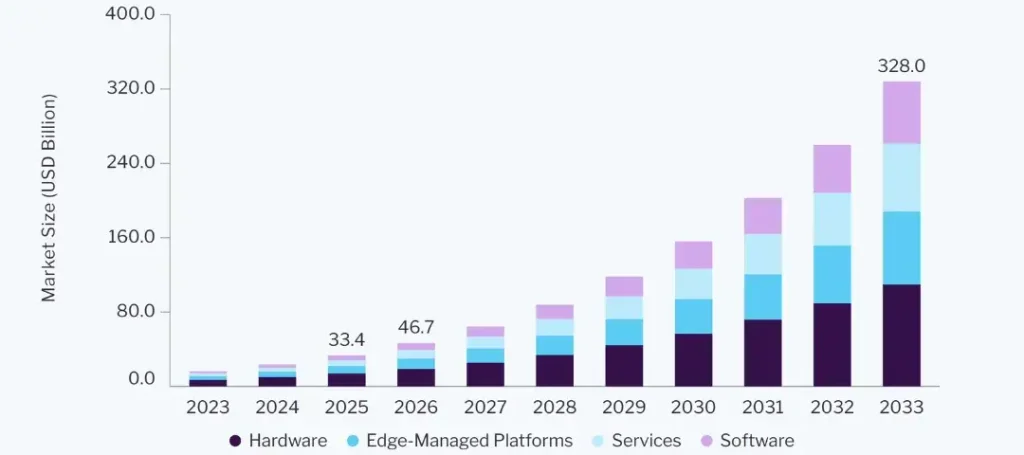
Source: Grand View Research
Growing market size of edge computing during the forecast period 2023 to 2033
Who Invented Edge Computing?
1997: Mahadev Satyanarayanan showcases computationally demanding functions offloaded to powerful servers by resource-constrained mobile operating devices, thus bringing computations closer to users.
Late 1990s: Content Delivery Networks (CDNs) popularized by Akamai placed users closer to content which formed the foundation for edge-computing models.
2009: Satyanarayanan, along with Victor Bahl, Ramón Cáceres, and Nigel Davies, published the founding manifesto of edge computations that proposed cloudlets and dispersed micro-data centers closer to users.
2012: Fog computing extended cloud capabilities towards distributed infrastructure closer to devices.
2013: In this year and for further decades, edge-based computing expanded into telecommunication, which was highlighted when Nokia and IBM introduced Radio Applications Cloud Server (RACS) for 4G/LTE communication networks. Under ETSI mobile edge-based computing followed in 2014 and further.
Key Elements of Edge Computing
Devices
This includes edge devices that are physically present at the collection point or at the edge of the network for data generation and processing, including smart battery-powered devices, IoT devices, actuators, sensors, low-power microcontrollers, hardware like specialized chips (Nvidia Jetson, Intel Movidius, and Google Edge TPU), single-board computers, AI accelerators, etc.
One might ask, is a smartphone an edge device? Yes, even smartphones are edge devices, as they are situated/placed where data generation and consumption take place. It performs local computations, such as AI inference, speech recognition, authentication, local data storage, and image, video, sensor data, and application processing. And is laptop an edge device? The answer is yes, it is.
Security Measures
Edge AI requires robust security approaches like intrusion detection, role-based access control, and encryption, such that sensitive health data stays protected during component-wise transmission. One might ask, is edge computing the same as quantum computing?
Gateways
Edge ruggedized gateways function as intermediaries between the data center or cloud and the devices placed at the network edge. They handle data aggregation and first processing and ensure secure data transmission to the data center as and when required.
Platforms
Although cloud reliance is reduced with edge AI, cloud services are needed for data storage for longer durations, conducting in-depth analytics, and wider management of data through swift interactions across data centers. It also includes mature edge AI platforms equipped with logging, CI/CD systems, remote diagnostics, health monitoring, OTA updates, centralized configurations, and device inventory.
Nodes
Miniaturized data center infrastructure and local servers act as edge nodes when they are positioned closer to edge devices. This minimizes the need to send all gathered data to the cloud as more intensive data processing and analysis occurs at the edge.
Software
All applications, software, and algorithms running on edge gateways and devices are included in this, as they empower informed decision-making, analysis, and data processing in real time.
Networks
This includes the communication infrastructure connecting nodes, gateways, and devices dispatched at the edge, and they facilitate swift and secure data transmission within the edge ecosystem.
Edge Computing Architecture Explained
In this section, we will discuss and explain its modular architecture. It is to be kept in mind that all these layers are secured using one or more mechanisms, such as Identity and Access Management (IAM), Role-Based Access Control (RBAC), mutual authentication, transit and rest encryptions, secure botting, and Trusted Platform Module (TPM).
Others include hardware root of trust, certificate management, network segmentation, zero trust policies, model provenance, application signing, patch and vulnerability management, remote attestation, logging, and/or SIEM integration. Edge communication management includes functions, such as configuration management, container orchestration, updates through firmware development services, remote upgrades, failure recovery, and others.
Device Layer
The data originates in the endpoint layer, and it includes industrial machines, connected devices, cameras, IoT sensors (temperature data), surveillance cameras (video stream), autonomous vehicles (telemetry data through telematics control unit), microphones (audio stream), robots, smartphones (user application data), PLCs, PoS systems, medical equipment, drones, smart meters, and more.
Edge Layer
This includes edge micro-data centers, gateways, servers, sites, and other computing resources that are positioned close to the devices for local processing, filtering, AI inference, network routing, device management, local caching, encryption, authentication, data normalization, aggregation, protocol translation (MQTT/HTTP), and analytics. Edge workloads may run as containers, microservices, virtual machines, AI inference services, and serverless functions. Edge nodes may use local SSD/NVMe storage, time-series and embedded databases, object and distributed storage, and caching systems.
Cloud Layer
Centralized cloud or data centers handle workloads, including long-term storage, computationally intensive processing, centralized management, large-scale analytics, etc., that may not necessarily occur closer to the data source.
Working of Edge Computing
Smart gadgets, smartphones, tablets, mobile devices, sensors, cameras, and other systems collect data, which is processed on a locally placed and networked edge device that can receive OTA updates like a server, gateway, or router, which forms the key element of this distributed architecture. Only the requisite information is sent upstream to the centralized cloud server for storage and analysis, while locally processed insights make up for quick decisions as compared to conventional approaches like backend system calls with SOAP/REST APIs and WEB API calls.
Regardless of its deployment location, edge AI follows the core workflow of model training, compression, quantization, deployment, and running local inference. The AI model is trained in the data center or cloud with abundant compute availability and large training datasets. The model and its memory footprint undergo compression and quantization for size reduction and ease of running on constrained edge hardware. The compressed AI model is deployed on the target edge device, server, or gateway, and local inference is run on the same device as per the received data without the need for cloud round trip.
Industrial Edge Computing Applications
Healthcare
Fitness trackers and smartwatches monitor user steps and heart rate in real time to provide instant alerts and feedback prior to sending sensitive health data to central servers, thus reducing time-to-intervention. It allows healthcare providers to ensure regulatory compliance (GDPR, ETSI MEC, ISO/IEC 25010, ISO/IEC 27001, and HIPAA) and quickly respond to patients. For example, medtech solutions like a smart insulin pump, monitor blood sugar, and process data locally without sending it to the centralized server. To answer what are some examples of edge computing, this industrial application makes quick decisions around adjusting insulin delivery on the spot, thus enabling data protection and real-time health management and even punctual remote surgeries.
Smart Cities
Other applications include the placement of sensors placed on roadside controllers or on the road that alter the timings of the traffic lights as per observed traffic conditions. This nullifies the need for remote data center connections per decision, thus facilitating swifter local control of traffic flow and reduced waiting time. Although the required aggregated data is still sent for enhanced analysis and coordination. It also enables real-time data analysis from public transportation and environmental sensing sources for rendering better public safety, efficient urban development, cooperative perception, and lowered energy consumption.
Security
It is utilized for smart video surveillance for on-site captured video processing through cameras that are equipped with live feed analytical technology, like in smart doorbells. AI in security and surveillance can instantly detect unusual activity or recognize wanted facial features or persons in collected video data without even transferring the same to a centralized server. Such alerts and information are especially useful for swifter responses during natural disasters and security incidents. This is due to edge solution features like situation analysis, sensitive data protection, personnel privacy, local data processing, low bandwidth utilization, and safe environmental maintenance developed through indigenous technology services.
Manufacturing
This type of computing is helpful in electronics manufacturing services and industrial automation, where factory machinery is equipped with sensors to monitor vibrations and temperature at all times. The collected data is processed near or on the machinery itself, and any worker safety, IIoT, or quality data anomaly is notified to the maintenance or management team in real-time to avoid major issues later. Edge AI also enables industrial imaging and machine vision, predictive maintenance in manufacturing environments, surface condition monitoring, deviation detection, and future fault identification to reduce downtime and related expenses.
Automotive
On-board edge devices enable low-latent functioning of self-driving vehicles by analyzing road conditions, traffic, pedestrians, animals, signs, lights, and computer vision object detection for decision-making in real-time. Automotive IT solutions can be used for swift and regulated V2X navigation, quick autonomous operations like shared mapping and voice assistants, and avoiding safety risks and accidents.
Retail
With edge AI, brick-and-mortar retail businesses can improve personal recommendation systems, customer support services, RFID-based logistics and inventory control, and sales approach strategy. Retail IT solutions like AI-powered cameras and IoT sensors can evaluate shopping trends and customer purchase records, perform heatmapping, queue, or foot traffic and market-basket analysis, cashier-less automated self-checkout, detect shelf stock-outs, and deliver personalized offers as per advised products and pricing adjustments.
Agriculture
In the agriculture sector, it is used to analyze weather patterns, irrigation, soil conditions, and status of crops during surveys using AI-powered drones across large crop lands. So, is edge an advantage? Yes, this is helpful for agricultural planning, field observations, insights, precision agriculture, pest detection, harvesting, spraying, or planting. Further, edge AI is useful for environmental monitoring like water and air quality checks and wildlife activity inspection across various ecosystems.
Energy
The energy and utilities sector benefits from edge AI and other IT solutions for manufacturing in the sense of power generation support, usage, and distribution management. Historical utilization data obtained from smart grids, IoT in energy, and weather patterns can be processed locally to determine grid health demand trends as per given current operating conditions and readjust distribution to reduce energy resource wastage and consistent output.
Finance
Edge AI is useful in financial risk analysis and fraudulent activity detection through local transaction processing, which helps in reducing latency and potential losses while improving security and accuracy of detection solutions. It also enhances customer service through edge-deployed chatbots for personalized interactions and loyalty. Other than this, it also monitors stock market changes for investment decision-making in real-time for maximized returns with optimal related strategies.
Gaming
It has significantly minimized latency in cloud-based and multiplayer gaming by deploying edge servers closer to users. High-speed, locally processed AR/VR data and complex graphics ensure faster response, gameplay, enhanced gaming experience, and high-quality streaming content across virtual environments.
Oil & Gas
In the oil, gas, and mining industry, edge AI is used for pipeline leaks using vibration and pressure change sensors. Edge cameras are used in rig safety and can detect unsafe conditions in real-time. Edge AI is deployed across mines to ensure onsite worker PPE compliance and on autonomous mining vehicles, such as haul trucks, for navigation across limited connectivity mining areas.
Telecom
It has proven to be useful in the communications and 5G/6G sectors by integrating into applications, such as virtualized RAN that processes radio functions and private 5G analytics across edge workloads that run within the enterprise’s networks. It enables edge hosting on premises through MEC for localized edge AI workloads across stadiums, manufacturing setups, and hospitals. It also renders network slicing assurance that can enforce SLA dynamically to ensure performance, security, reliability, and connectivity.
Here, one might ask, is 5G edge computing? 5G is a network or communication technology that provides connectivity for the near-to-user data processing performed by edge computing devices or architecture. When edge-based computing is integrated into mobile networks, the solution is commonly related to MEC.
Types of Edge Computing
Regional Edge Computing
This involves data processing at the data centers that are placed or located closer to the end user when compared to the main cloud servers. The regional edge approach reduces unnecessary delays alongside improving app performance. In applications like regional data hubs and content delivery networks, quick responses are needed despite the obviate instant data processing. This type of edge AI serves as an intermediate ground between centralized cloud computing and localized data processing.
Device Edge Computing
In the case of device edge, the data is processed on the sensor itself or IoT devices, that is, data is not sent off for analysis to central data servers. Rather, latency-critical sensitive data is processed on the device; and less time-dependent information is transferred upstream to reduce traffic and delays. Device edge AI and data handling at the location of data creation are seen in smart home solutions and autonomous vehicles, where quick decisions, responses, and data saving matter.
Cloud Edge Computing
Being a subset of cloud computing, the resources in this case are brought closer to the network edge; that is, cloud provider-operated regions. This may include localized zones, edge Points of Presence (PoP), Multi-access Edge Computing (MEC) sites, and others that are located closer to the devices or users. Cloud edge offers combinatorial power and flexibility of cloud with low latency and completely centralized data processing areas. It is applied across applications, such as online gaming and streaming services, where simultaneous support to multiple users and speed are required.
Local Edge Computing
Here, the data is generated and processed at the same location, facility, or building to minimize operational disruption; data travels to the cloud or central server and delays. It is useful for boosting business efficiency across smart industrial and factory settings for real-time decisions.
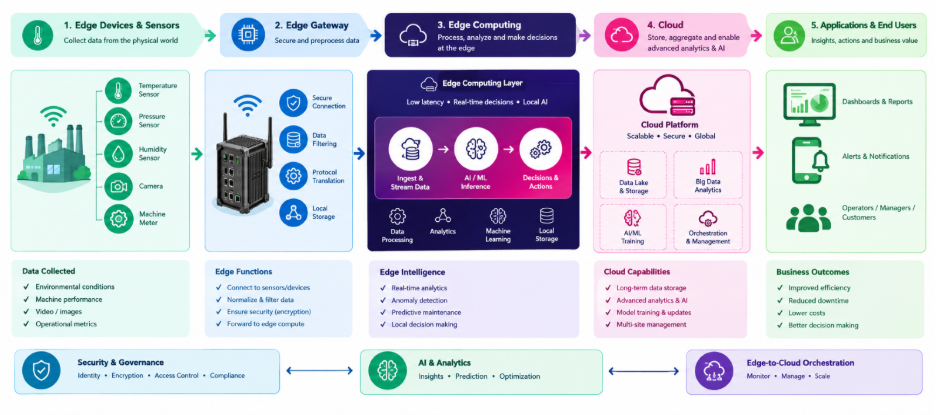
Diagram showcasing high-level edge computing architecture
Edge Computing vs. Cloud Computing
In this section, we will be highlighting the answer to the question what is the difference between cloud computing and edge computing? We will as well be comparing their functionalities and features with a hybrid of both. To decide amongst the three, one must consider the business use case or advantage sought after. Per se, edge computing is useful for businesses looking for real-time control, onsite analytics, and localized interference like in IoT devices, AR/VR systems, and autonomous vehicles. Cloud computing is suitable if organizations seek customized AI model training, batch analytics, and long-term storage, such as web applications and file storage.
In terms of latency, edge AI offers the lowest latent operations of all with local processing, while cloud operations may result in higher latency due to network round trips. In the case of bandwidth, edge AI offers optimized bandwidth usage by sending events in lieu of raw streams, while cloud computing requires heavier bandwidth used in transmission for central data ingestion. The compute ceiling is limited by local hardware in the case of edge AI, while it is effectively unlimited in the case of the cloud.
Edge AI has proven to be more resilient across businesses with the ability to operate even with poor connectivity, while cloud computing is heavily dependent on stable connectivity. The former is the preferred option to maintain data sovereignty, as it is a strong option for in-region or on-site data processing, while for the latter, it is solely dependent on the cloud provider’s regional choices. The inference runs on an edge server, gateway, or device, while it runs on a centralized cloud data center in the other case.
Although in edge AI one can simply add nodes near increasing demands for scaling up, the cloud offers a better option for scalability as it allows elastic compute at a large scale. Furthermore, it may be difficult to monitor operations at scale across multiple sites in case of edge AI as compared to cost-effective, centralized cloud operations. And yet, hybrid computing is what most enterprise production systems are and is preferred by businesses for balanced performance and operational efficiency.
So, is edge computing the next big thing? Hybrid computing combines the power of both edge and cloud, and it offers low latency for localized actions while delegating heavy lifting operations to the cloud. It utilizes bandwidth in a balanced manner through local filtering and centralized analytics. This distributed AI offers resilient localized continuity while cloud-centralized coordination. It is useful for locally processing sensitive data alongside syncing approved outputs. Moreover, hybrid computing requires a strong fleet and offers disciplined cloud operations.
In fact, these three can serve as complementary architectures serving various operations. Businesses need to choose edge AI over others in use cases where latency matters. One might ask, is edge computing faster? Yes, especially situations that require near real-time response predictable within a sub-second, and if streaming raw data continuously is not a cost-effective option due to expensive bandwidth and data egress. Also, if uninterrupted operations are required to go on even if the network is lost or goes offline and the residency-constrained business needs local inference through on-or near-device decisions over in-region stored, processed, sovereign, and sensitive data.
What are the Benefits of Edge Computing?
- Latency: Data is processed closer to the source to avoid latency from user to server travel.
- Sovereignty: National laws and regulations apply during sensitive data processing.
- Residency: Unauthorized data manipulation is nullified across physical handling and storage areas.
- Bandwidth: Improved bandwidth efficiency minus network obstruction within a given timeframe.
- Security: With encryption, anonymization, biometrics, and RBAC, low surface attack area is rendered.
- Flexibility: Cost-effective infra and change of workloads through added edge nodes during scale-up.
- Data Loss: Controlled, retained, and managed data systems and platforms to avoid losses.
- Decision-Making: Immediate decisions with the latest collected data for crucial industrial applications.
- Personalization: Context-aware user experiences adapted to real-time individual preferences.
- Efficiency: Energy conservation via specialized chips by reducing data travel power requirements.
Is Edge Computing the Future?
- 5G: Enables ultra-low latency and more bandwidth for feasible real-time edge workloads handling.
- AI/ML: Smarter devices with lightweight pattern recognition without transmission-enabled analysis needs.
- Continuum: Between edge devices for real-time processing and the cloud for storage and analytics.
- Fog Computing: Intermediate layers for coordinated data processing in distributed environments.
- Federated Learning: Collaborative learning for a shared prediction model with localized private data.
- Advanced Hardware: Powerful and energy-efficient edge processors for complex AI/ML solutions.
- Interoperability: Standards to improve compatibility and integration across industries and platforms.
- Containers: Lightweight container platforms for distributed deployments on multiple edge devices.
- Runtimes: Optimized AI model inference with efficient runtimes at the edge, like ONNX Runtime.
- SLMs: Small Language Models with simple edge architectures trained with specific data and tasks.
Get Your Business Edge-Ready with KritiKal
So, what is edge computing in layman’s terms? In this blog, we observed how edge-based computing assists with enhanced resilience, real-time performance, better data control, data sovereignty, and local inference, all within optimized bandwidth usage. KritiKal Solutions can uplift your existing solutions and deliver high-impact edge use cases. We start by targeting high-impact opportunities, defining measurable KPIs; and addressing issues to overcome like latency (PGW/UPF, local breakouts, URLLC), low bandwidth, or downtime, and target edge architecture developed through circuit board assembly services.
Thereafter, validating data and cloud-edge workflow, scaling up measures, building a tech foundation, security layers (VPN, IPSec, and TLS tunnels), aligning AI computing initiatives with digital transformation and cloud strategies, prototyping, and ultimately, industrializing while implementing edge MLOps practices. We can be your partner in running modern workloads with powerful TPU (like Google Coral Series), CPUs, NPUs, SBCs like Intel Celeron-powered Odyssey, or GPU-first edge-cloud-enabled infrastructure (like Nvidia Jetson), multi-core AI-optimized processors, mitigation support, and predictable networking.
One might ask, what are the disadvantages of edge computing? KritiKal can assist you in overcoming common edge computing challenges like coverage (multi-IMSI, SGP.32-compliant eSIM), power use, complexity versus inference capability trade-off, connectivity, data quality, model updates, resource-constrained devices, heterogenous fleets, expanded attack surfaces, and cross-functional resource requirements. This will not only enable all heavy-lifting model training and analytics but also optimize local data processing. Please get in touch with us at sales@kritikalsolutions.com to know more about our edge products, platforms and services and realize your business requirements.

Vipin Maurya currently works as an Architect – Embedded at KritiKal Solutions. He is proficiently skilled in project management, Agile, SAFe, ASPICE, AUTOSAR, CAN, MATLAB, dSpace tools, Embedded C, and more. With his ability to work efficiently in teams and more than 19 years of experience working with software development, he has assisted KritiKal in delivering various projects to some major clients.