


 Global
  United States

Overview of Generative AI in Healthcare
Generative AI (GenAI or GAI) has evolved from an experimental model to a pioneering force in the medical field and is being adopted across pharmaceutical organizations, hospitals, and health insurance companies. This advanced technology uses transformative algorithms to analyze existing medical information, which in turn helps in personalizing patient care efficiently. Generative AI services can be seen being utilized in streamlining operations, increasing diagnostic accuracy and interpretations, disease progression simulation, drug molecular design, clinical note summarization, and as a part of implementing AI in drug discovery, novel drug designing, and whatnot.
GenAI surpasses traditional methods through pattern recognition; prediction making from existing data; generation of medical images, new molecules, and structured reports; and formulating personalized treatment frameworks. GAI-based Large Language Models (LLMs) developed through AI development services are used to create chatbots over medical platforms that can assist patients with dosage reminders, appointment scheduling, and triaging symptoms, while Natural Language Processing (NLP) models assist clinicians with automatic diagnostic and research reports.
As one of the most promising frontiers in digital healthcare innovation and medtech solutions globally, AI in healthcare is used to significantly reshape clinical workflows, patient outcomes, and healthcare management by deriving insights and generating new content from existing patient data. A system powered by this technology automates complex tasks, such as analysis of radiological images, generation of synthetic data for research and clinical trials, reviewing huge volumes of medical data, and identifying hidden patterns. Not only does it rectify human errors, but it also allows medical professionals to focus on decision-making and treatment strategies.
The current global market for generative AI for healthcare is estimated to be around US $1.55 billion as of 2025 and is expected to surge and reach an approximate value of US $45.82 billion by 2034, increasing at a CAGR of 46% during this forecast period. Let us now go through the multifaceted role, working, prospects, and challenges of generative AI in automating clinical workflows and enhancing patient experience further in this blog.
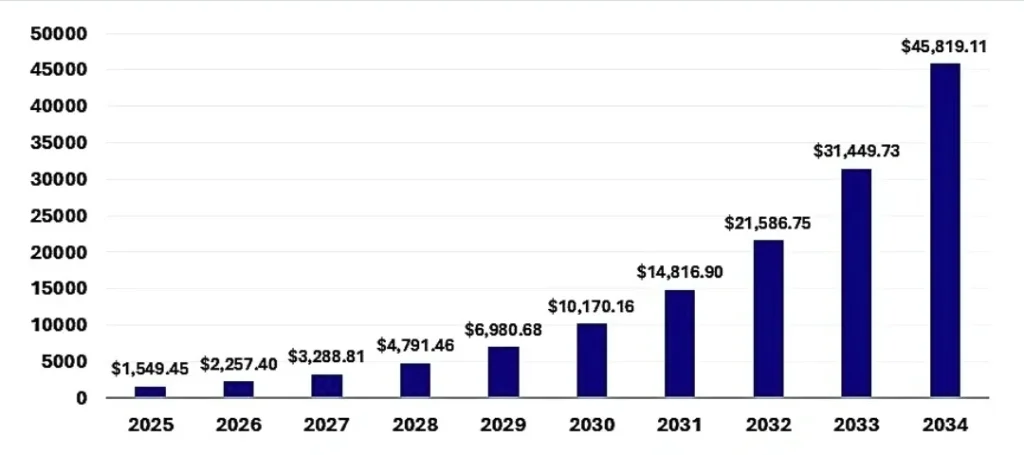
Source: Precedence Research
Growing market size of artificial intelligence and medical diagnosis from 2025 to 2034
Key Models of Generative AI for Healthcare
Here are the main architectures forming the core of intelligent GAI systems.
Variational Autoencoders
VAEs are generative models that outperform medical professionals in the context of learning hidden patterns and structures within complex datasets. These models generate synthetic data samples while preserving and recording necessary features of the original existing data. Other than this, some common healthcare artificial intelligence examples in daily life deployed through VAEs include patient population modeling, drug discovery, molecular designing, disease pattern discovery, representation learning from clinical datasets, etc.
For example, MedGAN combines autoencoder and GAN capabilities for electronic health record (EHR) data generation; molecular VAEs can create novel molecular structures with required properties; and medical imaging VAEs can reconstruct synthetic CT and MRI images, etc., for artificial intelligence medical diagnosis.
Generative Adversarial Networks
GANs are made of two neural networks, namely a discriminator and a generator that work in harmony to generate realistic synthetic data even with partial or incomplete information. These networks are used in creating artificial medical images, supporting medical image segmentation, enhancing machine learning (ML) model training, increasing datasets in rare medical cases, and protecting patient privacy through synthetic data.
For example, apart from generative AI for retail, Deep Convolutional GAN (DCGAN) is used to generate synthetic images in medical imaging research and improve AI model training; CycleGAN is used for image-to-image and image-to-other-modalities (like MRI-to-CT) translation; and GAN radiology models can enhance generated X-ray, CT, and PET images for research and analytics.
Large Language Models
LLMs are widely adopted GAI models that can be trained on large volumes of textual data using NLP to understand via automatic speech recognition (ASR) and generate human-like conversations or outputs. These models process medical literature, clinical notes, patient data, and guidelines to enhance clinical workflows through automated note generation, clinical documentation with system output auditing to catch drift, EHR summarization, and medical question answering (Q&A) agentic AI solutions.
Artificial intelligence and medical diagnosis using LLMs also assists in research support, knowledge retrieval, medical education, patient communication, virtual voice-based healthcare assistance, and clinical decision-making support. For example, Google Med-PaLM, LLaMA, Med-PaLM 2, BioBERT, PubMed-based models, and GPT-based healthcare applications. Healthcare systems can make data accessible, transparent, and interpretable through the retrieval of Q&A-based data by combining retrieval-augmented generation (RAG) on the Fast Healthcare Interoperability Standard (FHIR).
Multimodal Foundation Models
These are advanced GAI models that can process and generate information across different data types, including clinical notes, lab results, medical images, text, and genomic data. They provide an overall comprehensive understanding of patient data through various healthcare sources. For example, vision language models (VLMs) for imaging analysis, data science and analytics solutions, GPT-4V for healthcare assistance, textual interpretation, imaging analysis, etc.
Another example includes a multimodal large language model used as a healthcare foundation model that combines text and imaging data and CLIP-style vision-enabled LLMs for medical image retrieval, image-based Q&A, and implementation of AI in drug discovery. Some common healthcare applications of these models are multi-sourced clinical summary creation, improving medical discovery and research, supporting personalized medicinal treatment approaches, integrating genomic, pathological, and imaging information, and combining radiology images with clinical history for AI medical diagnostics support.
Apart from these, there are domain-specific healthcare foundation models that are trained and fine-tuned by using specialized medical datasets like biomedical publications, molecular information, and clinical records. These are better than general-purpose AI models, as they can improve accuracy and relevance in healthcare settings.
These are useful for clinical reasoning support, artificial intelligence drug discovery, precision medicine, healthcare workflow automation, and assistance in medical research and development alongside generative AI for cybersecurity. For example, medical LLMs trained in biomedical literature, specialized models for genomics, pathology, and radiology, and Google DeepMind with Alpha models for protein structure prediction.
Diffusion Models
Multimodal AI in healthcare learns existing historical data to create new information and realistic outputs via an iterative process for refinement. These high-quality synthetic MRI, CT, PET, and X-ray images generated by these models are useful in medical imaging and data augmentation for AI model training.
Other healthcare applications include medical image enhancement, denoising, resolution improvement, reconstruction, and simulation of rare diseases or conditions for research. Some examples are Medical Denoising Diffusion Probabilistic Models (Med-DDPM) for image enhancement that are used in medical imaging workflows, stable diffusion-based medical imaging models that support healthcare research, and so on.
Benefits of Generative AI in Healthcare
There are various advantages to implementing GAI systems in healthcare, such as the following.
1. Diagnostic Accuracy: These systems detect medical conditions accurately across specialties.
2. Treatment Efficacy: Personalized recommendations provided by GAI on analysis to improve efficacy.
3. Better Outcomes: Generative AI for healthcare reduces errors, translating to better patient outcomes.
4. Streamlined Workflows: It reduces administrative overhead and optimizes utilization of resources.
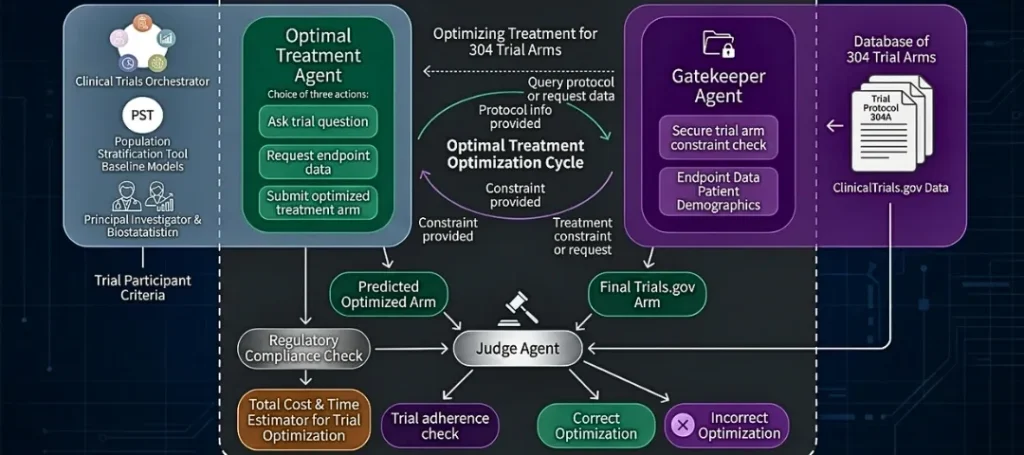
Working of multi-agent systems in treatment strategizing powered by AI applications in healthcare
5. Cost-Efficiency: Automated routine tasks enhance decision-making and cost savings.
6. Patient Satisfaction: Individualized treatment as per patient touchpoints assures their satisfaction.
7. Drug Acceleration: It shortens drug development time and costs by predicting target interactions.
8. Decision-Making: Valuable insights and regulatory compliance allow informed strategy development.
9. Swifter Reimbursement: It assures expedited billing cycles, cash flows, and lower claim denials.
10. Preparedness: Predictive spread assist governments to intervene in pandemic and limit outbreaks.
Applications of Generative AI in Healthcare
Here are the applications of generative AI systems in healthcare settings.
Healthcare Workflows
GAI systems automate time-consuming healthcare workflows and practice areas and make them more effective. Solutions like Microsoft’s Nuance DAX, Cerner, and Epic’s AI-powered EHR can document and summarize patient histories, automate authorization procedures, and insurance claims processing. Computer vision in healthcare assists medical professionals to focus on strategic discussions, complex patient requirements, and decision-making instead of mundane tasks. They convert unstructured data into structured information to enable real-time verification of advantages.
Patient Outcomes
GenAI can develop virtual health assistants and awarenes-spreading chatbots like CSource, make specific plans, and respond to inquiries round-the-clock as per disease symptoms mentioned. This is especially useful in sensitive cases, including mental health concerns and substance abuse, where robotic therapists prove to increase engagement through emotional outcomes, coping strategies, reducing stigma, and making resources and professional help readily available. Platforms like Ambience Healthcare can monitor vital signs, schedule referrals and appointments with doctors, and send dynamic reminders to patients for outstanding bills and medicinal dosage, especially for chronic cases like diabetes and hypertension.
As an advanced practical tool and application of AI in healthcare, GAI can interact and provide support in near-real time for better patient engagement and treatment results. Using sophisticated algorithms, they analyze historical data like EHRs for specific patterns to predict risks, disease progression, patient outcomes, readmissions, complications, remissions, and more. Healthcare providers can proactively intervene for timely patient care, tailored follow-ups in high-risk cases, and reduce hospital readmissions by using such forecasting capabilities and insights.
Procedural Simulation
Practicing clinicians, physicians, surgeons, medical interns, and professionals can use GAI for specialized patient care. By planning surgeries beforehand, it provides three-dimensional simulation models to strike out risks and deliver requisite plans during operational procedures. It helps in increasing clinical accuracy and strengthening confidence in planned methodology.
The field of surgical training is being transformed through GAI-based realistic procedure 3D simulation technologies that mimic the patient’s anatomical features and low-frequency clinic scenarios as per fed imaging data. It provides a no-risk environment for surgeons to perform complex procedures and improve their skills prior to actual surgeries. It also predicts potential complications and assists in formulating surgical plans for safer and effective outcomes.

Steps to implement GAI in a business for artificial intelligence in medical diagnosis
Treatment Plans
GAI-based solutions can leverage and analyze large volumes of patient data such as lifestyle factors, medical histories, and genetic profiles to develop comprehensive and tailored treatment strategies. AI applications in healthcare and systems like IBM Watson Health identify patterns and formulate different personalized plans by using deep learning (DL) algorithms to predict treatment responses. Such an approach improves treatment efficiency, reduces reaction risks, and ensures that preferred care is delivered to patients as per their individual conditions. In addition to sending reminders, it helps patients to comprehend their treatment plan, prescriptions, and over–the–counter (OTC) advice in an easy to use and understandable format.
Data Generation
Generative AI in healthcare generates diverse synthetic patient data mimicking real-world circumstances for clinical trials and research to avoid privacy and compliance issues. By eliminating such compromises, the created data can be used for testing hypotheses around rare conditions being studied like Huntington disease, Marfan syndrome, Duchenne muscular dystrophy, amyotrophic lateral sclerosis, and more. This mitigates the scarcity and risks of using actual patient data and allows researchers to simulate disease progression and clinical trials in an efficient manner while increasing trust amongst marginalized communities, under–presented or underserved regions, and socioeconomic backgrounds.
Medical Imaging
GAI systems like NVIDIA Clara can improve diagnostic accuracy by enhancing spatial resolution and signal-to-noise ratio of low-quality medical images using GANs, diffusion models, VAEs, Convolutional Neural Networks (CNNs), U-Net agentic AI architecture, transformer-based models like ViTs, Neural Radiance Fields (NeRFs), etc.
Another application of AI in healthcare includes advanced algorithms that can analyze medical scans, analyze patterns, and automate organ and abnormality segmentation to forecast diseases and pathological conditions. With this, radiologists can divert their time towards complex medical cases, early disease onset prediction, and detection of complications for enhanced patient outcomes.
Decision Support
Clinical decision-making is greatly enhanced and fastened when healthcare providers utilize in-depth insights extracted from journal articles, treatment protocol evidence, and huge datasets by generative AI-based systems like MedLM, Gemini, and GPT-4.5. Predictive modeling and simulation conducted on such extracts derived from protected electronic health information (ePHI) and genomic instances by Backend-as-a-Service (BaaS) assists these professionals to anticipate risks, potential complications, and supposed disease progression.
GAI and IoT-powered connected solutions like Google Researcher’s SensorFM can enhance patient care by enabling language translations, brain-computer interfaces, telemedicine app development and telehealth improvements, neurorobotics, neural prosthetics, timely interventions, and treatment. Artificial intelligence in medical diagnosis is especially useful in catastrophic events like cardiac arrest and strokes, where wearable health monitor band sensor data from photoplethysmography, accelerometers, electrodermal activity, skin temperature, altimeters, etc., can be analyzed to predict conditions.
Administrative Tasks
Generic tasks like billing, reporting, documentation, appointment scheduling, medical coding, flow rate forecasting, claims processing, patient record management, pinpointing bottlenecks, identifying billing errors, reviewing new legal invoices, populating intake forms, and other administrative processes can be automated and streamlined by these systems. Not only does this reduce patient wait time and administrative overhead for healthcare providers, but it also provides them with necessary buffer time to focus on patient care alongside refining operational yield.
Private players and hospitals are assisted with AI applications in healthcare and GAI systems to identify inconsistencies in patterns, thus reducing fraudulent claims and turnaround times. They also reduce support center workload by guiding in-network specialists and patients with denied claim clarifications, benefit explanations, expenses, and pre-authorization requirements. It streamlines inter-departmental data consistency and provider relationships through automated compliance reports, feedback, performance analysis, summaries, and updates.
Personalized Medicine
These AI-powered systems can develop highly tailored immunotherapy regimens for patients undergoing cancer treatment as per their individual characteristics, like a tumor’s unique mutations or joint implant simulations tailored to their anatomy. They do so by analyzing medical coding histories, lifestyle factors, genetic information, and other patient data to improve the level of personalization.
Given the various benefits of generative AI in healthcare, it ultimately improves the efficacy of medicinal applications, minimizing expected side effects of chemotherapy, enhancing quality of life, and improving patient outcomes. They can find the most suitable telehealth and logistics providers, clinics, remote care options, and specialists across directories that align with their requirements like specialty, language, location, insurance coverage, reviews, patient references, and treatment histories by using GAI-powered recommendation engines.
Health Management
Healthcare providers, public health agencies, and pharmaceutical companies can implement and strategize targeted interventions as well as healthcare inventory management to reduce unplanned risks, complications, number of hospitalizations, and readmissions. AWS offers patient management and healthcare data security control configuration options through KMS, Macie, Security Hub, CloudTrail, and Config.
This can be done through free-text prompts from integrated EHRs, customer relationship management (CRM, like SAP C4C) platform, and GAI-based predictive analytics for population health management and identifying and segmenting patients at risk, such as in the case of chronic kidney disease (CKD).
Drug Research
In the medical research domain, generative AI can simulate drug interactions and biological phenomena to accelerate the formulation of new therapies and treatments. It can efficiently identify potential candidates for drug research, which reduces drug development timelines, go-to-market expenses, and other risks, such as those related to Ebola and multiple sclerosis. It also optimizes data collection, hypothesis generation, clinical trial designs, site selection, feasibility and peer-reviewed studies, regulatory submissions, and result interpretation. Artificial Intelligence in drug discovery and development highlights suitable study populations for new medications and assists researchers by going through and analyzing various datasets.
Platforms, such as Chemistry42 and BioNeMo can accelerate research and development pipelines; summarize trial data; craft educational writing, reports, regulations in healthcare, research documents, marketing material, and chemistry models for pharmaceutical firms. It can predict medtech device failures and optimize medical prototype development and design (lighter, patient-specific, and efficient), uptime, maintenance, proof of concept (POC) testing, and patient recovery time by scrutinizing operational data, predictive insights, and previous expensive disruptions.
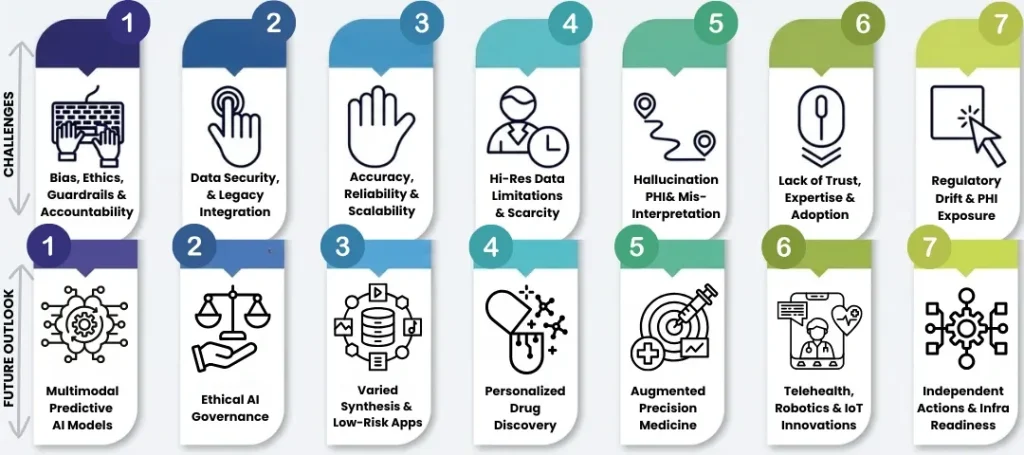
Challenges and future tech around artificial intelligence in drug discovery and development
Best Practices for Generative AI in Healthcare
The following are some of the best practices to follow while working with intelligent GenAI systems.
Security
One needs to consider data privacy and security while ethically gathering data for training or real-time feeding generative AI-based systems. The Health Insurance Portability and Accountability Act (HIPAA, 1996) highlights the standard for protecting patient information that may be sensitive in nature across the United States. Robust data governance practices need to be adopted to ensure compliance with HIPAA and other regulations through the following principles.
- Data Anonymization: Data de-identification includes modifying datasets by removing patients’ personal identifiers so that they remain anonymous. Under HIPAA, it can be done using safe harbor or expert determination methods, where the former deals with removal of specific identifiers, and the latter confirms the risk of re-identification. In the safe harbor technique, names, SSNs, images, etc., are removed, while in expert determination, statistical principles are applied to determine and minimize the above risks of using artificial intelligence in drug discovery and development.
- Data Encryption: To avoid unauthorized access to sensitive patient information during storage and transmission, data encryption becomes a necessity. Organizations in the healthcare domain implement encryption methods to secure and update EHRs. One should also consider other regulations set by the following:
1. Department of Human and Health Services Office of the Civil Rights (HSS OCR) breach guidance
2. Food and Drug Administration (FDA) guidance on Software-as-a-Medical Device (SaMD) with Total Product Lifecycle Approach (TLPC) and software development services
3. AI Risk Management Framework (AI RMF 600-1) by National Institute of Standards and Technology (NIST)
4. NIST Special Publication 1270 (NIST SP 1270) and Section 1557 for non-discrimination, bias guidelines, and artificial intelligence, how it works, etc
5. European Medicines Agency (EMA) and American Medical Association (AMA)
6. Health Data, Technology, and Interoperability Final Rule published by the Office of the National Coordinator for Health Information Technology (ONC HTI-1)
7. Department of Justice Office of the Inspector General (DOJ / OIG) 340B rules on drug pricing and Medicines and Healthcare products Regulatory Agency (MHRA)
8. International Organization for Standardization (ISO) and General Data Protection Regulation (GDPR) standards
9. Federal Trade Commission’s consumer protection and antitrust laws (FTC)
10. System and Organization Controls 2 (SOC-2) for auditing requirements
- Role-based Access Control: RBAC is implemented for restricting patient data access control to authorized professionals. Moreover, multi-factor authentication (MFA) also enables strict access control as an additional security and restricted accessibility layer as per specific job roles.
Transparency
GAI models need to be trained on accurate, representative, unbiased, and diverse datasets collected. A broad spectrum of demographic groups inclusive of various races, ages, socioeconomic backgrounds, and genders can prevent bias leading to divergent patient outcomes. Furthermore, regular dataset audits can ensure timely identification and addressal of existing biases, thus data collection process can be refined to improve AI fairness, care quality, equitable distribution, and remove monopolies.
Given the black box nature of artificial intelligence, how it works, and DL algorithms, it is necessary to maintain transparency, and informed, explicit consent; permissions or voluntary agreements from patients should be obtained in terms of the ways their data is likely to be utilized. This involves concise and clear-cut communication of data collection purposes, types, risks, processes, methodology, benefits, protection laws, and how it will be used, presented in an easily understandable format and language.
Collaboration
Healthcare professionals must be assured that GAI systems and AI-augmented software development complement their daily routine and not replace their capabilities. Therefore, human-AI collaboration should be encouraged for obtaining, interpreting, and applying GenAI-driven insights. Responsible data involves fostering initial scrutiny by analyzing images using artificial intelligence in medical diagnosis and final review and validation by radiologists.
To achieve digital literacy, healthcare providers need to undergo training and education on standard operating procedures (SOP), gaps, data gathering, working, and use of tools, and insight interpretation. This ensures secure data capture without any corruption or involvement of malicious factors that interfere with the working of AI models. Multidisciplinary teams including medical professionals, ethicists, and data scientists can assist in GAI model development and development to ensure its functioning is aligned with clinical ethics, requirements, and standards.
Improvement
Since GAI-based healthcare assistants and solutions undergo continuous improvement, their working and key metrics need to be consistently monitored. This ensures safety, provider performance, ethical alignment, efficiency, network adequacy, low expenses, and readmissions. Regular feedback, suggestions, insights, areas for improvement, updates as per new data, regulations, and medical findings are a must.
Accelerate Your Healthcare Business with KritiKal
This blog provides a gist of the new advancements, unique challenges, and benefits of generative AI in healthcare, which helps the providers in this field to navigate the same. It informs stakeholders of investing in this innovative technology by showcasing an in-depth understanding of the advantages it offers and ways to leverage them alongside compliance requirements like HIPAA, GDPR, and SOC-2.
We also learned why GAI has become a core enabler in modern-day healthcare as it transforms clinical workflow efficiency, patient care, research, and healthcare management. Its wide range of applications spans across artificial intelligence drug discovery, diagnostics, AI for medical imaging, integrative and precision medicine, predictive and preventive care, cost reduction, clinical expertise augmentation, documentation, and decision-making, patient engagement and outcomes, treatment effectiveness, healthcare accessibility, resource utilization and productivity, administrative task automation, and other dimensions of healthcare firms.
Leverage KritiKal’s expertise in tackling challenges associated with agentic AI solutions like adversarial AI agents, such as cognitive drift, lack of performance metrics, AI hallucinations, bias, unexpected behavior, data privacy and transparency concerns, non-determinism, opaque training data, regulatory compliance checks, interpretability, lack of robustness, and standard validation.
We follow the best practices for AI in healthcare, developing responsible, controlled models, including strong lifecycle-based AI governance frameworks and built-in guardrails; auditability; risk reduction; iterative refinement of prompts; patient privacy protection; data integrity; medical appropriateness; maintenance of transparency, model versions, evolution, relevance, and performance; embedment of newer technologies; response troubleshooting; digital literacy; pre-deployment clinical validation; communicated limitations; use of representative datasets; Human-in-the-Loop; oversight mechanisms; and an ethical approach.
Please get in touch with us at sales@kritikalsolutions.com to know more about our generative AI-based products, platforms, services, and realize your business requirements.

Virendra Sanjay Avhad currently works as a Senior Software Engineer at KritiKal Solutions. He is proficiently skilled in Embedded C, Python, RTOS, C++, Board Support Packages, and more. With his ability to develop result-driven software and more than 4 years of working with embedded software development, he has assisted KritiKal in delivering various projects to some major clients.