


 Global
  United States
A Brief on Computer Vision in Autonomous Vehicles
The concept of autonomous cars powered by battery-efficient electric powertrains has become a reality in the past decades. Self-driving vehicles are enabled with a domain within artificial intelligence (AI) called computer vision (CV) that allows these machines to see, analyze, and interpret their surroundings. With CV, or specifically an autonomous vision or machine vision system, they can understand the continuous incoming visual data stream and distinguish effectively between pedestrians, barriers, different types of roads, pathways, lanes, vehicles, objects, traffic signs, and more.
Further, automotive IT solutions enable safe autopilot driving and store the obtained data for future reference. With the advent of machine learning (ML), classifiers and Histogram of Oriented Gradients (HOG) algorithms are being extensively used for object detection, shape identification, gesture tracking, road and traffic flow perception, path planning, predictive and situational analysis, scene understanding, gradient examination, image and video analysis, and pixel-wise directional attributes. Given the ever-evolving trends in the adoption of advanced technologies like computer vision for autonomous vehicles, especially in the manufacturing, food and supply chain, and automotive sectors, machines with self-driving capabilities have leveled up.
The automation developed and installed through computer vision and image processing services renders these vehicles to be categorized by SAE based on their ability to comprehend gathered visual information and interact with their environment. Levels 0 to 2 require a human driver apart from their automation support, whereas Levels 3 to 5 do not require drivers except in specific conditions. CV allows in-built cameras, processors, and sensors to map, plan, perceive, localize, function, actuate, and learn. As data is obtained through mono, stereo, rear, side, or front or 360° camera for car, sensors like LiDAR, near or far radars, and ultrasonic sensors complement the same while the processor interprets it.
In the 1980s, the first autonomous vehicle prototype, which relied on CV techniques, was developed. This was followed by potential vehicles showcased in the DARPA Grand Challenge in 2004. By the 2010s, deep learning (DL) enhanced CV by inculcating object detection and scene understanding capabilities. In the 2020s, AI, Vehicle to Everything (V2X) communication, cloud, and edge computing are continuously enhancing autonomous vehicles.
The market for AI in self-driving cars was reported to be valued at about US $8 billion as of 2024 and is expected to rise and reach an approximate value of US $226 billion by the end of the forecast period in 2034. The calculated CAGR comes out to be 45%, majorly driven by refinement in autonomous navigation algorithms, DL architectures, sensor fusion, and notably CV.
Other important factors driving this growth include increasing investments in Advanced Driver Assistance Systems (ADAS), urban mobility infrastructure, electric vehicle control system, connected cars systems, AI-powered controllers, smart mobility, and safety automation. As the role of embedded vision in autonomous driving is redefined every now and then, Original Equipment Manufacturers (OEMs) need to address related issues and technicalities. In this blog, we will delve into the mechanics, advantages, and challenges faced during the development of CV-based autonomous vehicles.
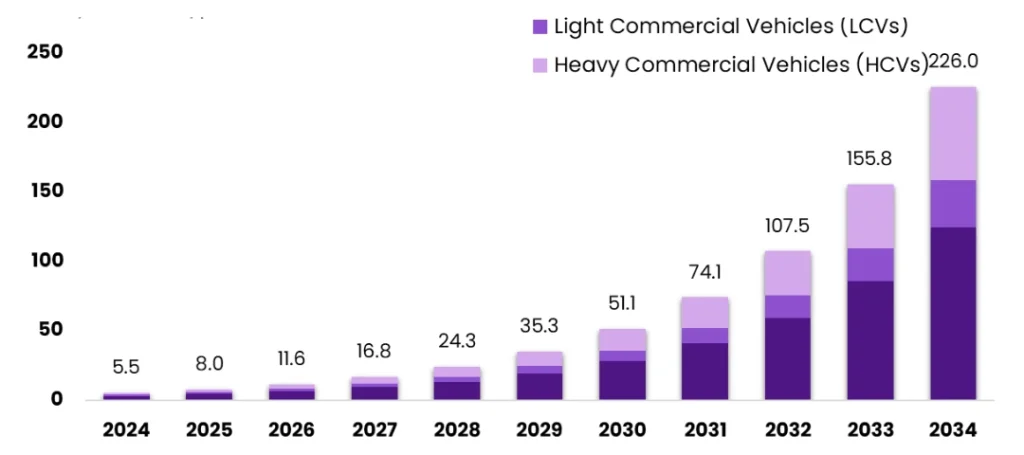
Source: market.us
Growing market size of ADAS and autonomous during the forecast period 2024 to 2034
Working of Computer Vision in Self-Driving Cars
Data Gathering
Autonomous cars replicate human vision, where cameras act as eyes, hardware sensors as sensory organs, and software algorithms or processors as the brain. They gather data using sensor fusion to build a three-dimensional map for navigating the environment. Computer vision forms one modality for perception and includes camera-based sensing only alongside others like LiDAR, radar, IMU, GNSS, and wheel encoders in sensor fusion, where the latter are used for robust location, object tracking, velocity and state estimation, and environment understanding. Commonly used sensor fusion models include DeepFusion, TransFusion, BEVFusion, etc., where a sensor fusion consists of the following.
- Cameras: These visual sensors capture 360° surrounding video to read signs, detect colors, lights, and more. Search and Rescue (SAR) and thermal cameras are more efficient than standard cameras like RGB, event, and stereo cameras. The former can capture video footage with high depth perception and low computing power utilization even in low, high, or uneven lighting conditions for lane detection, traffic sign recognition, semantic segmentation, and object detection.
- Radar: It refers to Radio Detection and Ranging and uses radio waves to determine distance from moving objects and their speed. It provides accurate results to autonomous vehicles AI even during adverse weather conditions like heavy rain, mist, tunnels, darkness, and fog and reduces the number of video frames for instantaneous hazard response.
- LiDAR: It refers to Light Detection and Ranging sensors that are placed on top of the car. They continuously spin and fire laser pulses that bounce back. Alongside high dynamic range (HDR) sensors, they measure specific time intervals to generate a precise three-dimensional point cloud of the surroundings. It is to be noted that similar to computer vision autonomous driving, it has limitations like high cost, image resolution lower than 2D cameras, and poor functioning in adverse weather conditions.
- GNSS: Global Navigation Satellite System assists ADAS autonomous driving in ground truth data collection, accurate localization, mobile mapping, and real-time positioning, assuring reliability.
- IMU: Inertial Measurement Units are sensors that provide orientation and motion data by combining gyroscopes, magnetometers, and accelerometers. They measure magnetic fields, angular rates, and forces to enable precise navigation and positioning without GPS.
- Wheel Encoders: Incremental or absolute encoders are electro-mechanical sensors that provide data on the speed, change in position (unique position value even if the vehicle is turned off), distance traveled by the vehicle (count of pulse series), and track movement. These convert rotation, angular position, or motion of the wheel into analog, or digital signals.
Processing
The sensor data describes a particular scene in the same coordinate system, which requires spatial calibration, and at the same instance, which requires temporal synchronization. Every sensor operates at a different sampling rate, has different delays, and coordinate frame, for example, typical frequencies and coordinate frame include cameras at 30 Hz and (x,y,z), LiDAR at 10 Hz and (x,z), radar at 20Hz and (y,z), IMU at 200 Hz, and GNSS at 1-10 Hz. A camera needs to capture the frame without the delay of 100 ms and 1.5 m car movement as per the LiDAR scan for a vehicle moving at 15 m/s supposedly.
To tackle this, hardware can be synchronized, where a common trigger signal like GPS Pulse Per Second (PPS), IEEE 1588 Precision Time Protocol (PTP), or trigger lines is sent to all sensors, and they timestamp their measurements using the same clock. Another approach is software synchronization for cases where hardware cannot be synchronized, thus each measurement by the sensors is timestamped. The fusion system matches measurements with the closest timestamps and interpolates if there is no exact alignment. As LiDAR measures points sequentially thus, its scans are not captured instantaneously, resulting in a distorted point-cloud. This is corrected through motion compensation or de-skewing, where IMU and vehicle odometry are used to transform each point back to a common reference time. As and when measurements are synchronized, sensors with their own coordinate frames consisting of different origins and axes.
In intrinsic calibration, a camera has internal parameters like focal length, principal point, and distortion coefficients, all of which are used to calculate the intrinsic matrix. This helps in projecting and aligning LiDAR points on image pixels in cases where the cameras may be placed on the right or left side of LiDAR. Data can be fused by expression in a common frame through extrinsic calibration that estimates the rigid transformation between sensors. Rotation and translation of the camera relative to LiDAR is calculated, ultimately defining a matrix which converts LiDAR points into a camera coordinate frame and projects into the image; thus, object is overlayed by the point cloud correctly.
GNSS gives global position and periodically corrects accumulated drift, but updates slower than IMU which provides high-rate acceleration angular velocity and predicts vehicle motion at high frequency. Fusion algorithms like Extended Kalman Filter (EKF) combine them by calibrating the IMU frame relative to the vehicle frame and synchronized with GNSS timestamps. The radar returns measurements like range, azimuth angle, and radial velocity from the Doppler effect in its own frame. These are transformed into the common vehicle frame prior to associating with the LiDAR clusters and camera detections.
After synchronizing and calibrating the gathered data using a sensor fusion approach, the onboard computer or electronic control units (ECUs) process it within the minimal time possible, which is usually milliseconds. The software is powered with ML, DL, and neural networks to disintegrate the video input into specific features. This includes identifiable patterns, edges, movements, and shapes as per its training on a massive vehicle dataset. The training dataset for autonomous vehicles AI must contain high-quality, annotated images (using bounding boxes, polylines, semantic segmentation, polygons, or 3D cuboids) and videos with labeled cars, pedestrians, animals, curbs, traffic lights, trees, lane lines, and other objects.
Perception
With time, the CV model learns to conduct highly probable visual breakdown, differentiation, and classification in real-world scenarios by using sematic segmentation. For example, Simple Online and Realtime Tracking with Observation-Centric (OC-SORT), Bag-of-Tricks SORT (BoT-SORT), and Multi-object Tracking Transformer (MOTR) track visual appearance and multi-object motion across frames. These augment the Kalman filter with a CNN-enabled Re-Identification (ReID) feature embedding for motion prediction and to improve robustness.
Due to feature extraction, the computer vision autonomous driving model requires more computing power but identifies, assigns ID, and tracks objects even after occlusion. Another example is ByteTrack which tracks objects through Intersection over Union (IoU) matching, motion cues, and high and low confidence detections. It is ideal for autonomy as it is lightweight, high performing, fast, cost-effective, maintains stable track, and gives real-time results in crowded, dense traffic, noisy and occluded environments, urban scenarios, and highways without deep appearance models and ReID.
Cognitive Decisioning
AI-powered algorithms function as per the above steps to recognize objects in their surroundings or assess a given situation. In concluding, they perform the required action, which can be the application of breaks, maneuvering, or acceleration to steer the vehicle safely through the vehicle control unit. By converting static images into necessary information, CV enables self-driving cars to navigate efficiently.
Applications of Computer Vision in Autonomous Vehicles
Apart from powering fully autonomous cars, CV uplifts the functioning of modern vehicles through ADAS. It analyzes historical insights and insights from in-vehicle components like battery monitoring system to compare real-time situations and avoid system failures, irregularities, accidents, safety risks, and other bottlenecks. It enables machines to detect, analyze, and perform context-aware decision-making and actions as per a continuous feedback loop of visual data. In this section, we will delve deeper into its applications in self-driving cars.
Driver Monitoring System
The cabin and driver monitoring system (DMS) assesses alertness and risky driving behavior by applying CV. This improves cabin experience and assures driver safety alongside vehicle autonomy. Some of its primary functions are mentioned below.
- Parking Assistance: Convolutional Neural Networks (CNNs)-enabled systems produce a bird’s-eye view obtained by merging images captured through multiple cameras. 3D reconstruction and parking slot marking recognition enhance situational awareness and simplify slower drives.
- Occupant Detection: Autonomous AI systems use Red, Green, Blue (RGB), and infrared cameras to identify passengers, children, and seat occupancy. It checks for the presence of a driver or other occupants after shutdown.
- Facial Recognition: CV enables secure access to autonomous cars, infotainment preferences, mirror alignment, seat position personalization, etc., as per the recognized driver profile.
- Drowsiness Detection: Inward-facing cameras perform facial recognition and eye tracking to monitor attention, identify distraction, early signs of fatigue, etc. AI in self-driving cars then issues audible or vibratory warnings and initiates required actions subsequently through the telematics control unit.
- Gesture Recognition: It detects and recognizes natural gestures of drivers to control in-cabin systems and even the EV motor controller. This may include climate, infotainment settings, etc., to reduce distraction and passenger intervention.
Driving Automation System
The basis of autonomous driving depends on inference and perception instead of rule-based assistance. Higher levels of CV-enabled vehicle autonomy depend on seeing, understanding the context, and taking preemptive actions. Some of its primary functions are mentioned below.
- Environmental Perception: Sensor fusion of cameras, LiDAR, and radar provides surrounding data to deep neural networks (DNN) for object detection and classification. This is useful for assessing drivable space, interpreting traffic lights, and other actions over a surround view system. Some examples of DNN include You Only Look Once (YOLO), ENet, SegNet, DeepLab, U-Net, Mask R-CNN, Single Shot Detector (SSD), Faster R-CNN, etc.
- Semantic Segmentation: Each frame is classified by the machine vision system into vegetation, road, pedestrians, vehicles, etc., up to the level of its pixels. This enables understanding of the composition of the scene and quick decision-making.
- Object Tracking: Continuous object detection and tracking is done using Vision Transformers like ViT, Swim Transformer, and Detection Transformer (DETR), PV-RCNN, Faster R-CNN, YOLO, PointPillars, PointNet, VoxelNet, CenterPoint, and other CV models. This improves anticipated trajectory and interactions with stationary (barriers, parked cars, pillars, or traffic cones) and dynamic objects (cyclists, vehicles using vehicle detection system, or animals) ahead of time.
- 3D Localization: Even in the areas where Global Positioning System (GPS) is not functional, the Simultaneous Localization and Mapping (SLAM) feature of computer vision for autonomous driving uses visual odometry to infer environmental geometry for three-dimensional mapping and localizing objects.
- Urban Navigation: CV models in a automotive monitoring system can recognize objects in complex scenarios, such as construction zones, for reliable navigation. They command vehicular components to avoid barricades, and cones and perform temporary lane shifts across dynamic urban surroundings.
ADAS and Autonomous Driving
ADAS combines CV capabilities with sensor fusion that is radar and LiDAR to minimize manual errors. They facilitate continuous environmental understanding, which is faster than traditional driving experience. Some of its primary functions are mentioned below.
- Luminance Detection: AI vision systems can automatically detect luminance and adjust the high beam headlights accordingly. This helps to avoid dazzling oncoming drivers and maximizing visibility.
- Blind Spot Detection: During lane changing, lateral cameras and a blind spot detection system monitor side regions and unseen upcoming vehicles from that zone to alert drivers of obstacles.
- Adaptive Cruise Control: In low-visibility and dense traffic conditions, multi-camera fusion in ACC can enhance responsiveness. Computer vision autonomous cars algorithms can measure the relative speed and distance of nearby vehicles to assist the self-driving car with braking and throttle adjustment.
- Lane Detection: To keep a safe headway, CV models in Lane Departure Warning (LDW) systems like SCNN, LaneNet, and Ultra-Fast Lane Detection recognize even degraded, partially occluded, dashed yellow, non-existent, or solid white lane markings using bounding boxes. In case of unintended drift from the detected lane, assisted corrective steering measures are put in place for keeping the same.
- Automatic Emergency Braking: ADAS and autonomous vehicles detect objects, and hazards and calculate predicted trajectory risks in real-time. To avoid collision, these systems trigger braking automatically through AEB, Forward Collision Warning (FCW), and Supplemental Restraint System (SRS for automatic airbag activation in case of accident).
- Traffic Sign Recognition: DNNs are empowered by high-resolution cameras to interpret traffic signals and road signs even in complex intersections and adverse weather and lighting conditions. For example, they can scan a red light, speed limit, or stop sign and compare them with geometric shapes (inverted triangles, octagons, etc.) they were trained on.
- Pedestrian Detection: Since a lot of unpredictability is involved in the case of pedestrians, CV models prioritize their pose and movement detection. These stems can be powered by models like Long Short-Term Memory (LSTM), Gated Recurrent Unit (GRU), VectorNet, LaneGCN, and Wayformer to analyze body language and estimate human intent to avoid mishaps.
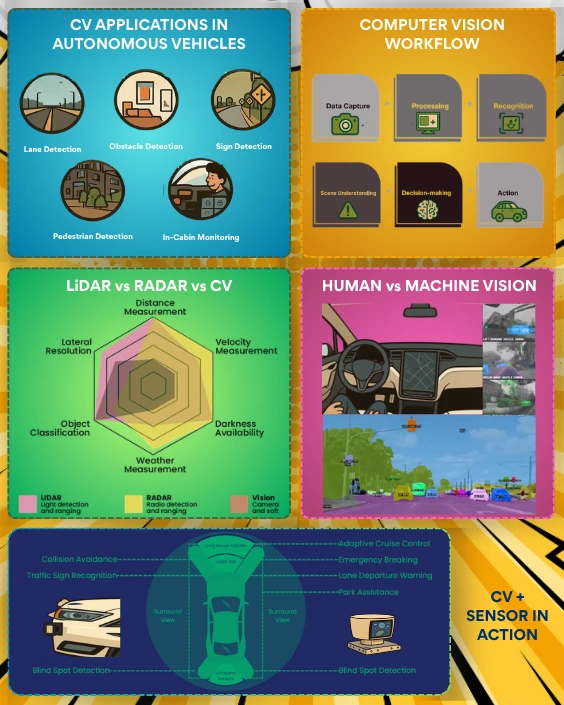
Comparative workflow & applications in computer vision autonomous cars
Benefits of Computer Vision in Self-Driving Cars
- Data Harvest: Navigation data can be used to train and improve autonomous systems.
- High Visibility: CV image processing allows object analysis even in low visibility or at night.
- Lane Safety: It helps cars stay in a curvy or elevated course and position and follow lane markings.
- Road Maps: 3D map in ADAS and autonomous vehicles provide road layout for driving adjustments.
- Less Accidents: By identifying and avoiding unforeseen objects, it reduces reaction time.
- Emergency Function: AEB reduces accident impact severityand maximizes protection.
- Synced Drive: Autonomous AI systems track vehicles to match traffic flow and prevent collisions.
- Real-Time Alerts: It issues warnings to drivers for hazards and collisions with FCW and LDW.
- Driving Experience: CV ADAS-based ACC and park assist reduce driver workload.
- Cost-Efficiency: Customers can choose features as per needs across a wide price range.
- Better Accessibility: Disabledand elderly drivers benefit from autonomous mobility solutions.
- Fuel Efficiency: As CVoptimizes traffic flow, it leads to reduced fuel consumption.
- Economic Growth: It creates opportunities for the automotive, logistics, and ride-hailing industries.
Challenges of Computer Vision for Autonomous Vehicles
- Unpredictability: Level 5 autonomy is far from global acceptance due to its unpredictable nature.
- Adverse Weather: Heavy snowfall, rain, and fog obscure lenses and distort video data.
- Lighting Variation: Low, bright light or dark conditions cause the system to miss cues.
- Complex Cases: Systems find it difficult to decode edge cases that were absent from training.
- False Positive: AI vision systems erroneously identify harmless objects as threats impacting flow.
- Processing Latency: It requires high computational power and digital bandwidth for real-time results.
- High Speed: It may be unable to capture images and detect objects at very high speed.
- Data Privacy: Cyberattacks may target datalike location, faces, and license number.
- Legal Issues: ADAS autonomous driving involves complex regulatory frameworks across regions.
- Ethical Dilemma: It may be unethical to leave decisions to vehicles in life-and-death scenarios.
- Limited Scalability: It involves high implementation costs for data, hardware, and expertise.
Future of Computer Vision for Autonomous Driving
CV-powered autonomous cars are transforming the automotive industry with the help of AI and ML that assist them to understand their surroundings in real-time. These technologies prevent hazards, dangers, and accidents and improve driver awareness, safety, convenience, and decision-making by supporting features such as LDW, safety assistance, and FCW, thus enabling safer and smarter roadways and seamless journeys. Computer vision autonomous driving algorithms play an important role in forming the perceptual core or foundation and the development of intelligent mobility and fully autonomous cars.
These are supported with sophisticated, high-resolution cameras mounted around the vehicle and sensors like LiDAR and radar to provide the latest information on obstacles, objects, vehicles, pedestrians, road signs, lane markings, and road features and conditions. By processing input data using ML algorithms, it accurately interprets the environment to take complete vehicle control and its environmental interactions for autonomous navigation in edge scenarios.
KritiKal Solutions has worked on embedded automotive systems over decades and shows the promise of provisioning a development team with apt expertise on working with end-to-end autonomous driving networks like ChauffeurNet, TransFuser, PilotNet, UniAD, Open VLA reasoning models, Vision-Centric Autonomous Driving (VAD), and more. Our teams have worked extensively on planning and control networks like Imitation Learning Networks, Deep Reinforcement Learning (DRL), DQN, DDPG, PPO, SAC, etc., as well as foundational models for autonomous driving like DriveGPT, DriveLM, GAIA-1, EMMA, OccNet, and others.
We can seamlessly initiate steps for implementing CV models in your automotive portfolio to enhance their autonomy through a series of engagements. Mostly discussing around your project objectives, selection of appropriate sensors and cameras, development of CV algorithms for object detection, lane tracking, scene understanding, testing and digital twin validation in simulation and real-world environments, integration of ADAS and autonomous driving with V2X systems, human machine interface development, and continuously monitoring and updating algorithms.
As we all know, with rising customer demands, OEMs and automaking giants like Tesla, Waymo, and Uber are increasing investments in the R&D field and partnerships with AI startups to overcome current limitations. The future is likely to make greater integration and smarter processing possible with better adaptation to adverse weather and uneven lighting, an advanced autonomous driving software stack, combinatorial multimodal perception, 3D mapping, 5G, and edge computing integration. One can expect increased V2X communication, visual independence, cheaper, smaller, and more durable solid-sate LiDAR, end-to-end learning from raw sensor input to steering output, and neural networks mimicking human driving intuition.
Join hands with KritiKal to reduce accidents, optimize AI traffic flow management, expand Level 4 and 5 autonomy and improve in-vehicle computing, urban transportation, and mobility for non-drivers. Our high-quality data collection, accurate annotation, and diverse edge case coverage processes enhance CV-based conversion of visual information into structured data in reliable autonomous vehicles AI.
We consider all legal and ethical regulatory frameworks that address safety standards throughout the development lifecycle, like AI bias, transparency, social impact, growing adoption in emerging markets, data protection, employment effects, urban planning implications, public trust building, and liability. Please get in touch with us at sales@kritikalsolutions.com to know more about our embedded products, platforms, and services, and realize your automotive and CV-based business requirements.

Adit Sule currently works as a Senior Software Engineer at KritiKal Solutions. He is proficiently skilled in ROS/ROS2, MATLAB/Simulink-based control design, PLC automation, AI/ML, PMP, and end-to-end development of robotic systems using Gazebo, RViz, Movelt, Nav2, and sensor fusion. With a strong foundation in electrical engineering and more than 5 years of experience working with high impact robotics, he has assisted KritiKal in delivering various projects to some major clients.