

 Global
 United States
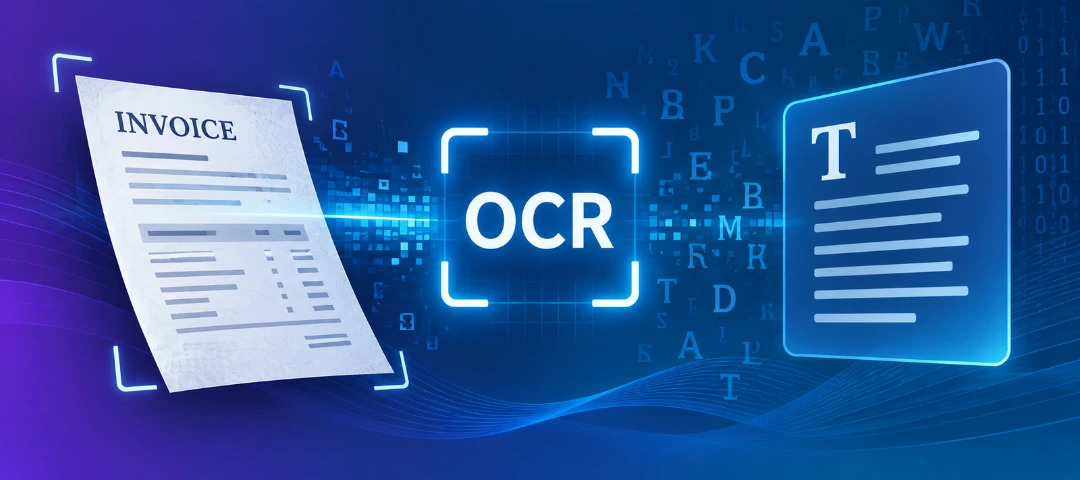
OCR stands for Optical Character Recognition and is basically a technology that automatically extracts data from images of text into a format (text, HTML, or JSON) that machines can read. It is a text recognition tool that repurposes data after scanning printed or digital documents, PDFs with images, excel sheets, direct camera images, screenshots, receipts, invoices, handwritten notes, etc. OCR services greatly reduce manual data entry efforts and allow editing of the scanned results with accuracy, thus minimizing the room for typing errors.
It uses certain hardware like an optical character scanner and circuit board to read and copy text, which is followed by processing through software components. AI-powered OCR systems can identify various handwritings and languages and are thus called Intelligent Character Recognition (ICR) systems. OCR can be deployed for converting analog, historical, legal, and other types of documents into digital formats for users to search, edit, and format the documents using the software.
Organizations like RCA developed systems that read specific postal and banking applications’ fonts in the 1950s. OCR-A and OCR-B fonts were designed in the 1960s, which could be read both by machines and humans, and were introduced across governmental and financial services. This technology was applied by Ray Kurzweil in 1974, where he developed omni-font OCR (sold to Xerox in 1980) to read printed text and deployed it with Machine Learning (ML) or Deep Learning (DL) to assist the visually impaired by using text-to-speech applications.
In the 1990s, historical newspapers were digitized using OCR, and now it is utilized in complex workflows for document processing, such as KritiKal’s Intelligent Document Processing solution (IDP). By the 2000s, the accuracy of OCR systems was improved by using neural networks, Robotic Process Automation (RPA), and ML technology to include handwritten text, complex layouts, poor-quality scans, and variable fonts. Now, one can scan receipts using an OCR receipt scanner, save the scanned output as an image file, use OCR to convert the image into a textual document, edit, count words, and store its content as text data for tools like package classification and more.
The current global market for optical character recognition software is estimated to be around US $19.8 billion as of 2026 and is expected to surge and reach an approximate value of US $46.4 billion by 2033, increasing at a CAGR of 12.9% during this forecast period. Let us now go through the working of OCR, its advantages, challenges, use cases, and more in this blog.
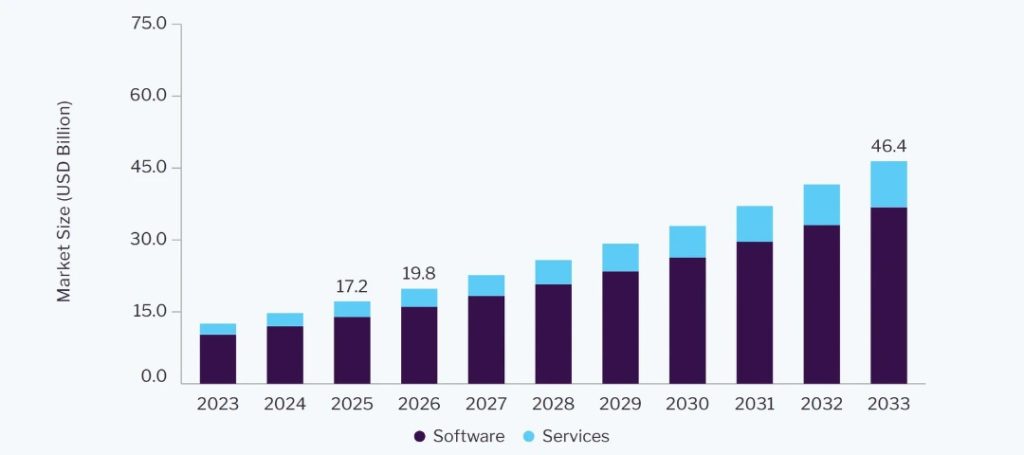
Source: Grand View Research
Growing market size of optical character reader during the forecast period 2023 to 2033
Types of Optical Character Reader
These are different types of OCR techniques as per their rising operational complexity.
- Simple OCR: It uses character-wise analysis and pattern-matching to compare stored glyphs with scanned input language combinations and fonts.
- OMR: Optical Mark Recognition identifies survey document bubbles, form signatures, checked boxes, watermarks, logos, symbols, and other marks that are matched with stored images.
- ICR: It uses AI/ML or DL-based types of neural networks (CRAFT and DBNet++ detection models) that uplift the OCR engine and reviews the text. It looks for distinctive features, such as intersections, loops, locations of curves, lines, and other attributes.
- IWR: Intelligent Word Recognition evolved from ICR, where the AI algorithm is trained to identify words in a given image, thus rendering faster results
How Does OCR Technology Work?
OCR technology uses optical scanning hardware developed using hardware development services to capture and edit physical documents. The scanned digital document can be viewed and edited using the software with a web-based service developed using a web application development service or an application programming interface. Here is the step-by-step working process of OCR.
Image Capture
The optical scanner scans and copies the text, which is then converted to a digital version using the OCR engine. This document consists of two-color (light and dark) or black and white portions, and the scanned image bitmap is analyzed for both. The OCR program reads the dark portions to recognize the characters.
Pre-Analyzation
Extraneous pixels are cleaned off from digital images with AI-based preprocessing. This includes median filtering or denoising, de-skewing, morphological operations, grayscale conversion, and normalization.
Further, it involves binarization, resizing or rescaling, shadow removal, edge detection and smoothing, Gaussian blur removal, orientation correction, faded or broken text restoration, contrast enhancement, and more. The engine also removes graphic rules and boxes present in the printed image to isolate digital script. Let’s move on to the next section to answer: what are the fundamental steps involved in the Optical Character Recognition (OCR) process?
Text Recognition
While the darker portions are recognized as texts, alphabetic letters, words, digits, symbols, and sentences, the lighter portions are rendered as background. The engine moves in a character-, text-, or block-wise manner, where the text is recognized using a feature or AI pattern recognition algorithm.
These systems utilize Deep Neural Networks (DNNs), Convolutional Neural Networks (CNNs) like Efficient and Accurate Scene Text (EAST) and Differentiable Binarization (DB), Recurrent Neural Networks (RNNs), Long Short-Term Memory (LSTM) networks, Vision Transformers (ViTs), Transformer-based encoder-decoder models, like TrOCR, GLM-OCR, etc., for word recognition.
- Pattern Recognition: OCR systems like Google Cloud Vision OCR are trained on textual datasets that feature various glyphs that form a combination of shapes, formats, and fonts. They recognize characters in the input documents by comparing them with a template through the pattern matching technique.
- Feature Recognition: This technique is utilized when the OCR engine is subjected to an input that it had not been previously trained on. The engine applies the rules pertaining to letters and numbers for software character recognition in the document scanned.
Basically, it recognizes line intersections, loops, angled lines, and curves in a given character and converts into the American Standard Code for Information Interchange (ASCII) code post identification.
Layout Recognition
Comprehensive OCR systems like Adobe Acrobat can also analyze the document structure and divide its components into certain elements, namely, text blocks, tables, images, etc. As the text undergoes semantic segmentation and is segmented into lines, words, and characters, a set of pattern images are compared with the same. The matches are processed, and texts that have been recognized are returned.
Post Processing
Domain-specific language models and rules are applied to verify and solve recognition errors. A few more post-processing operations are spell and reading order check, formatting (numbers, addresses, dates, currencies, bold, italics, underlined, etc.), duplicate and invalid character removal, grammar correction, etc. Ultimately, the scanned, processed, and gathered data is stored digitally as an editable or PDF document. Now the recognized data is ready to be exported as text files, excel sheets, or into ERP systems.
Use Cases of Optical Character Recognition Software
OCR has now become an integral part of document processing workflows in enterprises. Here are some of the use cases it is used for.
Contract Processing
Key-value extraction of fields and respective values, such as terms in clauses of contract forms, etc., is automated using OCR-based cognitive document processing. This not only improves accuracy during contract review but also reduces overall processing and approval time.
Data Standardization
Document-based workflows usually consist of unstructured data in different formats as per respective industrial guidelines. These variations can be normalized through table and textual extraction from technical reports, financial statements, and clinical notes by using OCR and object detection machine learning for consistent data handling across systems and faster processing.
Customer Onboarding
Organizations can save big time in terms of cost and hours taken for onboarding their customers across all industries by taking up information from their submitted documents, identification cards and forms. Data extraction, processing, verification, and output validation processes are automated with the help of OCR and AI/ML systems.
Natural Language Processing
OCR can be used for text recognition and extraction at the line, table, or word level. This ensures better content creation control over downstream NLP tasks, such as topic modeling, document summarization, entity recognition, classification, sentiment analysis, etc. Per se, entity recognition requires key value pairs of extracted text, while summarization needs paragraph-wise text extraction. Going forth, let’s explore what are the different types of OCR algorithms and their strengths?
Claims Management
Banks and insurance companies make use of OCR for automating extraction of the claimant’s information from the legal claim forms accurately while adhering to industry-wise regulatory compliances within a significantly reduced processing time span.
Invoice Processing
OCR-powered intelligent document processing solutions capture, extract, and process relevant information from invoices, for example, fields such as invoice amounts, currency, invoice date, vendor name, vendor address, and more. This avoids long hours of manual data entry, reduces human errors, and streamlines the entire accounts payable procedure. It is also used for scanning and processing credit or debit cards and for automatic invoice recognition and bill generation shared with users on their retail store or banking app.
Intelligent Archive Search
OCR can be used for intelligent digital document archive search, as it extracts texts from PDF and image-based documents. The recognized text is indexed accurately and utilized quickly for AI-powered searching across voluminous storage systems. This solves the digitization issue of printed documents, which can be converted into an automatically searchable knowledge base, which can be processed using data analytics.
Forms Processing
It is useful in automated form processing for extracting structured information and identifying fields from various types of forms. This helps organizations in database information integration without manual effort. One might ask, how can OCR accuracy be optimized for various document types and image qualities? To answer this, it can be done through preprocessing techniques as discussed previously.
Industrial Applications
- Logistics: In logistics, OCR can track package labels, receipts, business cards, license plate numbers using a license plate recognition system like TRAZER, and invoices in an error-free manner. It can be deployed in logistics inventory management and order processing, developed through retail IT solutions in retail store chains and logistics companies for generating automated invoices.
- Banking: OCR software developed using software development services like BlueVine powered by cloud-deployed Amazon Textract is used to prevent fraud by verifying loan docs, scan-to-pay in mobile banking apps, deposit cheque recognition (number, MICR, LAR, CAR, sign), financial transactions, and processing in banks.
- Healthcare: OCR can digitize patient and hospital records, lab reports, intake forms, tests, treatments, insurance payouts, billing, EOBs, invoices, etc., and store them in EHR systems to minimize manual work and streamline workflows. It is used for prescription and medication scanning and reviewing digitized patient histories by clinicians, thus reducing the risks of misread handwriting and lost records.
- Business: OCR and object detection machine learning eliminate data entry errors and fastens workflows, which reduces HR, BPO employees, and administrative efforts. It securely forms structured searchable data from large input volumes of compliance records, onboarding docs, contracts, invoices, etc., obtained from CRM, ERP, accounting systems, and DA platforms.
- Education: It helps students with note-making through text-to-speech applications, customizable highlights, digital bookmarks, etc. It can be catered through custom eLearning development services and is especially useful for dyslexic students. It can be used in forensics to determine the authenticity of handwriting by spotting writing patterns.
- Manufacturing: With IT solutions for manufacturing, deployed OCR systems can automate quality standard control, AI defect detection, and product compliance inspection of manufactured products (barcode, VIN, serial number, label inspection, etc.) and predictive maintenance.
- Defense: OCR can automate visa, passport, and travel application processing; identify fraud at the border using solutions like AI in security and surveillance; extract information from satellite and aerial imageries, shipping manifests, etc.
- Automotive: In autonomous vehicles and self-driving cars, it enhances ADAS, environmental perception, traffic and road sign recognition, and signal reading for optimal navigation.
- Others: Software character recognition can be used for e-Know Your Customer (eKYC) document processing and verification in government offices, hotel booking in the tourism industry, customer onboarding and payment processing in broadband and telecommunication service provider companies. in post offices for extracting information from parcels and orders for vendor management in IT and software companies. It can keep tabs on utility like energy and water usage, decipher blueprints, etc.
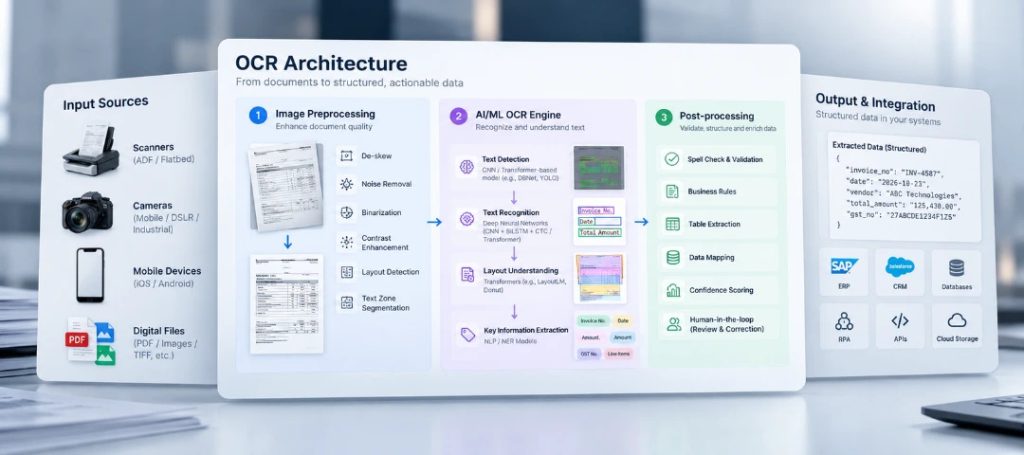
High-level architecture diagram and process workflow of optical character scanner technology
Advantages of Optical Character Scanner
OCR enhances productivity and customer satisfaction; other advantages are as follows.
- Scalability: OCR offers scalable applications that help organizations in processing large volumes and different types of documents across their branches around the world. With due training, systems incorporated with AI document processing can process more handwritten documents with time and without the need for additional resources. It saves processing time with disaster recovery, automated translation, doc routing, content processing, text mining preparation, and better record storage.
- Reduced Costs: Automated OCR and data processing systems help organizations reduce their operational costs incurred from redundant manual data entry globally. The time, costs, and material savings can be utilized in more beneficial activities as a part of strategic value-add to the business. It also speeds up research with searchable digital data and preprinted document or written form inputs.
- Improved Efficiency: By automating repetitive tasks and streamlining workflows that would have otherwise consumed a lot of time, OCR with semantic segmentation enhances organizational efficiency through document reading and processing automation and effective resource allocation. Also, OCR solutions can be made platform agnostic and accessed through customized applications developed as per business needs.
- Centralization: All datasets can be preserved, secured, and centralized against fires, vault loss, and break-ins. This enables easy access to visually impaired customers and resources, plus, it improves services by rendering employees with accurate and up-to-date data. OCR systems can nowadays extract and support searchable multilingual text documents that are used globally by MNCs.
- Agnosticism: OCR systems can be easily integrated and embedded into business applications as an additional feature for real-time text extraction to reduce analytical workload over input. Printed or handwritten text can be easily converted into digital format which is easy to store, edit, and read. Further, digitized paper records eliminate physical storage requirement for better document retrieval.
Build Your OCR Solution with KritiKal
In this blog, we went through the transformative approach of optical character recognition software, its working, components, features, and benefits, as well as use cases. Its future holds tremendous possibilities with respect to its current substantial benefits over traditional data entry methods.
This difference is mainly in terms of flexibility, time and cost savings, scalability, improved operational efficiency, seamless integration, amplifying accuracy, easier explainability and shareability, regulatory compliance, and huge unstructured data handling, as it leverages various AI algorithms in its functioning.
Although, there are certain challenges associated with OCR systems, which include low accuracy due to blurry scans, difficulty in handwriting recognition, complex and unusual fonts, and poor image quality. Other issues include skewed or rotated documents, low contrast, curved text, background noise, and small fonts.
Furthermore, improperly formatted output, multilingual documents, limited context understanding, high subscription fees, biased datasets, proofreading necessity, and complex document layouts also cause issues. There is a common problem with colored paper backgrounds or low contrast differences in text and background, as well as personal data security concerns.
KritiKal Solutions has decades of experience working with applications in neural networks and DL fields and is one of the best OCR solutions provider companies. We have accomplished the development of state-of-the-art computer vision trends-based indigenous OCR solutions. Our solution encompasses all features and is applicable in all use cases mentioned in this blog and much more. We have already explored how is machine learning applied in modern OCR systems to improve accuracy in this blog.
We are currently running more than 6 different LLM models on our local GPU server with different quantization. We use modern techniques and features to build our OCR solutions, such as synthetic data training, context-aware recognition and intelligence, multilingual and script-agnostic recognition, smarter RPA and AI automation, and expanded use in edge devices and wearables.
We address all technical challenges faced during integration of OCR solutions, such as inconsistent input document formats, low-quality incoming images, multi-lingual documents, low output accuracy, large sets of input data, overall workflow complexity, inflexible data hosting and storage-related issues, enterprise application integration and implementation, continuous model training and maintenance, ever-evolving regulatory compliances, cyber threats, data leakage, non-intuitive user interfaces, and other matters. These capabilities can tackle questions around what are the common challenges and limitations faced by OCR technology?
Today, OCR is no longer a niche tool but the foundation for digital transformation, which has been embedded in systems right from enterprise automation platforms to mobile applications. It handles real-time image acquisition and caters to multilingual documents as the intelligent automation’s integral component.
As OCR technology advances, more organizations tend to embrace it to place themselves as an agile competitor in the market. Let KritiKal support you through your transition journey from manual data entry processes to OCR systems as per your specific business requirements, be it enhanced cognitive capabilities, complex AI explainability, data insights, RPA-related process streamlining, etc. Please get in touch with us at sales@kritikalsolutions.com to know more about our vision and software-based products, platforms, services, and realize your business requirements.

Lakshay Dhawan currently works as an AI engineer at KritiKal Solutions. He is proficiently skilled in stack development, MongoDB, React, Python, JavaScript, LLMs, RAG pipelines, AWS AI services, GenAI, AI agents, MySQL, Git, and more. With his ability to work efficiently in teams, he has assisted KritiKal in delivering various projects to some major clients.