


 Global
  United States
What are Computer Vision Applications?
Computer vision (CV) represents cases under the umbrella of artificial intelligence (AI) where computers and machine algorithms are trained to extract, process, interpret, and understand meaningful data assets from given semi-structured and unstructured visual inputs. It has transformed various industries like gaming, retail, healthcare, and others in the last few decades, thus assisting practitioners, operators, and technical leaders. It has revolutionized businesses that kept pace with advancing technologies and harnessed their true potential.
It is important to know upcoming computer vision trends and next-generation AI-based products because it renders a decisive edge to track motion, analyze scenes, and read text over massive volumes of compromised digital images, video, and live streams. As digital and physical environments keep converging through augmented reality (AR), the Internet of Things (IoT), edge computing, and virtual reality (VR) towards smarter infrastructure, the relevance of CV is increasing consistently.
CV revamps granular insights and turns them into real-world events without the necessity of complex coding, such as efficient system designs, autonomous vehicular solutions, robotic and healthcare imaging, retail analytics, industrial quality checks, improved security, and accurate visual interpretation on user-friendly interfaces. From products to client experience, CV can be leveraged as a streamlined human-level strategy across organizational functions to increase operational efficiency.
Businesses need to partner with CV experts for using techniques like convolutional neural networks (CNN), machine learning (ML), deep learning (DL), generative AI (GenAI), etc., and to transform their portfolios with AI operations like pose estimation, movement tracking, semantic segmentation, object detection and identification, pattern identification, OpenCV face recognition, and computer vision and image processing services, classification, among others.
To give a gist of the upcoming trends, modern computing systems are integrated with task-specific models and edge AI in lieu of foundation models to cater to commercial use cases. Agentic CV systems are operationally deployed on a large scale, and visual general intelligence is assisting enterprises to operate in real-world scenarios. Given these facts, high-quality, scalable, structured, and reliable CV datasets; end-to-end video and image annotation services; and off-the-shelf CV data for sophisticated vision systems are on the rise.
CV models are becoming more accurate and business critical as a part of computer vision trends 2026, with increasing data and model maturation, leading to more intelligent decision-making systems and real-time, autonomous recognition applications. With perpetual AI advancements, CV systems have turned smarter, precisely operable, and valuable across sectors. In this blog, we will discover how CV’s forte and breakthroughs are redefining how machines see, assess, understand, function, make decisions, and respond in this contemporary world.
Did you know? The current global market for computer vision was valued at US $28.2 billion as of 2026 and is projected to increase at a CAGR of 20.1% to reach a value of approximately US $101.5 billion by 2033. Furthermore, some related trends are as follows.
- AI in the CV market may reach US $63.48 billion by 2030 from US $23.42 billion in 2025, rising at a CAGR of 22.1% during this forecast period.
- CV-based tasks such as classification/detection are being carried out by Vision Language Models (VLMs) that are multimodal models exhibiting Natural Language Processing (NLP), like Gemini Robotics 1.5.
- Model optimization and GPU advancements for smartphones, cameras, robots, and industrial equipment are influencing development as they reduce latency, cloud dependency, and bandwidth requirements.
- Vision-Language-Action (VLA) model reasoning and Physical AI perception that combine visual understanding, multi-robot collaboration, whole-body control, and local runs on devices, are emerging.
- Meta SAM 2 combines Gen AI and CV for synthetic data generation, video, text, audio, and image segmentation prompting, auto content creation, visual simulation, and masklets for generative video systems.
- The move from 2D to long horizon 3D vision, geometry, and spatial intelligence for VL research, Q&A, scene understanding, spatial depth, visual reasoning, camera pose, and representations is on the rise.
- StepX-Edge uses about 0.9 billion parametric VL models, and Snapdragon 8 Gen 5 with 0.84 seconds time-to-first token, 1.4 GB peak memory post quantization, and 98 token per second decoding for on-device UI understanding.
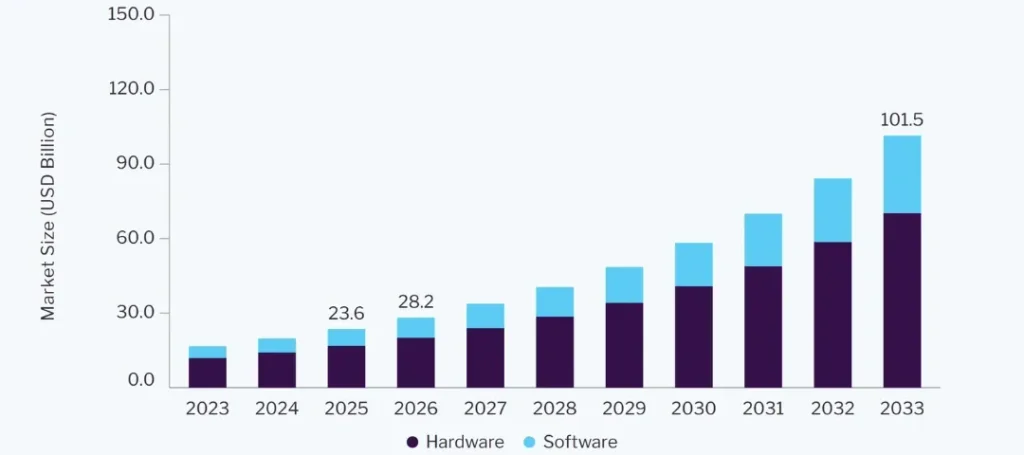
Source: Grand View Research
Growing market size of computer vision trends 2026 and further
How Do Computer Vision Applications Work?
Technologies
- Machine Learning: ML algorithms allow machines to conduct pattern recognition for recognizing, classifying, predicting, and recognizing events and objects based on large visual datasets for training, and the accuracy of this task improves over time.
- OCR: Optical character recognition or OCR receipt scanner enables CV systems to detect and convert text in images, documents, traffic signs, and videos into machine-readable information.
- AR, VR, MR & XR: AR/VR, Mixed Reality (MR), and Extended Reality (XR) utilize immersive digital overlays to enhance real-world visuals, track movements, understand physical surroundings, and place digital objects within real-world environments.
- Deep Learning: DL enables machines to automatically learn and interpret visual features, images, videos, and data through multi-layer neural networks that mimic the human brain to make them fundamental to modern computer vision systems.
- CNNs: These neural networks are designed to process visual data by extracting spatial features, such as edges, shapes, objects, and textures for important applications.
- Vision Transformers: ViTs divide images into patches and utilize self-attention to comprehend relations between various parts of an image, which are used for CV tasks like detection, segmentation, classification, , as some of the common computer vision trends.
- Attention Mechanisms: These are useful for pushing models to focus on relevant features and regions in an image instead of pixel-wise treatment, especially in the case of ViT
- Foundation Models: These are large, pre-trained models that adapt to multiple downstream use cases, such as Meta DINOv2 for classification, retrieval, depth estimation, and segmentation. These provide general-purpose representation, which is better than training a separate model for every task.
- Vision Language Models: These models allow CV systems to interpret input, combine language and vision understanding, and respond to NLP-based instructions or questions. They make visual search and reasoning, document understanding, image captioning, and related applications possible.
- Multimodal AI: It combines data from video, text, images, audio, spatial information, and other data sources to generate a comprehensive environmental understanding. It helps CV-based solutions to integrate LiDAR, RGB images, and language embeddings.
- 3D CV: Three-dimensional computer vision trends extend visual analysis from two-dimensional images to 3D objects and environments using depth cameras, LiDAR, stereo vision, and 3D reconstruction.
- Generative AI: Using this technology, CV systems can generate, modify, reconstruct, visual content, and synthetic training data.
- Self-Supervised Learning: Unlabeled images and videos are fed to models like DINOv2 to learn visual representations and reduce the dependency on costly, manually annotated datasets.
- Edge AI: Edge computing can reduce latency, bandwidth requirements, and privacy concerns as models run directly on cameras, robots, industrial devices, smartphones, etc., rather than transferring every image to the cloud for processing.
- Sensor Fusion: LiDAR, radar, depth sensors, language, and other inputs undergo multimodal fusion with the camera or RGB data for better scene understanding.
Working
- Image Retrieval: The CV-based system captures visual data through sensors, security video feeds, cameras, and real-time footage.
- Image Pre-Processing: The captured data is optimized and enhanced using pre-processing techniques. Noise reduction and adjustments in resolution, contrast, and brightness are done during this analysis.
- CV Tasks: This step includes one or multiple computer vision applications, such as the following.
-
- Object Detection: Present objects are identified, and their locations are detected using bounding boxes, for example, models like YOLO, DETR, etc.
- Object Tracking: Movement of objects is traced across successive video frames, such as sports analytics, industrial monitoring, video surveillance for banks, etc.
- Image Segmentation: Images are divided into meaningful regions and pixels for the system to identify object boundaries, for example, using models like Mask2Former, Segment Anything (SAM), etc.
- Facial Recognition: One of the common computer vision trends that uses facial features that are identified to verify individuals for authentication, security, and access control.
- Image Classification: In this, an image is assigned to a predefined category as per certain criteria.
- Depth Estimation: The distance of the objects from the camera is determined using visual data, for example, DINOv2, which is used for robotics, computer vision for autonomous vehicles, AR, and 3D scene understanding.
- Interpretation & Response: Post-interpretation of the visual information, real-time decisions are made, and valuable insights are provided.
Key Computer Vision Trends 2026
In this section, we will delve into the various trends seen in CV application development.
Explainable CV
Mission-critical operations across healthcare, finance, defense, etc., performed by AI systems require explainable CV, as transparent models ensure clear, auditable, interpretable, accurate, and understandable predictions and decisions.
Visual General Intelligence
The newly deployed product category of VGI refers to AI/CV systems capable of understanding virtually perceived physical environments, contextual reasoning observations, acting on self-served decisions, and answering questions about NLP even with no training data, DL model development cycles of six or more months, and large annotation training data within minutes of a prompt. Task-specific CV models function on labeled visual data collection, high-precision low-tolerance specific task deployment, specialized model training, and fine-tuning. These are being replaced with flexible, cheaper, and swifter foundation models like GPT-4o, Gemini 2.5 Pro, Qwen3-VL, and InternVL3 as they generalize across tasks without any operation-specific retraining data.
Responsible AI
One of the common computer vision trends observed is where it acts as a vital tool for attaining Environment, Social, and Governance (ESG) targets to support the organization’s sustainability practices and render it a competitive differentiator. This may include initiatives to monitor ecosystems, identify environmental risks, optimize resource usage, and contribute to green ethics. Responsible CV and ethical AI considerations like privacy preservation, regulation adherence, explainability, data management issues, bias mitigation, surveillance, transparency, prejudice, anonymization, and trusted ethical deployments have become necessary as this field expands.
Spatial Intelligence
Integration of 3D vision and spatial intelligence using stereo vision, depth sensing, and LiDAR technologies with CV systems is rapidly on the rise. These technologies help in shape, motion, and distance perception and spatial understanding, which are utilized for autonomous navigation, AR, digital twins, robotics, metaverse applications, etc. 3D vision-based CV services will handle more complex applications with environmental awareness and interactions.
Physical AI
It is one of the computer vision trends that refers to AI systems that can function, perceive, reason, make decisions, and act safely within a physical environment, where CV forms the perception layer. It brings CV into physical systems, including humanoid robots like Tesla Optimus Bot; autonomous vehicles and mobile robots in logistics like Agility Robotics’ Digit; robotic arm assembly systems; AI-enabled drone fleets across agriculture and construction.
AI Regulations
Stringent standards and regulations, such as the EU AI Act and UK AI Regulation Act, have moved to enforcement reality from legislative text to reshape CV deployment decisions across professional settings for direct implications. As CV systems utilize facial recognition, biometric identification, and employee behavior monitoring, informed decision-making in the workplace context is classified as high-risk under the Act. It requires edge and privacy-first architectures, transparency obligations, risk assessment documentation, data minimization, audit-ready records with trail functionality, system data governance, and oversight mechanisms.
Vision Language Integration
The emergence of large architectural, pre-trained models like Google PaLM, Gemini, OpenAI CLIP, and GPT-4o accelerates development and handles various applications with minimal fine-tuning. Businesses tend to leverage such fast, adaptable, multipurpose, and scalable systems with visual and language understanding in a single architecture instead of building tailored models per project. This fusion empowers CV systems in scene description, object recognition, image query resolution, and contextual report generation. Enterprise applications reduce deployment barriers, widen the scope of business issue addressal for vendor categories and employees, and allow CV to interface with NL workflows.
Low-Code & No-Code
Democratization of computer vision applications on artificially intelligent platforms involves using low-code and no-code tools to create, train, and deploy vision models without any technical understanding. This helps small and medium businesses to optimize existing workflows, facilitate analytics and automation, speed up innovation, and expand CV solutions.
Video Intelligence
Another trend is semantic video intelligence and unanalyzed video footage querying, which enables employees to receive relevant answers around natural language questions. The CV system or operator does not require any prior configuration, annotation, or manual analysis of large volumes of video feeds. It works on large vision models and semantic search over video embeddings for meaning-based query matching instead of pre-defined metadata tags. In-depth video understanding and analysis allows these systems to track movements, analyze actions, predict behaviors, and summarize entire sequences, such as in security, sports analytics, surveillance, retail customer behavior analysis, and more through valuable insights from video feeds.
Simulation Environments
Businesses are required to invest in acquiring large volumes of real-world data, which can be costly and time-consuming amongst other computer vision trends. This issue can be resolved by utilizing simulation environments and labeled, high-performing, diverse, and ethical synthetic model datasets for CV task development. These GenAI-enabled visual content creations, produced within hours, can be used for augmented training data, realistic image generation, rare scenario simulation, corrupted visuals restoration, gaming, marketing, and other creative workflow assistance. Applications like Sora can generate photorealistic rendered environments with situational edge cases, custom lighting, and angles, thus making the annotation-heavy AI/CV system development pipeline seemingly optional.
Alongside automated model training, transformative platforms like NVIDIA Omniverse and Scale AI data engine are likely to fuel quicker development cycles, better data diversity, and innovative industrial applications where real data is sensitive, expensive to collect, and scarce. Synthetic hybrid data is now reaching training parity with real data in terms of quality, accuracy, robustness, controlled testing, model performance, real-world conditions, coverage, and diversity management, apart from benefits like lower collection hardships, expense, and time consumption. These can be seen utilized across safety monitoring, AI defect detection, object detection, artificial data generation, and other applications.
Multimodal Systems
An important trend around multimodal AI systems is also on the rise, where these solutions process and comprehend multiple types of texts, audio, images, and videos. These systems merge such inputs to gain a deeper and contextual understanding, enhanced decision-making, predictions, and failure forecasts. As computer vision applications are becoming more encompassed with transactional, behavioral insights, and other solutions like NLP, sensor data and maintenance log analytics, and speech recognition, they can now comprehend audio, text, numerical, visual, and other forms of information for smarter automation.
Real-Time CV
Edge AI can be used for real-time visual processing and running references directly at the edge, on devices such as drones, smartphones, industrial cameras, etc. Energy-efficient AI chips from NVIDIA, Jetson, and Qualcomm AI edge chipsets reduce latency, connectivity constraints, and dependence on cloud-based processing; enhance DL inference, response time, privacy, reliability, and swift decision-making. Real-time visual data processing at its site of generation is especially useful for logistics and manufacturing operators to act swiftly on valuable insights within seconds.
Although edge computing is reaching maturity at deployment and is becoming a baseline requirement across manufacturing, unionized workforce, pharmaceutical, and governmental environments. This is as per sovereignty laws under regulations, such as China’s Personal Information Protection Law, the EU AI Act, etc., that now penalize cross-border transfer liabilities due to dependency on external connectivity.
Merged Reality
MR is another key trend in the realm of CV, where it combines or blends digital elements or virtual objects created using CV with the physical or real world. It is used for creating experiences in industrial training, gaming, and education.
Vision Transformers
ViTs outperform CNNs by functioning like language models for textual processing, capturing global features, and treating images as sequences for conducting tasks. ViTs are becoming the standard architecture and default backbone for computer vision applications and tasks like image classification, multimodal reasoning, segmentation, computer vision object detection, and depth estimation. Edge-performing models like YOLO26 and InternVL are useful for enterprise-level visual understanding tasks and scaling across large datasets, constrained environments, and industrial deployment in the absence of cloud connectivity. They can easily capture global context, although they function on diverse datasets featuring high-quality annotations, including key points, polygon segmentation, instance masks, complex scene labeling, etc.
Agentic CV
CV-based solutions produce outputs like alert generation, object detection, event flagging, and more where they detect, observe, decide, correctly act, and accomplish workflows without any stepwise manual intervention. It forms the perception layer of agentic systems that automatically initiate a corrective action in case of any violation in safety, route visual evidence to the Human-in-the-Loop (HITL), and update Environmental, Health, and Safety (EHS) systems. Here, the layer works by itself on the captured footage, allows users to upload videos and images, and describes what needs to be identified in NL. Connected agentic CV solutions self-serve to return a working vison-based application built around the description provided by the user and test what CV recognizes in the environment prior to operational layer integration.
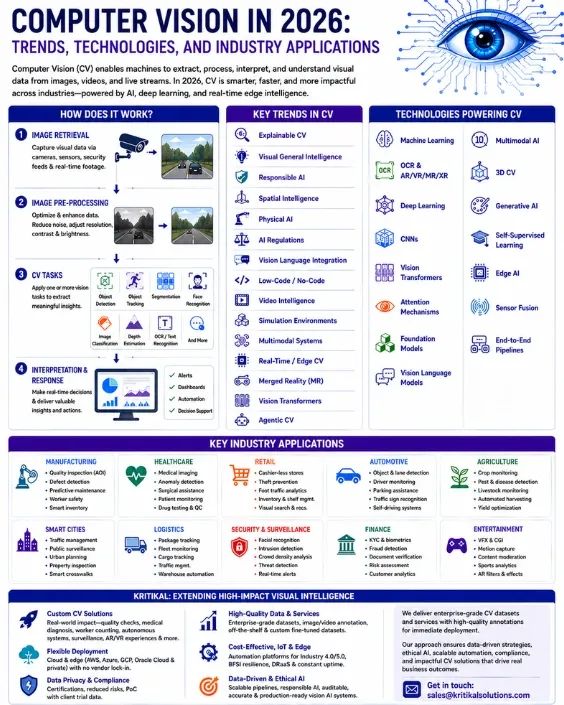
Computer vision trends 2026: Key trends, industrial applications, technologies, and working
Key Computer Vision Trends Across Industries
Generic CV applications are being supplanted by the expansion of industry-specific regulations, work procedures, use cases, and situations and domain-trained models to meet certain operational requirements. Here are some CV applications that are trending in specific industries.
Manufacturing
Today, CV powers smart factories through Industry 4.0 and 5.0, visual AI supervision, high-resolution Internet of Things (IoT)-connected camera integration, automated quality and worker safety control, fast defect detection in manufacturing, compliance, hazardous geofencing, automatic emergency stops, high-speed products, conveyor belts, and automated optical inspection (AOI). Increasing accuracy can be observed, for example, misalignment in assembly parts, macro to microscopic flaws, dents, or cracks in units, color inconsistencies in products, etc.
Moving towards the future, computer vision applications like round-the-clock predictive maintenance of machinery that uses visual sensors, signals, and thermal cameras are likely to become more accurate. Real-time alerts for broken parts, failure precursors, vibratory patterns, thermal hotspots, etc. can bring down unplanned or scheduled downtime, costs, loopholes, waste, manual involvement, and errors. Smart vision will also take over inventory management through maximized profitability, warehouse cobots, robotic process automation (RPA), raw material tracking, supply chain optimization, stock shortage prevention via stock monitoring system, finished product checks, etc.
Healthcare
Vision systems are increasingly gaining importance in triaged medical imaging at scale, review prioritizations, potential tumor and anomaly detection, pattern spotting and flagging, robotic surgical and clinical assistance, pixel-level change tracking, reduced time to diagnosis for critical patients, remote patient monitoring, treatment, rehabilitation, and recovery assessment, highlighting nerves to be avoided, quick emergency response, and more. These systems can detect patterns in MRI, CT, and X-ray scans that are too miniscule for the human eye and act as predictive decision support for HITL. They can directly analyze and compare vascular issues, cancerous and non-cancerous cells with intelligent image detection for greater precision, minimized errors, better patient outcomes, and AI medical diagnostics. In the field of pharmaceuticals, CV is increasingly being used for quality control automation, drug manufacturing and testing, contamination detection, GenAI-based regulatory compliance checks, patient condition inconsistencies, etc.
Retail
A common trend observed nowadays is utilizing CV to facilitate cashier-less stores, theft prediction and retail loss prevention systems, automated self checkout kiosks that identify products and barcode-less items, smart carts, GenAI-driven foot traffic, customer behavior analysis and product recommendations, robotic or aisle-fixed tracking, inventory and shelf management (out-of-place, misplaced products, pricing labels) for a smarter, hyper-personalized, and efficient shopping and customer experience in retail.
Applications for computer vision speeds up supply chain logistics, demand, sales and dynamic pricing, check out queues, predictive analytics, and enhances engagement, customer satisfaction, tailored promotions, and caters to a responsive and conducive environment for browsing. It reduces buying journey friction by allowing customers to upload an image for product recognition and visual search for similar items over the retailer’s application. In the warehousing and FMCG sectors, vision-based intelligence is consistently being used for packaging and errors in label inspection, waste reduction, barcode scanning automation, forecasting demand fluctuations, product tracking, and planogram compliance.
Automotive
Another important 360° vision system trend is around self-driving cars that assist them in the detection of objects, road cracks, obstacles, parking spaces, lanes, potholes, collision, and pedestrians. It is useful for road and traffic sign recognition, OCR for textual reading, traffic management, safe driver transit and behavioral monitoring, parking assistance, accident prevention, and more, thus making vehicles smarter.
Agriculture
CV is seen integrated in global agricultural setups and machines for automatic weeding, seeding, watering, harvesting, and accurate aerial monitoring of field crops. This helps in identifying nutrient deficiencies, pests, diseases, ripe fruits, mature vegetables, resource optimization, enhanced yield, efficiency, protection, waste generation, crop health and management, and automated machinery. Smart cameras powered by visually intelligent solutions for livestock management, early illness symptoms, and abnormal behavior detection.
Education
Vision-powered learning using YOLO11 model feature gesture, expression recognition for hyper-customized, adaptive and personalized learning, immersive AR/VR simulations for engagement, and student movement tracking are spreading across schools, institutions, experience and research centers. Edtech applications for computer vision powered by Gen AI are reconstructing automated grading and assessments, live translation, sign language understanding to close classroom gaps and render and inclusive educational environment.
Urban Development
CV and AI agents are empowering smart cities and conscious urban systems that react to their inhabitants via intelligent signal control, traffic flow monitoring, smart crosswalks for pedestrian safety, reduced congestion, carbon emissions, idles, anomaly detection for public space security, and faster incident response. Urban city planners are utilizing aerial images analysis to understand the use of spaces, foot traffic heatmaps, etc., to build sidewalks, public transit stops, parks, and more. Computer vision trends also include enhancing the real estate sector by revolutionizing automated surveillance against unauthorized access, direct footage over consumer-facing portals, damage and structural flaw detection, and property management and vision inspection system.
AR-based 3D immersive, virtual tours of remote properties, digital twin of property interiors, virtual walkthroughs, and e-commerce workflows with links, and videos in the 3D model can be used for a better client experience. Apart from maintenance alerts and suspicious human activity detection, CV deployments are used in ML-based property valuation as per condition, vision-captured metadata, home remodeling costs, and market pricing estimate.
Logistics
In the field of logistics, CV trends towards creating safer and efficient transportation, including automated package tracking, self-driving cars, DL-powered traffic management, vehicle segmentation, traffic infraction reporting, cargo tracking in real-time, parking occupancy identification, streamlined warehouses and supply chains, timely deliveries, and lesser accidents.
Security & Surveillance
Security breaches, suspicious activities, potential threats, risks, intrusion, and unauthorized access can be instantly determined with triggered alerts using facial recognition, situational management, and crowd density analysis
Finance
Applications for computer vision are enhancing the banking, financial investments, and insurance industry for better customer engagement, impenetrable security, fraudulent transaction detection, abnormal behaviors, real-time facial recognition for Know Your Customer (KYC), assessment of client interactions in branches, personalized services, simultaneous operations in multiple datasets, biometric authentication, cross-check identities, anomaly detection, eased and automated document verification and onboarding procedures.
Entertainment
In the gaming and media industry, CV is increasingly being used for automated moderation, immersive content creation, personalized experiences and recommendations, live events and sports analytics, brand exposure checks, drone racing, redefined sports broadcasts, audience interactions, content moderation, using VFX, CGI, motion capture technology, and AR-powered filters.
Energy
CV is now gaining importance for seamlessly managing operations in the utilities, power, and energy sector for automatically detecting supply outages, visual inspection, substation examination, cleanliness assessment, power plant monitoring, maintenance, KPI monitoring, ML-based fire and smoke detection in far-off facilities.
Key companies that are gaining importance in advancements and applications for computer vision include SG Analytics (object tracking, video analytics, and visual search), NVIDIA (GPUs, CUDA, TensorRT inference engine, and Metropolis edge AI), Google DeepMind (ViT and production-grade deployments, self-supervised learning, Google Lens in medical imaging), Microsoft Azure AI Vision (Azure Cognitive Services, Azure AI Vision Suite, OCR), AWS (API, Amazon Lookout, Amazon Rekognition, S3, SageMaker, and Lambda), Cognex (In-Sight and VisionPro), Mobileye (EyeQ and REM), Scale AI (RLHF and Rapid), Zebra Technologies (FrontLine AR, Aurora, and Photoneo), Sight Machine (IIoT, ML across multiple industries), among others.
KritiKal: Extending High-Impact Visual Intelligence
As we discussed in this blog that the CV landscape and subsequent trends are redefining competitive market innovations through Gen AI, multimodal AI, foundation models, ViTs, and real-time edge applications. By embracing these groundbreaking technological advancements and navigating the trends, businesses are shaping new industry-agnostic possibilities by strategizing innovation-driven implementation, expertise to unlock the full potential of CV, related support, and beyond.
A subtle shift has been observed at the horizon of every decade from narrow and trained systems to general and deployable systems, detection to action, cloud-dependent systems to edge-native systems. And companies that thrive on building their AI/CV infrastructure would be able to compound the benefits of this generation of technology as compared to those who would continue to retrofit the previous generation, leading to a widened competitive gap.
They are keen on the development and tailored deployment of computer vision applications that enable machines to efficiently interpret visual data. They can perform real-world applications, like automated quality checks and defect detection, medical diagnoses, worker counting, enable self-driving cars, streamline operations, improve surveillance for industrial safety, and provide spatial OS-based powerful, immersive AR/VR experiences while transforming their portfolio.
Join hands with KritiKal Solutions to achieve the above, and furthermore explore CV-powered Gen AI capabilities, including object detection, image recognition, document processing, visual analysis, asset monitoring, predictive maintenance, etc. We offer a structured evaluation framework for your business problem, define the specific visual task like CV-powered automation, integration or augmentation, and provide a solution that enhances brand recognition.
Our pre-built APIs and custom models developed by teams with industry-relevant experience can be flexibly deployed over both cloud (Oracle Cloud, AWS, Azure, Google Cloud, and private cloud ecosystems), and edge environments without the need for vendor lock-in. Our practices are mindful of computer vision trends 2026, mission-critical visual data privacy, certificated compliances, overall cost of ownership, reduced implementation risks, and proof-of-concept (PoC) development as per trial data provided by the client.
We are changing AI-powered managed solutions with cost-effective IoT products, human-centric approach to intelligent automation platforms, edge-computing for Industry 4.0 and 5.0 solutions, resilient BFSI applications, automated production line quality and security check, constant uptime, compliant, integrated disaster recovery (DRaaS) and backup for reduced reliance on cloud. We can deliver enterprise-grade CV datasets and services for contemporary, next-generation AI development, high-quality image and video annotation, off-the-shelf, customized, structured and fine-tuned, datasets for immediate deployment.
We understand the future of computer vision applications is data-driven, and thus alongside adapting to new trends we ensure the fundamental principle of impactful, industry-specific, large vision model performance with high-quality data, multimodal intelligence, minimal or no training infrastructure built, ethical AI, scalable automation pipelines, data-driven CV strategies, reliable, responsible, domain-centric, compliant, accountable, auditable, accurate and production-ready vision AI system designs. Please get in touch with us at sales@kritikalsolutions.com to know more about our CV-based products, platforms, services, and realize your business requirements.

Sushant Dogra currently works as a Senior Quality Engineer at KritiKal Solutions. He is proficiently skilled in Product Lifecycle Management (PLM), quality assurance, SPC, MSA, PPAP, quality management documentation with ISO 9001, IATF 16949, agile methodologies, and more. With his ability to work efficiently in teams and more than 6 years of experience working with quality management systems, he has assisted KritiKal in delivering various projects to some major clients.