


 Global
  United States
What are GANs in Computer Vision?
Generative Adversarial Networks (GANs) are basically models that can learn inferences from existing datasets and create realistic data like music, video, and images, similar to real-world data, which can be used for training new models. They are Machine Learning (ML) models that are used across various industries like data science, healthcare, and gaming. They create realistic data results through pattern-based learning from training datasets by using an unsupervised learning framework and Deep Learning (DL) technology and computer vision and image processing services.
GAN was first introduced by Ian J. Goodfellow in 2014 (NeurIPS paper) and has been transforming generative modeling since. Similar to other agentic AI solutions, it reduces the computational complexity of image classification, speedy recognition, new data, texts, and image generation, and model and algorithm development that can easily generate realistic high-resolution data. One might ask, are GANs used anymore? To answer this, yes, they are, and their various applications will be discussed in this blog.
The current global market for GAN is estimated to be around US $5.52 billion as of 2024 and is expected to surge and reach an approximate value of US $36.01 billion by 2030, increasing at a CAGR of 37.7% during this forecast period. Let us now go through their importance of generative AI services, and GAN in particular, further in this blog.
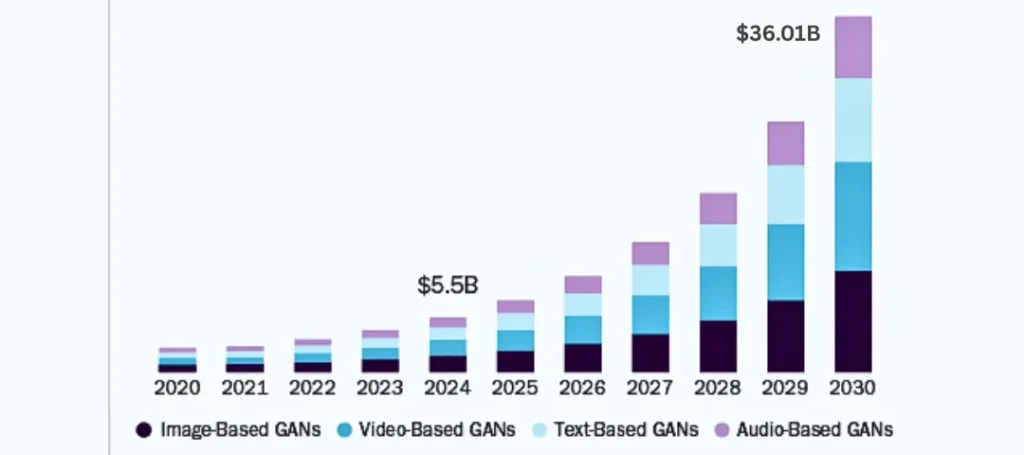
Source: Grand View Research
Growing market size of GANs in computer vision during the forecast period 2018 to 2030
Architecture of GAN
These models contain two neural networks, a discriminator and a generator network, that are trained in an adversarial manner, where the latter creates similar data and the former distinguishes between synthetic data and real ones. One might ask, is ChatGPT based on GAN? To answer this, it is not, as ChatGPT uses a transformer neural network for token prediction and sequence generation for understanding prompts.
Generator Model
The generator model is a deep neural network that takes a random noise vector sampled from a uniform or normal distribution as input. It then creates images, text, audio, and other realistically mimicking data to learn the underlying differentiating patterns in the training dataset. It adjusts internal parameters while in training via a backpropagation process, similar to the training process in retrieval augmented generation.
Some examples include Naive Bayes, Gaussian Mixture Model (GMM), and Latent Dirichlet Allocation (LDA) developed using DL generative modeling algorithms like Deep Belief Network (DBN) and Restricted Boltzman Machine (RBM). The loss function it uses to minimize the loss is JG = – (1/m) Σi = 1m log D(G(zi))). Here, JG is generator loss, D is discriminator neural network, G is generator neural network, z is random noise vector, m is batch size, and j is iteration, similar to how some components of agentic AI are trained.
It uses deconvolutional layers to upsample noise vectors and generate images. Its main objective is to generate samples for the discriminator model to classify the real ones. The final output layer uses a sigmoid or tanh function as per the result or generated data with pixel values in a normalized range. Its component-wise sequence other than the aforementioned input and output layers is as follows.
- Fully Connected Layer: Transforms input noise into a suitable shape for processing.
- Batch Normalization: Normalizes output for fast convergence and to address layered mode collapse.
- Activation Functions: Introduces nonlinearity in the model for complex data generation.
- Deconvolutional Layers: Upsamples previous layer input to higher spatial dimensions.
- Reshaping Layers: Reshapes data into the required output format during image generation.
Discriminator Model
As discussed, the discriminator is a binary classification model capable of distinguishing simulated samples (generator model-assigns scalar value 0) from real-world data (training dataset-assigns 1). Throughout the training, the model refines its internal parameters for improving its detection technique while working with images and other data. It uses a loss function to reduce its loss, which is J = – (1/m) Σ log D(x) – (1/m) Σ log (1 – D(G(z))). Here, J is the loss function, m is the number of samples or batch size, z is the random noise vector, x is a real sample, G is the generator network, and D is the discriminator network.
It enhances the accuracy of its classifier, which might use transposed convolutional layers. The final output layer is fundamentally a neuron to produce a probability value with a sigmoid activation function. Similar to components within agentic AI architecture and the generator, its architecture consists of convolutional layers (data feature extraction), batch normalization, activation functions, pooling layers (spatial dimension reduction), and fully connected layers.
One might ask, can you explain how a GAN network works? The backpropagation technique is used for neural network optimization, where the loss function gradient is calculated as per the network parameter, which is in turn adjusted for reduced loss. The generator model receives the discriminator model’s feedback to update weight for further improvement and creates more true-to-life data. Thus, the discriminator acts as a feed-forward neural network.
GAN architecture undergoes an adversarial process in which the generator model tries to make the discriminator model classify synthetic data as real, whilst the latter improves the distinguishing ability. The whole process occurs with the help of guidance by the Binary Cross-Entropy (BCE) loss function, which measures the performance of both networks. Understanding this sequence might make one ask, why are GANs so hard to train? It is mainly because of network imbalance, the moving target issue, mode collapse, instability, and high hyperparameter sensitivity.
The generator loss does the measurement of how well the discriminator is deceived by it into thinking the data is real. Low generator loss indicates successful creation of realistic data, while a low discriminator loss is the measure of successful synthetic data identification. Hence, the architecture performs minimax formulation to reduce the discriminator’s reward as the generator tries to maximize its loss, which is min max V(G, D) = [E [log D(X)] + E [log (1 – D(G(z)))]].
Types of GANs in Computer Vision
One might ask, can you give me an example of a GAN? There are different types of GANs for specific purposes, such as the following.
Traditional GAN
Vanilla GAN is the simplest GAN type, which consists of a generator and discriminator developed by using Multi-Layer Perceptron (MLP). This type of GAN can optimize its mathematical formulation through stochastic gradient descent (SGD), but at the same time, it may undergo unstable training alongside a limited type of output generation. For example, the creation of handwritten digits, similar to the MNIST multimodal LLM dataset. Vanilla GANs tend to become unstable in their training period, and thus the hyperparameters need to be carefully tuned for obtaining the required results.
Laplacian Pyramid GAN
LAPGAN can develop images of ultra-high quality through multiple resolution approaches that are different generator-discriminator pairs at various Laplacian pyramid levels. The input images are downsampled layer-wise in the pyramid and are then upscaled through conditional GAN. The image refines details in a gradual manner while reducing noise and enhancing clarity during the process. Per se, generation of high-resolution landscape images in a stepwise technique from low-resolution input images.
Super Resolution GAN
SRGAN increases low-quality image resolution as well as preserves the details by using a deep neural network along with an adversarial loss function. This enhances the images with low-resolution, adds finer details, and makes them realistic and sharper. Overall, it minimizes the common errors that might occur during upscaling of images, including pixelation and blurriness, such as high-resolution images from blurry ones.
Deep Convolutional GAN
DCGAN is one of the most commonly used models for image generation and employs Convolutional Neural Networks (CNNs) in place of MLPs. Convolutional strides replace max pooling layers for efficient output rendering. The model lacks connected layers, which allow comprehensive spatial understanding or zoom-in into the input images, for example, realistic human face and object generation from random input noise.
Conditional GAN
CGAN includes an additional parameter for condition or labels that guides the output generation process. In lieu of random data generation, including noise, these parameters allow the model to generate a specific result, object, style, topic, or type. It consists of a conditional variable that is fed as input to both the discriminator and generator to ensure that the latter develops data as per the specified condition. The discriminator also obtains labels to differentiate between synthetic and fake data, such as in the case of black and white to red, green, and blue (RGB) color-specific objects like cats and dogs as per the label.
DiscoGAN
This type of GAN is used to infer inter-domain relations without the need for training data that is paired. Instead of one each, this model uses two discriminators and two generators for image translation from one specific domain to another, and vice versa. This ensures closely resembling image reconstruction with the help of a consistent cycle. It is useful for enhancing images, style transfer, and image-to-image translation even if only unpaired datasets are available.
CycleGAN
In this case, the discriminator and generator models are trained in a cycle by using unpaired datasets for image-to-image translation. One image is translated into another style by the generator and then reverse translated by the reverse generator to the original style. The process of cycle consistency ensures that the reconstructed image resembles the original one and is thus used for tasks, such as computer vision AI solutions, image enhancement, and style transfer.
StyleGAN
It is useful in producing high-resolution images as the models are trained using the same object datasets. Multiple layers add various levels of image detail, right from basic to intricate low-level features, thus composing the generator network. The overall quality and detail level can be evaluated by a multi-layered discriminator.
Dual Video Discriminator
DVD GAN is used for video generation and is based on the BigGAN architecture that utilizes a temporal discriminator and a spatial discriminator.
Least Square GAN
The discriminator of the LSGAN model adopts the least-squares loss function, which minimizes the result’s objective function and the Pearson divergence.
Info GAN
In this case, the generative adversarial network uses a supervised vs. unsupervised learning approach to learn and isolate representation in an advanced manner.
Auxiliary Classifier GAN
ACGAN has similar functioning as CGAN, where the discriminator classifies the input image into either synthetic or real and mentions its class label and source.
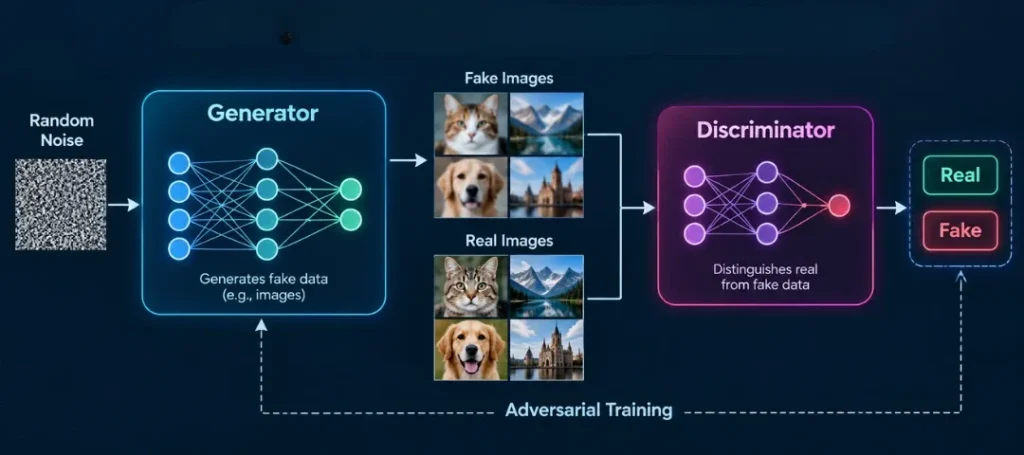
High-level architecture diagram of the working of GANs in computer vision
Applications of GANs in Computer Vision
Here are the main applications of GANs.
High Image Resolution
The main tasks These networks can improve images in low-resolution to high-resolution by enhancing image details and quality. For example, high-resolution realistic pictures are created by NVIDIA StyleGAN2, which can control fine-grained attributes like pose, expression, content, and identity. This allows users to conduct image manipulation for art and other practical applications.
Video Retargeting
Video content can be adapted to fit various formats and aspect ratios by using GAN-based unsupervised video targeting. This cyclical strategy preserves visual information, such as Cycle GAN named RecycleGAN, can be applied to video input and convert it to the social media square format from the widescreen one. This ensures the video stays intact, and all the key elements and movements remain the same.
Image Creation
These networks create photorealistic pictures and visuals through simplified text descriptions, scenes, and specific attributes. GANs are especially being utilized in the healthcare sector for realistic medical imaging like CT scans, MRI, and X-rays, analysis; training; and drug discovery for creating molecular structures.
For instance, BigGAN is used for creating data (encoding models and images aligned with encephalogram readings) as per certain conditions, categories, and classes in applications such as colorization, image synthesis (better fidelity and naturalness in stimulus rebuilding), reconstruction, and other computer vision AI solutions. Another model, namely GAN-BVRM, employs a classifier for fMRI as per its Bayesian visual reconstruction method.
Facial Feature Manipulation
Facial expressions, attributes, and aging effects can be altered by using GANs, which have proven to be useful in social media apps, entertainment, and gaming sectors. Such as in the case of StyleGAN which applies modifications in layers to the created image samples with respect to the latent space styles. Users can gain intuitive attribute control on facial expression, hair color, and more without any manual handling.
Object Detection
The diversity and quality of synthetic training data augmenting and resembling real-world datasets used for object detection models can be improved by using GANs. This helps the models to render generalized and accurate performance. As we know, the DL model performance deterioration is directly linked to distortion, blurriness, and noise affecting image quality. For example, the GAN-DO framework exceeds fine-tuning of traditional techniques and enhances GANs for robust object detection, featuring low complexity and high inference speed even with low-quality images.
Image Translation
These networks achieve image editing and style transfer through inter-domain image-to-image translations, for example, painted-to-sketch versions, and more. CycleGAN, for instance, converts pictures (one domain) to paintings (another domain) via a cyclic constraint that retains semantic coherence mapping. Thus, GANs are the preferred choice for applications like computer vision AI solutions, super-resolution, real-time video generation, and image translation, even in edge deployments.
Imputation
The generative model of GANs is utilized for guessing and completing missing information in the dataset, such as sub-surface images below the ground. It learns and understands known subsurface images, underground data, and surface structures, and then generates the required outputs. This can be used to map terrains for energy applications, carbon capture, and geothermal energy storage.
3D Model Generation
GANs are useful for creating three-dimensional models from two-dimensional images and scanned photos. This is especially useful in the healthcare sector for surgical simulation and informed planning. This can be done through X-ray images, and other body scans can be combined using these networks to generate realistic pictures of internal organs.
Industrial Applications
These networks are applied in Natural Language Processing (NLP) for improving vision language models, generating textual data, realistic instrument sounds, and music compositions. In the gaming industry, GANs create realistic simulations of characters and environments, and they can detect anomalies through pattern identification. They integrate with robotics, NLP, and reinforcement learning to modify AI systems through AI integration services.
They aid scientific research through complex data simulation for impractical and expensive experiments. These networks require only a single forward pass which is basically a single-time input flow via a neural network for output generation. Thus, they offer swifter inference speeds for real-time applications like phones, IoT systems, and other edge devices that may be resource constrained, especially in the case of multimodal AI in healthcare.
GANs also find applications in the detection and mitigation of cyber threats, adversarial attacks, and AI model development security across DL systems, as they can generate synthetic training data. They preserve privacy by generating and cracking encryption codes across defense and military sectors to discover newer data security approaches. GAN-powered systems can alter product images, visual concepts, and clothing styles across generative AI for retail.
These are also used in the generation of restricted terrain data, including lesser amounts of sensitive healthcare data for conventional methods. They perform pseudo-style transfer, limited or a particular feature modification in an image, which can be used in processing speech and NLP.
Steps to Implement GANs
One might ask, how are GANs trained? TensorFlow, Caffe, MXNet, Chainer, and Keras can be used for implementing GAN models in Python by using training dataset, scripts for discriminators and generators through the following steps.
- Library Import: TensorFlow, NumPy, Matplotlib, and other required libraries are imported for training and building GAN models.
- Preprocessing: The dataset is loaded and preprocessed to represent the distribution of target data, including images, texts, videos, and audios.
- Generator: TensorFlow or Keras can be used to build the generator model that can take random noise as input, identify data attributes, and generate data samples to match target distribution.
- Discriminator: As the generator model produces synthetic data samples, the discriminator model is built to perform classification between the same and real-world data attributes during training.
- Optimization: The loss function needs to be defined, and suitable optimizers need to be used for both the discriminator and the generator in GANs in computer vision.
- Combining: The discriminator and generator are combined into a single GAN model to train the generator into deceiving the discriminator.
- Training: A loop is implemented to alternate the training with synthetic and real-world data between the discriminator and generator.
- Analysis: The accuracy and classification probability given by the discriminators and output by the generators are analyzed to ensure convergence over epochs.
- Mimicking: New samples are created using the trained generator, which allows mimicking the distribution of target data as the discriminator guides the generator to reduce cyclic noise vector randomization.
- Validation: Ultimately, conduct the plotting or analysis of the produced synthetic data for validating the learning of the GAN in terms of target distribution.
In short, the steps involve objective identification, problem definition, GAN architecture construction, and deciding the nature of the discriminator and generator (MLP or CNN). This is to be followed by choosing an epoch number (1 to infinity) to train the discriminator using the generator’s synthetic data, training the generator with the discriminator’s output, and validating the synthetic data as compared to the original one to stop the training.
Benefits of GANs
There are various advantages, such as the following.
- Create realistic pictures, high-resolution visuals, and avatars through AI pattern recognition and data learning, especially in the design, gaming, and art sectors.
- Domain-specific images can be transformed while necessary features can be preserved, for example, sketches to realistic images and day to night.
- Textual descriptions through GANs in computer vision can be used for generating images, AI-powered art, and automatic content generation.
- In cases where real data is limited, diverse simulated audio, text, and image data can be generated for training models, which ultimately improve their robustness.
- Low-resolution images can be upscaled for better clarity, which is especially useful for enhancing videos, satellite images, and medical imaging techniques.
- Synthetic data can be produced, which resembles real-life data distributions, which are thereafter used for detecting anomalies, augmentation, and tasks that are creative.
- These models developed using custom AI development services may not require labeled data for certain scenarios, as the labeling process can be difficult to perform and expensive as well.
- GAN is useful for generating photorealistic audio, images, videos, and other high-quality media that are applied across tasks like style transfer, text-to-image generation, and generative AI in healthcare.
- They enhance ML operations by enhancing the diversity and quantity of training data through data augmentation and advanced image segmentation, which tackles the limited big data issue.
- GANs are lightweight in architecture and can render higher computational efficiency as compared to transformers; thus they are ideal for edge-based deployment.
- They offer fine-grained feature manipulation and controlled generative AI applications using fewer parameters as compared to transformers for specific tasks to be simplified.
- They predict corresponding new video frames, provide image-to-image interpretation, and make text-to-image and text-to-text generation possible to develop pragmatically specified images.
KritiKal: Ready Support for Your GAN Requirements
Some common limitations in developing and implementing GANs, include unstable training and difficulties faced with balancing discriminator and generator convergence. Other challenges that we support you in surpassing include mode collapse that is poor quality and limited output variety, large data amounts and computational requirements, and difficulties with performance evaluation. Another issue is related to output inconsistency, where the conventional metrics may not engage in the generated data nuances.
One might ask, what is a major challenge in training GANs? One of the growing concerns is around ethical usage of GANs as they can be used to generate harmful content and deep fakes. KritiKal Solutions can assist you in overcoming such limitations with advanced custom AI development services. We also render expertise in flow-based models like Real NVP, diffusion models, variational autoencoders (VAEs), and other DL models for new data sample creation/
These samples mimic real-life data alongside support with tools like AWS SageMaker, AWS Bedrock, Google Kubernetes Engine (GKE), Gemini Enterprise Agent Platform, etc. We use Leaky Rectified Linear Unit (ReLU) activation functions in the generator model for complex data generation as per computer vision trends.
Here, VAEs refer to probabilistic models with encoder (recognition) and decoder (generative) components that represent data across probability distributions and the likelihood of data values and variations in outcomes. They conduct pattern learning from datasets for creating variations of real-world data instead of replicas in case one scrutinizes over what are the downsides of using GANs?
KritiKal assures quick library imports, diverse high-quality dataset gathering, preparation (normalization and preprocessing), network definition, initial image generation, parameter setting, sample image production, efficient training, and accurate result evaluation. We use generators and discriminators that are appropriate as per the use case, carefully select learning rates, monitor losses and generated samples, use suitable GAN loss functions, experiment with batch size and Adam optimizers.
Please get in touch with us at sales@kritikalsolutions.com to know more about our AI-augmented software development, products, platforms, services, and realize your business requirements.

Rajat Kumar currently works as a Software Engineer at KritiKal Solutions. He is proficiently skilled in DevOps, Azure, Terraform, CI/CD, Git, Docker, and cloud infrastructure automation. With his ability to work efficiently in teams and more than 6 years of developing reliable and scalable solutions, he has assisted KritiKal in delivering various projects to some major clients.