


 Global
  United States
What is Smart Factory Automation?
The manufacturing industry forms the driving force of all sectors globally, ranging from production plants to local workshops for high-volume good production within less time at low costs. Amid global conflicts, labor shortages, changing tariffs, disrupted material availability, unpredictable costs, rapid delivery surges, and complicated production planning, fulfillment timelines have tightened. High-quality goods produced and delivered with greater efficiency without any extensive labor can be achieved by using revolutionary automated manufacturing solutions that utilize advanced technologies.
Smart factory technology involves a highly connected production facility that uses the internet of things (IoT) services, sensors, robotics, cloud IoT solutions and computing, artificial intelligence (AI) development services, machine learning (ML), augmented reality (AR), sensors, big data science and analytics solutions, and other technologies to automate and uncover impactful, predictive insights, continuous process improvement, and run smarter production procedures. On top of conventional methods where machines follow predetermined instructions, these smart factory networks, or Industrial IoT (IIoT), are built in with systems that can gather, analyze, learn from data and adjust or optimize the protocol without any supervision.
This connects shop floor operators to a digitally transformed ecosystem of thousands of smart, powerful, easy-to-use, and safe devices, processes, and tools through internet connectivity. This network allows IT solutions for manufacturing and operations with increased efficiency, responsiveness, quality, automated decision-making, and real-time monitoring. The current global market for smart factory technology is estimated to be around US $3.6 billion as of 2025 and is expected to surge and reach an approximate value of US $8.6 billion by 2034, increasing at a CAGR of 9.73% during this forecast period. Let us now go through the concept, working, and advantages of the same further in this blog and why manufacturing enterprises need to adapt to stay competitive in the market.
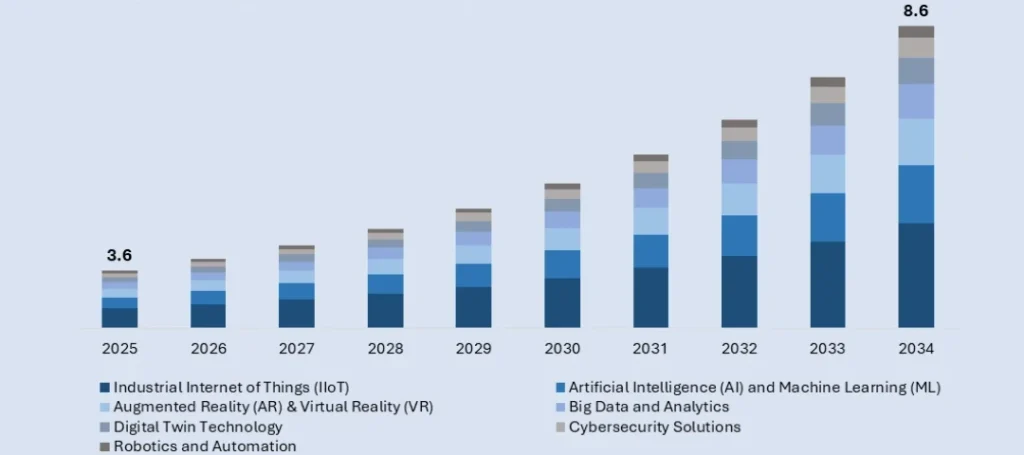
Source: IMARC
Growing market size of smart manufacturing automation during the forecast period 2025 to 2034
Role of Smart Factory Automation in Manufacturing
Automation technologies form the foundational pillars of smart factories that connect people, software, processes, and machinery into a unified network and perform the following functions.
Working
Data Collection
Unique business circumstances and brainstormed structures determine blueprints and adoption of advanced technology in digital transformation for manufacturing from conventional factories into a smarter one. The most important pillar for this evolution is data acquisition from integrated key systems, tools, sensors, floors, and workflows through an adept technology. This consolidated data is used to gather insights on key metrics, such as downtime, waste, return on investment, and operational performance, by adjusting on the fly.
Data Analysis
Historical and real-time gathered information can be merged in smart factories for streamlining procedures and further accurate proposed solutions. High volumes of datasets can be sorted easily through ML-based algorithms and mechanisms. Potential issues across demand forecasts, efficient logistics, and maintenance can be predicted through smart factory solutions like advanced analytical, proactive, and action-oriented insights.
Process Automation
After data acquisition and analysis, these factories utilize AI and ML algorithms to interpret data, act through virtual PLCs, and improve existing processes without any manual aid. Automated processes monitor demand in real-time, compare with historical data, and employ predictive maintenance, reducing downtime and repairs. Existing environments and processes turn scalable, safer, and require less production time.
Self-Optimization
Through continuous data exchange and advanced analytics in lieu of siloed functioning, large, real-time datasets are interpreted by agentic AI solutions to find patterns, assess reliability, guide decision-making, forecast disruptions, and refine their own processes. AI-driven enhancements in integrated manufacturing execution system solutions and tools can correct inefficiencies, surface performance, and trigger required actions to improve production dynamically.
Technologies
Cloud
All gathered and processed unified name space (UNS) data is centrally stored over a cloud data warehouse, which eliminates physical server requirements for continuous data flows. Smart factory solutions like cloud computing through cloud-managed services over a digitalized network abolish physical constraints, connect global warehouses, factories, logistics, and supply chains.
Digital Twin
Smart factories can be used to run risk assessments, test production capacity, and gain insights through high-fidelity digital twins, which are virtualized processes, products, and machines. This technology minimizes time-to-market and increases overall equipment effectiveness (OEE).
IIoT
Sensors and IoT device management assist analog machines in collecting real-time data like temperature, pressure, and equipment performance. They assist in processing datasets and obtaining deeper, impactful insights that can increase manufacturing yields, raise customer satisfaction, lower investments, and can be applied across entire business workflows.
Big Data
Compiling, analyzing, and linking big data from cloud-based ERP system, MES, SCADA, CRM, and other datasets is made simpler using AI/ML algorithms, which earlier required human intervention. AI-generated clear visual reports are effective in obtaining predictive insights and preventative maintenance to optimize existing operational schedules and work demands.
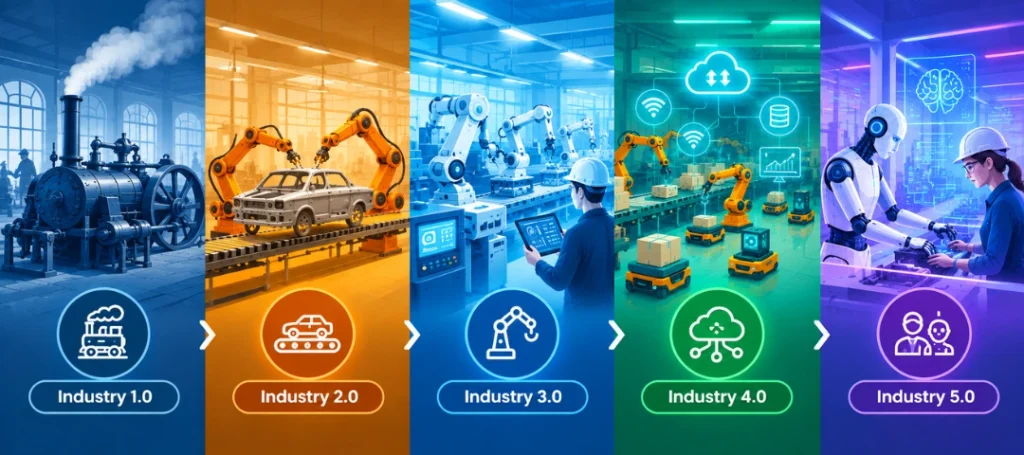
Evolution of smart manufacturing automation from the 1900s to the 2020s
Robotics
Another key part of smart factory automation solutions is robotics via robotics-as-a-service (RaaS), where automated machines, cobots, and arms can perform functions like heavy lifting, welding, assembly, and packaging, sparing unnecessary shop floor and operational expenditure (OpEx).
AI/ML
AI can assist in data-driven decision-making, continuous process improvement, real-time equipment and noise monitoring, potential failure prediction, anomaly detection, and production process optimization. ML analyzes sensor, machine, and production system data, identifies patterns, and optimizes resource utilization.
HMIs
Human-machine interfaces are devices and screens used by shop floor workers and the management to control and monitor automation systems even remotely. HMIs assist in a self-adjusting production environment that minimizes downtime and enhances operational efficiency.
AR/VR
Smart factories produce recommendations to optimize layouts, logistics, and inventory control by analyzing environmental conditions through spatial awareness. Augmented and virtual realities can amplify such capabilities that highlight areas in need of improvement to enhance efficiency and avoid stockouts.
Additive Printing
Automated single step layer-by-layer component or part production from digital design files directly on the factory floor as compared to multistep injection molding. 3D printing allows businesses to reduce waste, respond as per demand, maintain production, and shift to virtual inventory from physical ones.
RPA
Smart factory automation solutions also include robotic process automation that utilizes robotics, AGVs, and software to automate shop floor operations, perform repetitive tasks like material handling, assembly, and others throughout the production line. RPA also supports error-free activities like machine reading logs, stock tracking (RFID), and record updates.
Blockchain
Secure digitized ledger for tracking assets and financial transactions across a network and securing material and machine records. Blockchain can reduce disputes by speeding up audits and through trusted data trails, easy handovers, quality checks, smart contracts, parts traceability, supporting suppliers, and protecting connected assets across multi-tier supply chains and production lines.
Cybersecurity
Robust cybersecurity measures and frameworks like zero-trust principles deployed across connected smart factories can protect sensitive information and critical infrastructure amidst cyber threats and converge information technology (IT) and operational technology (OT).
Architecture of Smart Factory Automation

This detailed end-to-end smart factory architecture diagram showcases data flow from machines to analytics. The high-level architecture of smart factories involves IioT sensors and machines at the front that capture real-time operational data. Edge gateways and PLCs provide local control, protocol conversion, while MES and SCADA are used for production monitoring, quality tracking, and execution control. Cloud platforms function as centralized integration and storage, and showcase enterprise-wide visibility. AI/ML-based analytics enable predictive maintenance, detection of anomalies, and optimize processes., while ERP and business systems utilize insights for informed decision-making and planning.
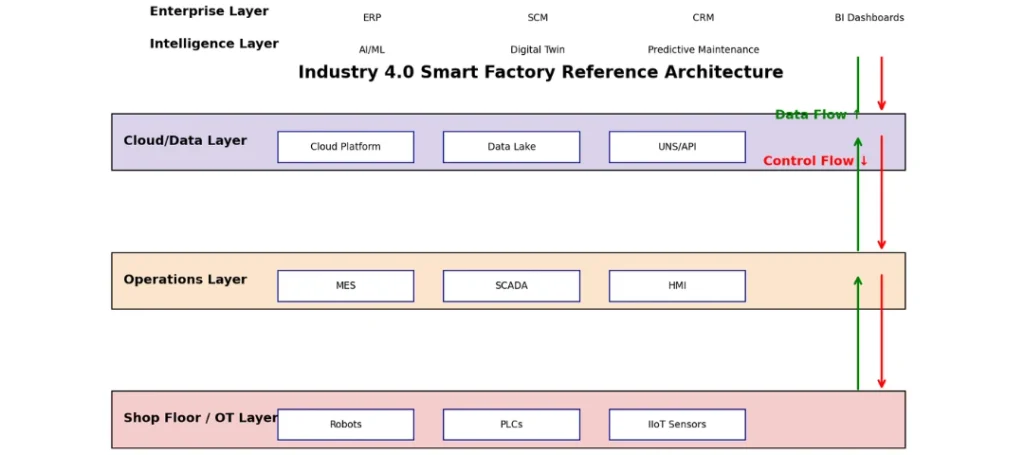
Architectural layers of enterprise smart manufacturing automation
This layered architecture is an illustration of the working of operational technology (OT) on the factory floor which integrates with various cloud platforms, manufacturing systems, enterprise business apps, and AI-enabled intelligence. It highlights how real-time production data flows in the upward direction for analysis as optimization control commands and decisions flow in the downward direction. This overall data flow improves the reliability, quality, and efficiency of manufacturing processes. The following is the layer-by-layer explanation of the diagram.
- OT Layer: The shop floor or the OT layer consists of production equipment, IIoT sensors, robots, PLCs, CNC machines, etc., that generate operational data in real-time.
- Operations Layer: HMI platforms, MES, and SCADA can perform production monitoring, workflow management, quality assurance, and provide visibility into operations.
- Data Layer: The cloud or data layer unifies data models, lakes, APIs, and cloud storage so as to centralize information from multiple sources, systems, and plants.
- Intelligence Layer: Digital twins, advanced analytics, and AI/ML models can deliver detection of anomalies, predictive maintenance, and process optimization.
- Enterprise Layer: This layer includes executive dashboards, CRM, SCM, and ERP that can convert insights from the factory into strategic actions, planning, and business decisions.
Applications of Smart Factory Solutions
Pharmaceuticals
Smart factories with IoMT ensure warehouse logistics and regulatory compliance in every step of medicine production with strictness and accuracy, for example, in Pfizer and Moderna manufacturing plants.
Electronics
Micro-level precision with highly automated fabrications ensured in the manufacturing, pick, and placement of tiny parts of smartphones, laptops, and more without any errors, like in Intel and TSMC setups.
Automotive
Smart sensors attached to robots improve CNC machine tending, material handling, durability, and safety with accurate part fitting, assembling, and welding, such as in Toyota and BMW factories.
Food & Beverages
Smart manufacturing automation and AI in food industry ensure that quality and hygiene standards and freshness of consumer products are maintained at all times through autonomous mobile robots (AMRs) and automated quality checks, packaging, and labeling.
Oil & Gas
Automated drone-based surveillance and AI/ML technology for predictive maintenance solutions as compared to legacy systems for overcoming hazardous issues, such as in Shell and Schlumberger.
Energy
AI-based smart grid optimization, blockchain energy trading, and IoT in energy for smart factory operations against aging infrastructure, for example, in ABB and Schneider Electric.
Aerospace
3D printing, digital twins, and integrated gigafactory casting are utilized in this sector while following stringent safety regulations and certifications, like in the case of Boeing and Airbus.
Chemicals
This industry has seen a rise in IoT development services for monitoring and AI-driven process optimization across hazardous environments and operational conditions.
Benefits of Smart Factory Automation
A connected smart factory solution performs predictive maintenance and fosters sustainability with smart hybrid inverter and green manufacturing practices, energy efficiency, and human-machine collaboration. There are various other advantages to deploying them, such as the following.
- Flexibility: Easy design switching from one product to others for market demand competitiveness.
- Safety: Hazardous and heavy jobs can be done through machinery and robots to reduce accidents.
- Productivity: Continuous and sped-up processes with consistent output quality minus the breaks.
- Quality Control: Error, anomaly, and AI defect detection in real-time using sensors to reduce wastage.
- Lower Expenses: Cost-efficacy and savings around labor, energy waste, and downtime in the long run.
- Affordability: Industry 4.0 technologies are made affordable and available for various factory benefits.
- Efficiency: Predictive analytics for responsive, and proactive approach against underlying inefficiencies.
- Sustainability: Low carbon footprints and utility usage to develop plans as per regulatory requirements.
- Customer Satisfaction: Identify new trends in customer experience, preferences, and expectations.
- Visibility: Team collab, speed to value, and workplace safety through digital twins, AR, and VR.
Smart Factory Transformation with KritiKal
KritiKal Solutions can identify key areas of concern in existing manufacturing setups including supply chain events, downtime situations, production inefficiencies, and inventory stock issues. We can devise strategies and assist in adopting advanced technologies that can resolve core business issues. Our team of experts can formulate methods to enhance connectivity and digitize equipment (such as isolated barcode scanners and cameras) and business processes through IT-based sensors.
They can integrate modern smart factory technology with legacy connected systems via cloud computing and other sophisticated tools to showcase process or floor overview. After assessing capabilities, operational gaps, bottlenecks, outdated tools, and needs through comprehensive audits of assets, data, software, and processes, we can identify domains for upfront modernization via cloud migration solutions. On integrating AI, automation, and analytics, small-scale projects can be established with controlled deployments for employees to adapt and then tracked and refined as per KPIs.
Our solutions also include advanced big data analytics to obtain predictive and prescriptive insights, such as alerts for factory floor machine repair. We use action-oriented data for workflow optimization and efficient supply chains, inventory, and schedules. We can re-evaluate step-by-step processes for continuous improvement, smart factory automation, and optimization. This synergy of steel, thought, and code allows robots to lift, measure, assemble, and map productivity pathways that were once invisible. Efficiency soars, factories hum with intelligence, and errors fade away with monitors and machines ready to meet the demands of tomorrow, yet humans shape the final design. Please connect at sales@kritikalsolutions.com to learn more about our products, platforms, services, and lean solutions for your business requirements.

Praveena JS currently works as a Senior Embedded Engineer at KritiKal Solutions. He is proficiently skilled in RTOS, Simulink, SSIT, HSIT, MATLAB, SCADE, Embedded C, V&V, and more. With his ability to work efficiently in teams and more than 6 years of working with software development, he has assisted KritiKal in delivering various projects to some major clients