

 Global
  United States

A Brief on IoT in Energy Sector
Amidst the energy revolution, the future is undeniably to be driven by renewable energy sources. Given their astronomical adoption rate, it would be an understatement to not label them as the new, viable, primary forms of energy generation. Not only do they overcome the limitation of non-replenishing natural resources but also save our ozone layer, ecosystems, and the overall environment from harmful emissions, carbon footprints, and other rising climate concerns. Technologies like Internet of Things (IoT) services are rising as a transformative force to generate, distribute, transmit, and utilize the various modalities of clean energy.
IoT in energy is a network of various sensors, smart devices, and other physical objects that stay interconnected to each other to gather, pass, and analyze collected data. It lies at the forefront of renewable energy resources, and therefore, incorporating optimized and digitalized smart energy solutions has become necessary. IoT devices, such as those deployed in IoT-based parking management system, can remotely oversee, manage, and automate specific functionalities of energy equipment, assets, and utilities in real-time.
Cloud IoT solutions can ensure seamless communication between system components, predictive maintenance, optimized generation, minimized wastage, and downtime. It enables lower operational costs and workflow efficiency, business productivity, reduced load and dependency on declining fossil fuels, and enhanced safety and control for the operators. These devices facilitate cohesive and unified energy flow by integrating multiple sustainable sources like wind, solar, geothermal, motion, and hydropower.
The current global market for IoT in renewable energy is estimated to be around US $67.2 billion as of 2023 and is expected to surge and reach an approximate value of US $113.69 billion by 2030, increasing at a CAGR of 7.8% during this forecast period. In this blog, we will explore how new technologies like IoT are helping in embracing the unprecedented adaptation towards renewable energy resources, advanced applications developed hereto for a cleaner, sustainable, and smarter future, and the challenges that pose a limitation to this adoption.
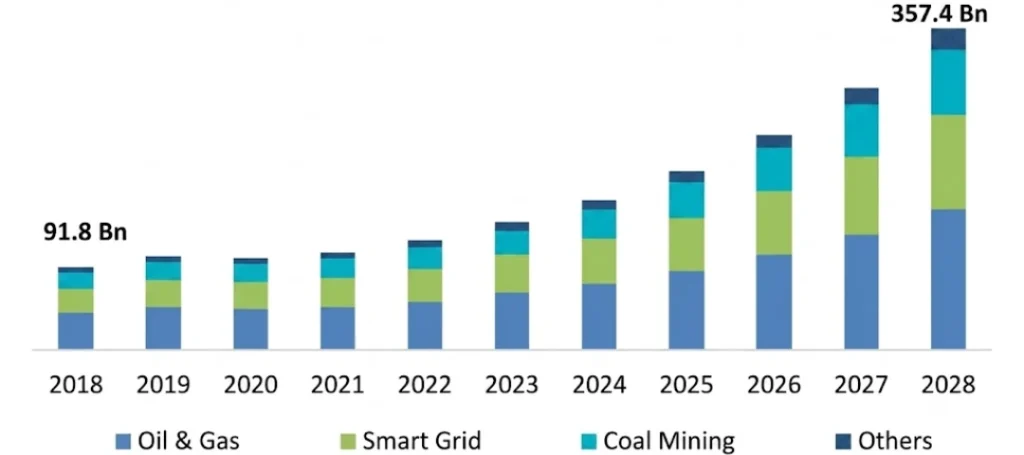
Source: KBV Research
Growing market size of IoT applications in smart energy during the forecast period 2018 to 2028
Components of IoT in Renewable Energy
IoT is primarily of five types, which are Industrial Internet of Things (IIoT), Internet of Medical Things (IoMT), Consumer Internet of Things (CIoT), Infrastructure Internet of Things, and Commercial Internet of Things, each of which is related to industrial electronics manufacturing services, medical, consumer electronic product development, infrastructure like factories, and retail domains, respectively. There are various components to forming these IoT networks, such as the following.
- Actuators: These devices convert a form of clean energy into action patterns like rational, linear, and oscillatory movements to communicate to other nearby devices. They control actions based on demands, for example, circuit breakers, motorized valves, relays, and switches.
- Networks: In a given environment consisting of IoT applications in smart energy, IoT gateways (connect local devices to cloud, like edge or IIoT gateways) are connected to sensors via wireless systems to accomplish comprehensive communication from hard-to-access renewable energy plants. Communication networks like Zigbee, Wi-Fi, NB-IoT, 5G, LoRaWAN, Ethernet, and Bluetooth enable data transmission between devices.
- Sensors: These devices collect real-time environmental data, including irradiance, humidity, pressure, temperature, voltage, current, wind speed, vibration, etc. to generate, route, and allocate clean energy in a load-optimized manner.
- Controllers: These IoT devices, including PLCs, Arduino, Raspberry Pi, ESP32, etc., process sensor data and control equipment. Cybersecurity mechanisms like authentication, firewalls, encryption, and intrusion detection protect IoT devices and overall communication.
- Platforms: Cloud computing platforms like databases developed through cloud engineering services store, process, and analyze data, while edge computing platforms like edge servers and embedded processors perform local data processing for low latency. AI-powered analytical platforms that use predictive analytics, ML, and forecasting algorithms to optimize energy production and predict faults. The user interface of mobile apps, web dashboards, and control panels in applications of AI and IoT in renewable energy domain enables users to monitor and control systems.
- Infrastructure: Smart grids in smart substations integrate renewable energy with power plants for distributive automation.
- Systems:Energy Management Systems (EMS) like Home EMS (HEMS), Microgrid EMS, and Building EMS (BEMS) monitor andoptimize energy generation and consumption. Energy Storage Systems (ESS) like battery management systems and Li-ion batteries, store excess renewable energy. A Supervisory Control and Data Acquisition (SCADA) system includes monitoring dashboards and remote-control systems to supervise and control energy plants.
IoT Applications in Renewable Energy Domain
To give a gist of the various applications of this advanced technology, one can highlight the use of IoT sensors in detecting repair issues and optimizing blade angles in windmills like GE’s turbines, which nullifies the chances of expensive failures. IoT enables adjustment of solar panel angles as per current weather information, which maximizes the capture of energy. Moreover, it assists in monitoring water levels; optimizing turbine performance, speed, and position; ensuring safety across ecosystems; and enhancing efficiency, output, and remote management in hydropower plants. In this section, we will explore further how IoT transforms the renewable energy resource landscape.
Automation
Driven by a reduction in the costs of technological advancements globally, commercial, residential, and industrial renewable energy generation has increased rapidly; for instance, IoT applications can combine multiple energy production techniques for reliable output. To cite an example of IoT applications in energy, they can do so through remotely deployed dual-axis trackers over solar panels for maximal radiation intake and, together with sensor-based pertinent parametric tracking of windmills, for pre-defined electricity generation.
Distribution
Smart energy grids, including the small and principal generators scattered within, are at expansion due to a surge in commercial and residential power demand. IoT application development services and smart sensors ease the load of controlling and monitoring these large numbers. Through strategic placement, these can swiftly collect information between the transmission and production lines in real-time, thus reducing the expenses and balancing the distributed power systems more efficiently. Although sunlight and wind do not work in a continuous manner, IIoT balances this inconsistency of energy production and distribution by tracking radiation, temperature, wind speed, voltage, vibration, etc., to forecast output flow and adjust settings.
Transparency
IoT-powered visualization tools and data analytics platforms like IBM Watson are used to make power usage amendments as per the valuable insights gained. Graphical representations in intuitive dashboards embedded with IoT in renewable energy systems can illustrate usage data with consolidated charts that can be used by utility organizations and households. Data processing solutions and analytics are used to develop trends and patterns of peak load conditions for improving switching techniques. Utility companies reduce power plant functioning during normal off-peak times and vice versa, which also leads to fewer toxic emissions in the ecosphere.
Optimization
Balancing the supply and demand of power within a given timeframe to reduce wastage is made multifold easy with solutions like EMS and IoT-based water quality monitoring system. Vital usage information regarding weather conditions, energy output, and equipment health can be collected to establish improved monitoring and control over power-consuming systems by power suppliers, energy companies, and producers. It is more cost-efficient, reliable, and less time-taking to scrutinize faults, check usage for high-demand intervals, and make informed decisions alongside infrastructure performance than to utilize manual labor.
Smart Meters
IoT-enabled smart meters can connect to the internet, automatically monitor, generate alerts, and reports for excessive consumption of water, electricity, and gas. These cost-efficient devices can identify related issues, remotely fix them, and reduce the risk of undesired power outages and other unexpected outcomes. They assist in quick power restoration due to less consumption, monitor real-time water allocation and conservation, and thus generate accurate bills without hidden charges. IoT applications in renewable energy can decrease solar station building, management, inspection, troubleshooting, maintenance, downtime, and repair-related expenses and unexpected breakdowns across wind turbines and solar panels through real-time predictive analytics.
Smart Homes
Apart from the initial setup expense, the maintenance and running costs of renewable energy devices, such as thermostats, are negligible as compared to the bills paid to utility companies. Residential communities are becoming more aware day by day of their advantages, such as lowered power wastage and costs due to micro-owned solar panel setups or microgrids like Schneider Electric’s. Addition of IoT and smart sensors to remotely monitor, manage, and control these panels, windows, or roofs alongside accomplishing household demands by simply using web, mobile, or desktop-based applications. Governmental subsidies for using green energy and monetary compensation for discharging excess electricity into smart grids are becoming common.
Smart Grids
Traditional energy grids support distribution of uniform energy through one-way transmission from power plants for monthly billing and do not function properly with variable supply from renewable sources. A solar farm generates and transmits electricity and stores excess amounts in an in-built battery system for overnight usage. The intermittent nature, variation, or inability to generate this specific amount of converted electricity is caused by scenarios like harsh weather conditions, different geographical locations, etc., and thus legacy grids struggle to support the same. IoT applications in energy systems like Siemens smart grid solutions overcome this challenge by allowing manual or automated switching between existing power plants and renewable energy supplies for uninterrupted flow for an overall elevated implementation.
By integrating IoT-based sensors and solutions like Tesla Powerwall for real-time data collection in power substations and smart grid distribution lines, utility companies can gain necessary insights into energy consumption data. Measurement of dynamic usage patterns surpasses the limitations of manual labor and enables better decisive actions around load switching between distribution lines, voltage regulation, and network and IoT device configuration management. Dust build-up, anomalies, shading, debris, and faulty lines can be instantaneously identified, and smart switches can automatically shut down such regions, which further minimizes the risk of low device lifespan, electrocution, wildfires, massive outages, and power overload and simplifies grid management.
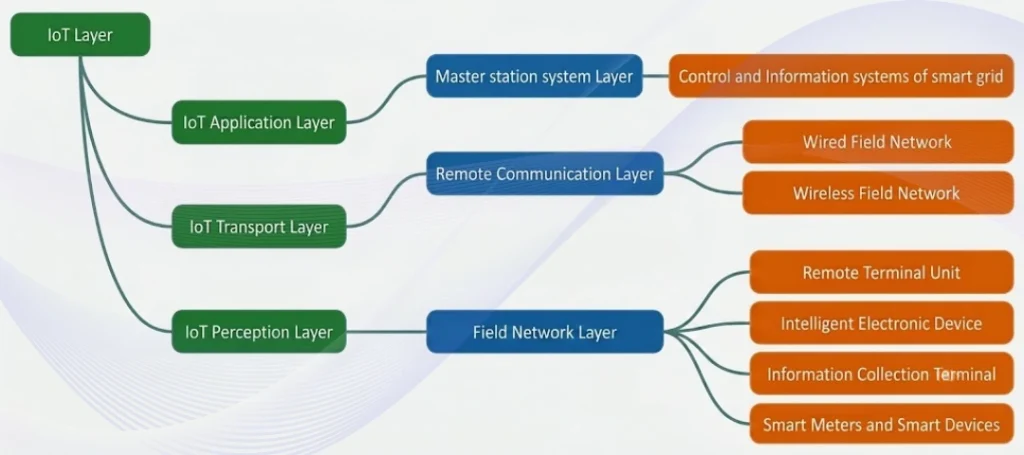
High-level architecture diagram of smart grids – one of the major IoT applications in energy
Challenges of Deploying IoT in Renewable Energy Sector
The Industrial Internet of Things (IoT) forms the control unit of contemporary renewable energy systems that connect solar grids, panels, wind turbines, hydropower energy storage, and other components. It changes the digital transformation game by anticipating failures, ensuring uninterrupted clean energy flows, and optimizing device performance. Although, there still lie some misconceptions and challenges around maximizing output, balancing complex power grids, and making this energy form more reliable and efficient. Here are the main challenges related to the deployment of these systems.
Investment
Generating energy from non-renewable resources like coal, fossil fuels, etc., is a costly affair and affects the environment in a drastic manner through greenhouse gases. But at the same time, setting up solar panels is also an unfamiliarly expensive business with high chances of transmission losses. Most countries are not well-equipped for large-scale cash flows into such resources or smart cities.
Infrastructure
Outdated infrastructure aligned with existing legacy systems that utilize uniform energy flow from non-replenishable resources does not comply with advanced smart meters and grids. The upcoming IoT applications in smart energy should be such that they seamlessly integrate with these systems and provide combinatorial benefits instead of an end-to-end overhaul for modern technology and desired energy targets. Integration of IoT technologies requires niche skills or re-skilling, and insufficiency of the same alongside digitization experience undermines the functioning of organizations in this domain.
Durability
Apart from issues in implementing these systems, there are certain challenges with the durability in the longer run and practicality of IoT-based solutions and their components. All parts of an IoT-built system are required to produce maximum yield and attain their targets in their lifespan, which requires research and development. Rapid consumption of fossil technologies and raw materials for the development of IoT applications in renewable energy, electronics, devices, and production lines may result in their scarcity in the near future.
Sustainability
Vehicle-to-grid (V2G) cyberattacks are becoming common, especially in the US, while there is clear mismanagement due to a lack of necessary information. An increase in e-waste generated from IoT-powered systems, a lack of proper disposal techniques, and timelines pose potential environmental threats in lieu of increasing sustainability and pollution-free energy production.
Towards a Sustainable Future with KritiKal
It is a well-known fact that changing climate concerns and transformative technologies leading the shift away from non-replenishable natural resources like fossil fuels are on the rise. And to tackle this, governments are accelerating the adoption of cleaner energy sources, including wind, geothermal, solar, and hydropower. With applications of AI and IoT in renewable energy sectors, like real-time energy management and infrastructure monitoring, more predictable, reliable, and smarter ecosystems can be formed. These solutions not only improve power generation, resource allocation, asset life and operational efficiency, but also system performance reliability, uptime, and sustainable asset utilization.
The near future is likely to showcase huge investments in renewable energy technology, such as related platforms, sensors, analytics, employee re-skilling, sensors, and cybersecure and transparent communication channels to gain maximum benefits from these sources. Continuous integration and innovative autonomous optimization towards emerging technical advancements like blockchain and IoT across energy assets is a must for proactive decision-making and streamlined and sustainable energy operations at reduced operational costs.
KritiKal Solutions designs and develops various IoT-powered solutions for the renewable energy domain, such as remote asset monitoring and management systems, decentralized energy transactions and marketplaces, smart, resilient energy transmission and distribution solutions, power grid balancing and integration with clean energy, IoT for predictive maintenance applications, EMS connectivity, and disaster response management systems. We have assisted organizations working with IoT in energy domain in supporting informed decisions around grid expansion, energy investments, dynamic changes in energy demand, tailored grid energy management strategizing, photovoltaic (PV) and inverter system integration, policy formulation, energy storage deployment, and more.
We understand that IoT-based technologies in this domain are likely to become more intelligent and capable of meeting global energy requirements with sustainable power generation. Leverage our smart IIoT solutions to render cleaner, more accessible, stable, resilient, efficient, and adaptable energy to your customers. Gain real-time operational insights; connect distributed energy assets; improve overall system efficiency; and automate monitoring and control with our cloud-native, digitally transforming, and industry-agnostic platforms. Please get in touch with us at sales@kritikalsolutions.com to know more about our products, platforms, services and realize your renewable energy business requirements.

Ginni Viyogi currently works as an Embedded Hardware Engineer at KritiKal Solutions. She is proficiently skilled in working with embedded systems, microcontrollers, electronics, hardware designing, engineering, analog circuit designing, VHDL, BOM, CAD, and more. With her ability to work efficiently in teams and more than 6 years of experience working with in this field, she has assisted KritiKal in delivering various projects to some major clients.