


 Global
  United States
What is Image Segmentation?
Computer vision (CV) works in a manner similar to the functioning of human eyes, as it detects, captures, and recognizes previously identified objects that surround us. It instantly visualizes and labels them, and irrespective of their current shape, outlines them precisely using image segmentation. This technique explores computer vision object detection in a premise by segmenting its captured video frame or image into multiple fragments, regions, parts, or segments and labeling each of them. The output is clustered or classified at the pixel level using criteria like texture or colors to understand, analyze, and differentiate the object within its class and frame as per its boundaries and features.
To enable accurate and real-time segmentation and processing of unknown images using computer vision and image processing services, the system is fed with open-source (OS) or manually segmented datasets to train machine learning (ML) models. Machine vision applications powered by this method are being utilized across various industries, including satellite imagery in geospatial science, radiology and tumor detection, agriculture, surveillance, image editing, autonomous vehicles, etc. In the past few decades, different types of segmentation techniques have been developed, ranging from CV to deep learning (DL), and especially with the expansion of deep neural networks (DNNs) and convolutional neural networks (CNNs), their applications have made significant progress.
The current global market for image segmentation is estimated to be around US $155.06 million as of 2026 and is expected to surge and reach an approximate value of US $199.43 million by 2032, increasing at a CAGR of 5.13% during this forecast period. In 2026, the market for DL is approximately valued at US $178.3 billion and is forecasted to rise at a CAGR of 30.1%, reaching a value of around US $1,125.7 billion by 2033. Let us dive into an in-depth discussion on tasks, applications, processes, similarities with CV, forms, and technological advancements developed using this segmentation technique.
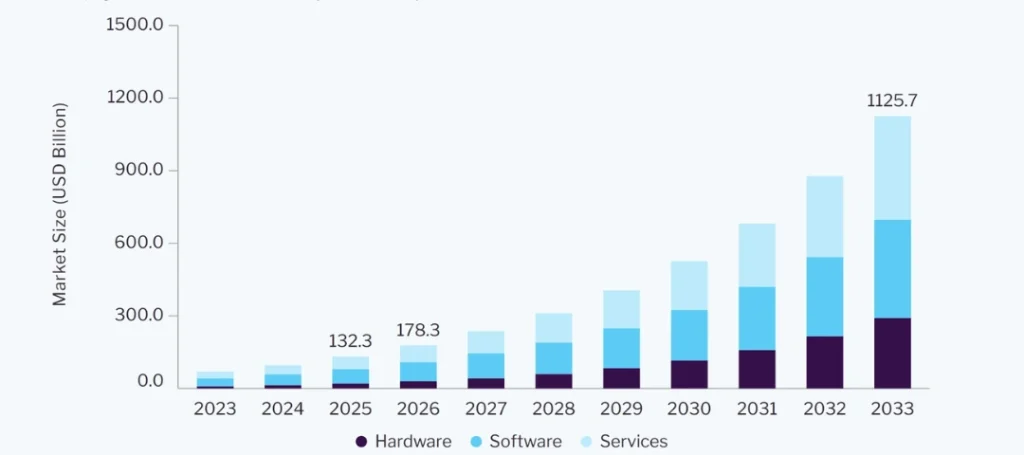
Source: Grand View Research
Growing market size of deep learning image classification during the forecast period 2023 to 2033
Working of Deep Learning Image Classification
Conventional segmentation labels each pixel and its region present in the image belonging to a specific object as 0 to n-1. The segmented areas are represented with different colors and share characteristics like texture, brightness, or color. that are easier to process, although it does not point out similarities between adjacent pixels. Deep learning-based segmentation solves this challenge by highlighting other characteristics like color, shading, shape, size, and combinations of disparate parts.
Conventional methods use neighboring pixel similarities and discontinuity to form clusters and edges respectively which fails when a single object has disparate parts and no pixel-level uniformity due to lack of semantic understanding, for example, it may not recognize both the components’ boundaries or amplitude of a multipurpose screwdriver with blade and handle. It handles a single segmentation condition or threshold, whereas deep learning image classification is used for complex scenes or changing object characteristics simultaneously.
Layers
A classification process-based convolutional neural network consists of a convolutional layer, a pooling layer, or a fully connected layer. The pooling layer fastens the process by performing data generalization and reducing dimensionality. It makes the network less sensitive to a characteristic location in the image, as each cell considers the input from a given array of preceding layer cells. Its most common function is the maximum value in the cell array of inputs, averaging, etc.
The fully connected layer considers inputs from the preceding layers and consists of various cells, each of which has as many weights as the number of preceding layer cells. The number of weights is the product of the number of layers present in the two layers. FC layers are shown as one-dimensional layers, as the output of a classifier is a vector representing classes. Every cell in the layer is associated with weights to every cell in the preceding layer; thus, an FC layer does not have inherent dimensionality.
Arrangement
The various networks configured for applications like complexion classification differ in arrangement and numbers. A DL-based segmentation uses a structure that does not get reduced to an array of discrete outputs. It resembles the classification network in an encoder-decoder arrangement. Here, the decoder starts at smaller layers and resembles a backward classification network that increases to a layer that is the image’s size.
This architecture consists of FC layers that can be an up-sampling layer replacing the encoder pooling layer to increase instead of the resulting size. Otherwise, it can be transposed convolutional layers that increase the output size and the dimensionality. The ‘bridge’ or ‘bottleneck’ forms the connection between the decoder and encoder where details may be lost at the pixel level.
Additionally, the outputs of the encoder layers act as inputs to the decoder layer. The segmentation model encoder is trained as a classifier by using labeled images where the labels identify the objects present in the image. The encoder accurately recognizes object classes for reliable segmentation through continuous learning. The decoder in deep learning image classification model is trained with training images annotated using outlined or shaded object pixels that require segmentation. The error between the labels and outputs forms the feedback for the encoder, and the match between the manually labeled pixels and the encoder’s output pixels forms the decoder’s feedback.
The four pixel counts that determine segmentation quality include true positive (represents pixels belonging to the object and labeled as a part of the object), true negative (pixels belonging to the background and not labeled as part of the object), false positive (pixels not belonging to the object and labeled as part of the object), and false negative (pixels that are part of the object and not labeled as part of the object).
Techniques of Image Segmentation
Classification highlights and confirms if an object is within the image but does not mention if its copies are present and their numbers. Detection pinpoints the object’s location in the image using a bounding box. Segmentation performs both functions, labeling the pixels that belong to the object in the image, and therefore, forming segments of the image eases embedded image processing. The output regions or pixels are presented as different colors and labeled with a value from 0 to n-1. Given below are the common techniques used in this type of segmentation.
Edge Detection
Edge detection-based segmentation involves Laplacian edge detectors, the Sobel algorithm, etc., which can identify sudden alterations in the intensity or discontinuation in the image. It detects image edges between different regions that represent boundaries but struggles with noisy or smooth regions. Common models include Sobel, Laplacian of Gaussian (LoG) edge detection, Canny, etc., and are used across feature recognition, contour extraction, OpenCV face recognition, and shape detection applications.
Watershed
In this type of image segmentation technique, the watershed lines or boundaries are identified as per connectivity and pixel intensity. The image is treated as a topographic relief from flooding, an image from its minima, where the height of the terrain is represented by its intensity.
Region Growing
This technique is useful for handling noise in the image, as it is segmented or divided into smaller regions and iteratively merged as per predefined attributes like texture, intensity, and color. It starts from a seed point, adds neighboring pixels with similar features, and grows the region. It is used across scene segmentation, medical imaging, and region analysis applications.
Thresholding
In this type of instance segmentation, a threshold value is selected, and as per the intensity values, the image pixels between the background and the foreground are classified in binary format. That is, all pixels with intensity levels below or above the threshold are allocated to distinct regions. It is used across basic object detection, classification and tracking, and document scanning applications.
Clustering
Gaussian model, K-means model, etc., can group object pixels present in an image into specific clusters that are grouped as per the similarity in their features, such as texture, intensity, color, and others. It finds applications in feature extraction, color-based segmentation, and image simplification applications.
Graph
Graph-based semantic segmentation works on the basis of graph theory principles where the image is represented and partitioned as a graph.
Histograms
Histograms can plot the frequency and infer the background and other pixel values, isolate object pixels, and define thresholds.
Active Contour
These are curves or snakes that deform to locate an object’s boundary within an image. They are controlled by an energy function that reduces the distance between boundaries of objects and curves.
Superpixel
Superpixel-based segmentation groups together similar image pixels to form meaningful and larger regions, also called superpixels.
Deep Learning
Techniques, such as DNNs, CNNs, etc., provide accurate image segmentation and processing solutions by using a hierarchical approach. The input image undergoes multiple layers of filters and extracts high-level features.
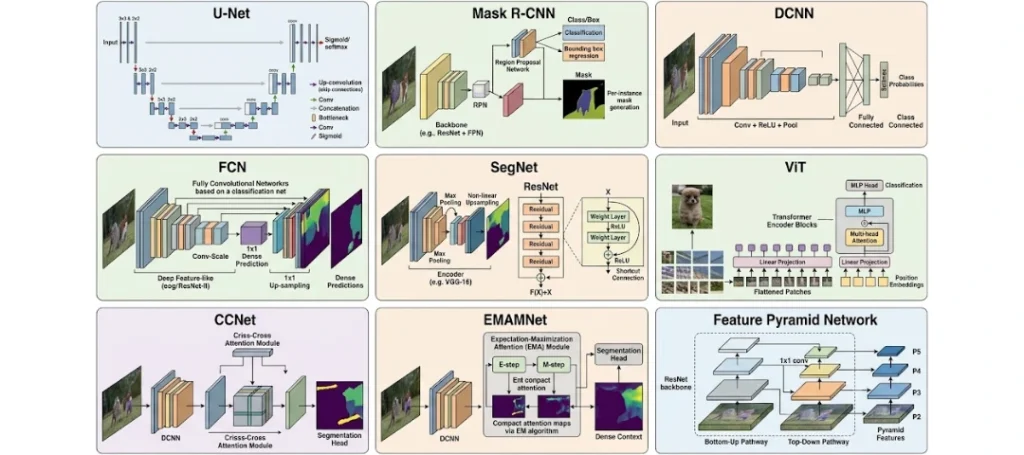
High-level DL-based architectures for semantic segmentation and instance segmentation
Types of Image Segmentation
In the classic segmentation process, the connected pixel regions with common characteristics like color, texture, or brightness are found. Although, at the pixel level, it can be challenging to define similarities between adjacently placed regions. DL-based segmentation handles combinations of disparate parts, and variations in shape, color, shade, and size by segmenting learned objects. Thus, by exhibiting additional features to conventional image processing operations, it becomes preferable to traditional methods. Here are the different types of segmentation types that can be applied to images and video frames.
Panoptic Segmentation
In this type of method, visual pixels of the entire object are identified, grouped, and labeled using a segmentation mask by data engineering services that is created, which is basically the label of all the pixels present in the image. Being a combination of semantic segmentation and instance segmentation, the image in its entirety is class-labeled, and each pixel from different instances is assigned a different value even if they belong to the same category.
It is used in autonomous vehicles for image mosaicing, analysis, and 360-degree surrounding views, as it combines broad categories and detailed object boundaries at the same time. For example, during road sign recognition, scene and traffic analysis, semantic methods would label vehicles and pedestrians, while the instance segmenting component will outline their locations as well.
Semantic Segmentation
In this method, a segmentation mask represents completely labeled images in the ongoing task. This step highlights that all the pixels in the image belonging to the same or different instances are categorized with specific class labels according to shared characteristics. A single segment represents all the pixels within the same category.
That is, if four pixels are categorized as “traffic sign”, the segmentation mask pixel values, texture, shape, and colors are likely to be the same for all four of them, separating them from the road background and other objects. Individual objects are not distinguished; rather all pixels categorized into the same class are marked as identical. That is, if an image consists of multiple trees, all the pixels that correspond to any tree are labelled as “tree” irrespective of the number of trees appearing in the image.
Instance Segmentation
Objects are detected in the image with their respective boundaries, and each new object within the same category is labeled as a separate instance. For example, “pedestrians form a category”, but identify as varying instances due to individual characteristics like gender, height, race, age, etc. That is, each of the pedestrians will be represented as different entities with differentiated colors, despite all of them being under the same label.
In comparison to this, semantic methods only distinguish between the category and the background and identify the exact shape of every instance present in the image. Instance segmentation accounts for the various types of objects of the same class and color of each pixel during the segmentation process. This approach recognizes a unique instance of an object of the same class, whereas semantic methods may not be optimal for precise labeling of plant or animal species, etc., without any discrepancies.
Deep Learning-Based
A DL-based technique with complex segmentation architectures consisting of a decoder and encoder enables speed, accuracy, and high-performing processes. Within the convolutional encoder-decoder architecture, the pooling layer comprises filters that extract parts of the image and produce results with a segmentation mask.
A DL model called U-Net with ‘U’-shaped architecture is composed of up-sampling or contracting paths and down-sampling or expanding paths. It performs faster and accurate segmentation for medical imaging by repurposing the existing feature maps that expand a vector into a fully segmented resulting image. U-Net is majorly used in medical imaging and related applications.
Another efficient DL model known as Mask R-CNN generates instance segmentation masks, and the resulting instances also contain bounding boxes, which allow it to be used for various purposes. Such neural network types consist of two stages, where the first one is the Region Proposal Network (RPN) that proposes regions of interest, and the second one deals with region-based parallel processing where the instance bounding box, binary mask, and classification are sought after.
Google’s DeepLab version 1 uses a Deep Convolutional Neural Network (DCNN), which performs dilated or atrous convolution to control feature response resolution. Its results are passed to Fully Connected Conditional Random Fields (CRFs) to enhance edges of segmented instances. Version 2 is composed of Atrous Spatial Pyramid Pooling (ASPP), which provides input to CRF to segment objects with different scales. DL models can be pre-trained and fine-tuned for Transfer Learning and hybrid approaches.
This method increases overall edge detection and segmentation efficiency, such as in face detection and alignment applications. Version 3 introduces batch normalization, ASPP updates for image features, and removal of CRFs. The network architecture of DeepLabV3+ was improved to a decoder-encoder structure, where the former involves upscaling to recover boundaries. Generative models and adversarial networks are utilized for the generation of invisible object parts, hair loss diagnosis, cells, and medical image segmentation.
Other deep learning image classification models to be considered include Fully Convolutional Network (FCN), where convolutional layers replace dense layers for pixel-wise segmentation of images. SegNet performs accurate object localization and scene understanding by utilizing an encoder-decoder structure. ResNet is a backbone model with residual connections for faster and deeper feature extraction. A vision transformer (ViT) captures image patches and global context for complex segmentation tasks.
Feature pyramid network-based models utilize neural network architecture for multi-scale analysis dynamic multi-scale filter network, gated multi-scale aggregation, salient object segmentation, context-contrasted network, and multi-scale context intertwining. Attention mechanism-based models like Criss-Cross Attention Network (CCNet) and Expectation-Maximization Attention (EMANet) utilize end-to-end semantic segmentation and instance segmentation with recurrent attention, a discriminative feature network, and a point-wise spatial attention network.
Interactive Segmentation
It is a deep learning technique for segmentation where the user provides pixels for segmentation, and the model produces results for input points and segmented instances as per the image. On the basis of each region and multiple segment inputs, the segmented instances can be obtained. An example would be the feature-Backpropagating Refinement Scheme (f-BRS) that utilizes inclusive and exclusive user clicks, for instance, as model training input. Certain parts of the network are updated using auxiliary such that backpropagation is optimized, as does not require going back to input features.
Another example is the Deep Extreme Cut (DEXTR) model that considers the bottom, left-most, top, and right-most pixels as four extreme points to produce point-wise Gaussian. An additional input channel is added based on the total distribution of the Gaussian. Furthermore, Meta’s Segment Anything Model (SAM) has been trained on over a billion masks for accurate predictions even in complex semantic segmentation applications like human thermal imaging, satellite imagery, and medical imaging.
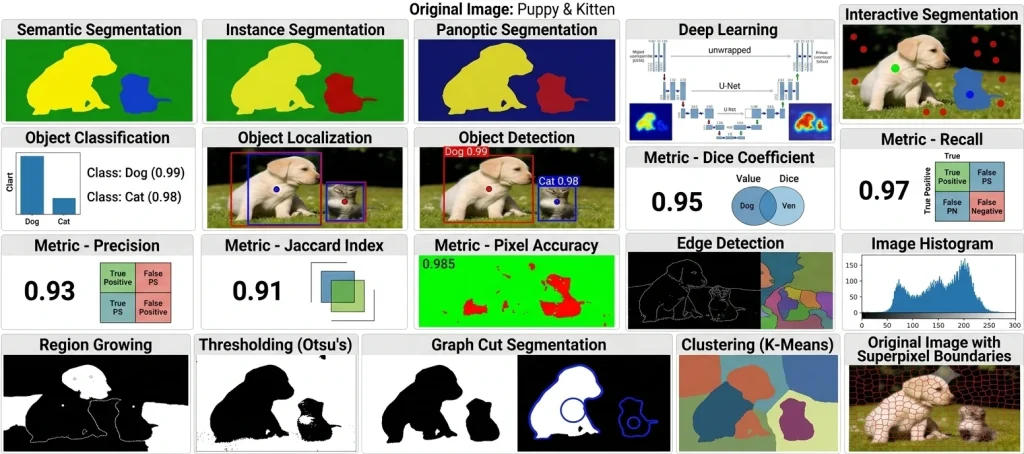
Semantic segmentation and instance segmentation alongside other CV tasks
Comparative Overview of Image Segmentation
Segmentation vs CV Tasks
In the former case, innately different processes, such as image annotation services, classification, detection, and localization, are merged, that is, the latter forms a part of it. In classification, a class is assigned to the main object portrayed in the image. That is, if the main object is a cat, the image is classified as “cat”, although the location of the cat remains unknown.
In localization, the locations of the main subject and all other localized objects are determined, but classes are not assigned to them as it mainly takes the object in the focused frame under consideration. In detection, all objects are detected, labeled, and marked with bounding boxes around their limits. Although this task also comes under segmentation, the background is cut, and only object outline is considered.
To summarize, classification assigns a label to the whole image as per the main object; detection locates multiple objects, and segmentation divides the image from the background into meaningful regions. Classification results in a single category; detection generates bounding boxes around identified objects, and segmentation produces pixel-wise masks.
The classification process is simpler and faster; detection is of moderate complexity, while segmentation is intensive and complex on the computational front. For example, classification labels “cat” in an image, detection bounds cars and pedestrians on the road, and segmentation regionalizes tumors from healthy tissue in an X-ray image.
Instance vs Semantic Segmentation
In the former case, individual objects are partitioned, while in the latter, pixel-level classification of object categories with semantic labels is done. Semantic segmentation conducts in-depth prediction as compared to image classification, where a single label is subjected to the frame or image. Instance-based segmentation extends this scope by delineating and identifying all objects of interest in the image.
Evaluation Metrics
1. Dice Coefficient: The F1 score evaluates similarity between two images in the overlapping areas.
2. Recall & Precision: Assesses true positives versus false detections identified by models.
3. Jaccard Index: Intersection over Union measures actual and predicted overlapping regions as 0 to 1.
4. Pixel Accuracy: The percentage of correctly classified pixels is calculated.
Applications of Image Segmentation
There are various applications of this technique, such as the following.
1. Gesture Recognition: It enables identification and analysis of body parts and their movements.
2. Extended Reality: It can assist in interactions with real-world objects in AR, VR, and XR.
3. Image Editing: It enhances videos and photos and can remove or replace backgrounds.
4. Quality Control: It can identify product defects and anomalies in a manufacturing environment.
5. Object Recognition: It can recognize individual objects for different practical applications.
6. Scene Analysis: Deep learning models can classify objects on or near the road for scene analysis.
7. Agriculture: It can track the ecosystem, environmental changes, growth of crops, land cover, etc.
8. Medtech: It segments organs and identifies potential tumors in MRI, CT, and X-ray scans.
9. Facial Recognition: It enables recognition of the face as per extracted facial features.
10. Surveillance: It recognizes objects in videos and aids in terrain analysis for obstacle detection.
11. Robotics: Remarkable perception, decision-making, and engagement with surrounding environment.
12. Entertainment: Enhanced visual effects, game object detection, and enriched gaming experience.
13. Automotive: Supports behavior analysis, anomaly detection, and comprehending road scene.
14. Retail: Useful for product identification, categorization, store navigation, and virtual clothes try-on.
Conclusion
Today, techniques for segmentation of images face various challenges, such as complex backgrounds with little contrast between objects and their settings; variation in object appearance, like changes in viewpoints and lighting; high computational costs, resources, and processing time; low-quality images, noise, overlapping, partially hidden, difficult to distinguish, or occluded objects that reduce accuracy; high manual annotation efforts; and others.
KritiKal Solutions can be your go-to partner for overcoming the same and deploying industry-agnostic segmentation technology and applications like AI defect detection, traffic control, object classification, tracking, recognition, counting, localization, semantic segmentation, object boundary detection in videos and images, label inspection, construction material detection, precise identification of individual instances of objects, appropriate model selection, pixel-level understanding of images, satellite imagery, industrial imaging and machine vision, agricultural automation, tumor detection, autonomous driving, medical imaging, mimicking human vision perception, robotics, and more.
Our DL-based segmentation models are trained using large annotated and popular datasets like PASCAL VOC, MS COCO, Cityscapes, ADE20K, YouTube-VOS, KITTI, OMG-Seg, SUN, SYNTHIA, LabelMe, Adobe Portrait, Shadow Detection, Barkeley, Semantic Boundaries Dataset (SBD), etc. They can predict segmented boundaries, semantic class of each pixel, patterns, and pixel characteristics like color, intensity, spatial location, and texture for each class; division of image into meaningful regions; simplification of object-based image analysis and preprocessing steps; and isolation of objects of interest using ground truth. Please get in touch with us at sales@kritikalsolutions.com to know more about our vision-based products, platforms, and services and realize your business requirements.

Uzair Ahmad currently works as an AI and Embedded Systems Engineer at KritiKal Solutions. He is proficiently skilled in backend and system design, Spring Boot, Kafka, LLM engineering, edge deployment of quantized AI models for real-time inference, and more. With his ability to work efficiently in teams, algorithmic problem-solving skills, and embedded vision system development, he has assisted KritiKal in delivering various projects to some major clients.