


 Global
  United States
What is Embedded Firmware Development?
Firmware refers to a programmed code located in a hardware device’s non-volatile memory (RAM, ROM, EPROM, flash memory) that enables it to function similarly to a computer operating system (OS). It is basically a low-level software embedded in these devices that can be updated on a regular basis to resolve issues, enhance features, deliver instructions like device start-up, interaction with other devices, critical input/output (I/O) tasks, or improve their compatibility for future technologies.
Here, other devices may refer to cameras, surveillance systems, AI in diagnostic imaging devices, drives, industrial machine vision systems, printers, routers, mobile phones or smartphones, drones, robotic systems, AR devices, satellite imaging systems, PCs, laptops, driverless cars or automotive ADAS platforms, universal remotes, embedded systems and Internet of Things or IoT sensors, etc.
In the context of sophisticated imaging systems, secure and efficient firmware integrated through hardware development services is used across medical imaging, automotive vehicles, inspection solutions in a manufacturing setup, and other domains. For example, firmware connects and indicates the functioning of software and hardware, such as pre-existing lenses and sensors with new image or digital signal processing (ISP or DSP) systems or dedicated imaging System-on-Chip (SoC).
It controls frame buffering or loading and exposure time, image quality, sensor readout, device reliability, and data movement into the processing pipeline. Thus, it becomes important to utilize or develop robust embedded firmware through firmware development services as a business differentiator as compared to a mere backend necessity.
The current global market for imaging systems is estimated to be around US $30.9 billion as of 2026 and is expected to surge and reach an approximate value of US $52.2 billion by 2035, increasing at a CAGR of 6% during this forecast period. While the market for image processing embedded systems was valued at US $21.4 billion in 2025, this value may surge up to US $47.9 billion by 2032, increasing at a CAGR of about 12.2%. Further in this blog, we will delve into the intricacies of firmware and its importance in imaging systems.
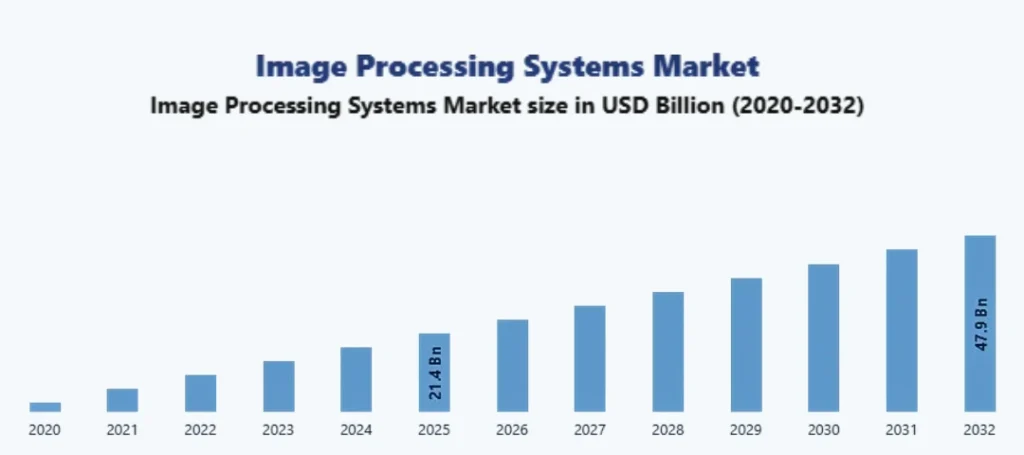
Source: Maximize Market Research
Growing market size of image processing embedded systems during the forecast period 2020 to 2032
Key Concepts of Embedded Vision
Components
The firmware is placed close to the hardware in the imaging system where it manages the memory, sensors, clocks, power rails, peripherals, image capture, and processing. Even a delay of microseconds in its functioning might result in broken images, rolling artifacts, and dropped frames. Imaging functionalities are dependent on the following components.
1. Built-In Control Systems: The firmware performs its operations within the embedded systems that are developed to perform specialized computing tasks, including image capturing and processing. Imaging systems need to ensure real-time processing for smoother video streaming and AI medical diagnostics.
2. Processing Pipelines: These are sequences of operations implemented during embedded systems development at the firmware level that transform captured raw lens and sensor (CMOS or CCD) data into optimized visual outputs. Typical functions include image acquisition, white balancing, denoising, compression, color correction, sharpening, etc.
3. Hardware Abstraction Layers: The firmware uses HALs to form the connectivity interface between software apps (logic and memory subsystems) and hardware components (sensors, device drivers, imaging processors, microcontrollers, and peripheral devices) in the embedded systems. The absence of HALs necessitates direct hardware register manipulation to firmware for respective platforms.
They enable firmware to control data transfer, configure cameras, manage interrupts, optimize processor interactions, and ensure seamless communication without the need for direct hardware-level programming. HALs ease hardware migration, simplify debugging, and promote module software architecture. They allow firmware to support multiple camera modules and processor architectures with no or minimal changes in the code.
They improve development time, maintainability, scalability, and portability by isolating hardware-specific operations with software. They provide standardized APIs for sensor access, memory control, Direct Memory Access (DMA) operations, ISP configuration, General Purpose Input/Output (GPIO) handling, clock management, and interrupt servicing.
Platforms
1. There are several tools and platforms for developing firmware for embedded image processing systems, such as debugging tools (JTAG debuggers and logic analyzers) that recognize and resolve problems at the hardware level and simulation software (MATLAB and Simulink) that help in simulating imaging algorithms prior to implementation.
2. Other than these Integrated Development Environments (IDEs), including Eclipse IDE, Keil Micro Vision, and IAR Embedded Workbench, are useful in debugging, testing, and streamlining codes, while version control systems like Git and SVN facilitate seamless collaboration in firmware-related projects.
3. It is necessary to select the right platform and tools for developing firmware for imaging systems based on considerations like developer expertise, business requirements, and others as follows.
- Operating Environment: Imaging firmware utilizes real-time operating systems (RTOS), such as bare metal systems, FreeRTOS, ZephyrRTOS, ThreadX (Azure RTOS), VxWorks, QNX, TI-RTOS, NuttX, RTEMS, Integrity RTOS, RIOT OS, LiteOS, Contiki-NG, eCos, Mbed OS, etc.
- It performs task scheduling, interrupt priortization, resource synchronization, inter-process communication, timer management, and deterministic execution. The firmware uses RTOS to capture frames without loss, process ISP, perform AI inference, telemetry log, update UI, and predict performance, such as in machine vision applications.
- Compatibility: One needs to ensure that the platform supports hardware, sensors, and processors during embedded systems development.
- Architecture: The most common processor architectures for imaging systems include ARM Cortex (A, M, and R), RISC-V, x86 / x64, MIPS, PowerPC, SPARC, DSP, NVIDIA CUDA GPU, Xtensa, Intel Atom, Apple Silicon, AI Accelerators (TPU, NPU), Heterogeneous Multi-Core, FPGA design-based architectures, etc.
- Development Ecosystem: It is of utmost importance to choose based on community support as well, since platforms with extensive and detailed documentation and active communities proliferate development.
Applications
In the healthcare industry, embedded imaging systems are powered by firmware for accurate image capture and processing, such as in the case of CT scanners, MRI machines, and ultrasound systems. It has been proven to be useful for obtaining high-resolution images through endoscopic cameras. In telemedicine, firmware is an integral part of remote imaging solutions for accurate diagnoses. Also, in the manufacturing context, it can be used for vision inspection system, intelligent video analytics, and human action recognition in a factory setup.
In the transportation and automotive domain, firmware is applied to support features in the Advanced Driver Assistance System (ADAS), such as adaptive cruise control, collision avoidance, lane detection, blind spot monitoring system, surround view camera, etc. It can process raw sensor and imagery data in autonomous driving systems for navigation and decision-making. It is also used in traffic monitoring through vehicle detection system and license plate recognition system.
Role of Firmware in Embedded Vision
A well-designed firmware forms an integral part of the imaging systems and performs the following.
Sensor Initialization & Configuration
An image processing pipeline initiates with sensor configuration, as image sensors contain programmable registers that control resolution, frame rate, analog and digital gain, exposure timing, pixel binning, High Dynamic Range (HDR) modes, color filter array settings, etc.
Firmware communicates with the sensors using protocols like Inter-Integrated Circuit (I2C), Serial Peripheral Interface (SPI), Mobile Internet Protocol Interface (MIPI I3C), and Universal Asynchronous Receiver/Transmitter (UART). It is noteworthy that any defect in the timing of the firmware leads to incorrect register sequencing and corresponding image corruption, dropped frames, and sensor instability.
During boot time, firmware loads register tables, and operational modes are configured thereafter. Some initialization tasks may include Phase-Locked Loop (PLL) clock and MIPI lane configuration, frame synchronization, black-level calibration, temperature compensation, and defect pixel correction in image processing embedded systems.
Image Acquisition Pipeline
A firmware manages the flow of raw pixel data to memory and processing engines from the sensor. The pipeline includes processes such as image capture, buffer allocation, DMA transfer, ISP preprocessing, image enhancement, compression, storage, or transmission.
It efficiently configures DMA engines to move large image frames without causing excessive CPU intervention. RTOS often deal with frame handling, and budget is altered due to latency of even microseconds. Therefore, to avoid this, the firmware looks for cache coherency, circular buffer management, memory alignment, bandwidth optimization, interrupt handling, and frame synchronization.
Image Signal Processors Control
ISPs are blocks within the hardware that specifically perform image processing operations, which may require intensive computations. A firmware is responsible for configuring ISP modules, including demosaicing, noise reduction, auto white balance, gamma and lens shading correction, edge enhancement, tone mapping, HDR fusion, and color space conversion.
To cite an example, it increases denoising strength in low-light conditions, modifies exposure timing during high-motion scenes, and alters gain and fusion parameters in HDR scenes. Adaptive firmware algorithms adjust ISP parameters as per the environmental conditions in a dynamic manner, which leads to continuously optimized image quality in real-time.
Image Processing & Optimization
Accurate imaging results are necessary, especially in the domains of quality control and healthcare. The firmware ensures that the images are captured and processed with high precision to obtain meaningful data. It maximizes the capabilities of the hardware to enable swifter processing of images while reducing consumption of power.
Memory Management
Enormous data streams may be generated by high-resolution embedded image processing; for example, a single 4K (4000 pixels or 4 kilometers) image may exceed several megabytes in size, whereas higher frame rates lead to the processing of gigabyte-sized data per second. This is where optimization of memory operations and bandwidth by the firmware comes in, which includes usage of double buffering, circular buffers, DMA chaining, cache management, zero-copy architectures, scatter-gather DMA, etc.
It also coordinates Double Data Rate (DDR) bandwidth allocation, SRAM usage, cache invalidation, and memory protection regions to avoid memory management issues, such as buffer overflows, frame tearing, spikes in latency, and overall system instability. It assures that efficient memory orchestration takes place at all times in the imaging system, like in-vehicle infotainment systems.
Enablement of Next-Gen Innovations
As firmware architectures are customizable, this allows the development of tailored solutions that can adapt to industry-wise imaging requirements. It also supports adoption of AI-based analysis and predictions, 3D and quantum imaging, edge computing, cloud, ML algorithms for pattern recognition, etc. as per advancements in the future. Moreover, certain trends are already impacting firmware development in terms of extensive automation and enhanced interoperability with an overall focus on sustainability.
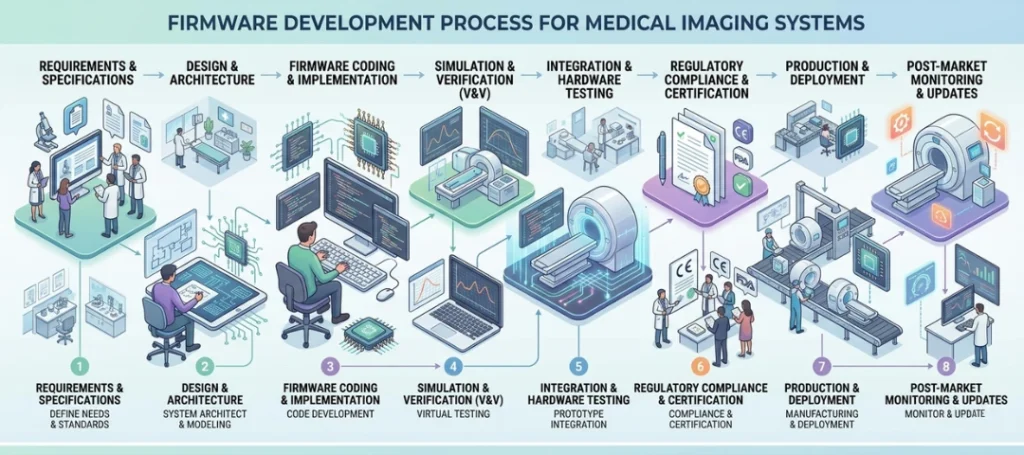
High-level process of embedded firmware development for medical imaging systems
Best Practices of Embedded Systems Development
It is necessary to implement methodologies for effective firmware development, especially in the case of imaging systems, such as the following.
1. Testing: Developers and testers need to implement hardware-in-the-loop (HIL) testing, unit tests, and integration testing strategies for assured reliability against system failures and undetected bugs, especially in the case of medical device design and development.
2. Optimization: Efficient coding practices must be put in place to reduce revisions in embedded image processing and to boost overall system performance, such as in a drone security system.
3. Design: The firmware must feature a reusable modular design that can be broken down into versatile parts for the ease of scaling up and maintenance, post-circuit board design and manufacturing.
4. Records: Maintaining detailed documentation is the key to effortless debugging techniques, such as in automated attendance system and firmware updates in the future.
5. Constraints: One must make sure the firmware is in complete alignment with the hardware for preventing bottlenecks, such as in the use case of AI defect detection.
6. Security: Developers need to consider security vulnerabilities during development to avoid cyber threats in the imaging systems capturing sensitive health-related data or during video surveillance for banks.
7. Control: To avoid loss of progress and code conflicts within the team, proper version control must be executed alongside strategies like medical device testing.
Embedded Firmware Development Decoded
In this blog, we explored the importance of firmware in imaging systems and its various important functions, such as real-time image acquisition, ISP configuration, DMA and memory management, focus and exposure control, power optimization, and much more. It forms the bridge of deterministic interactions between the hardware blocks and strictly maintains and adheres to timing constraints, such as for IoT device configuration management.
However, certain technical hurdles do come in the way of firmware development, including limitations in the processing power and memory of hardware, RTOS for processing demands in real-time, and even integration issues that cause issues in the firmware and hardware communication.
KritiKal Solutions can assist you in building reliable firmware for imaging systems, such as human machine interface development with accelerated hardware platform integration. We conduct thorough testing of all components to avoid any such drawbacks and pitfalls. Our experienced team of developers and testers overcome all security concerns by ensuring encrypted data transmission and storage and secure booting to avoid unauthorized modifications in the firmware. We release regular firmware updates to increase embedded image processing functionality and address vulnerabilities.
Our development practices reduce complexity related to advancements, for example, manufacturing setups involving AI-based label inspection. We assure the developed firmware functions as required, such as in AI accelerator coordination, hardware synchronization, human thermal imaging and monitoring, communication protocol handling, and fault detection and recovery. Please get in touch with us at sales@kritikalsolutions.com to know more about our embedded products, platforms, services, and solutions and realize your business requirements.

Lovejeet Kaur currently works as an Embedded Software Engineer at KritiKal Solutions. She is proficiently skilled in integrating low-level drivers for communication protocols like GPIO, SPI, I2C, UART, USB, PWM, TIMER, CAN, easyGUI, and third–party library (FreeRTOS) integration. With her ability to work efficiently with UART-based displays like Nextion and DWIN, and extensive experience in implementing software designs in C for various platforms like PIC32, ATSAM, ARDUINO, STM32, and more, she has assisted KritiKal in delivering various projects to some major clients.