


 Global
  United States

What is Cloud Computing?
In today’s fast-paced world, the cloud is empowering every functional instance of a workplace, whether in a multinational corporation or a localized startup, right from billing, education and attendance to customer service. It now forms the backbone of data accessibility and automation across modern business operations, service deliveries, and digital appliances. Cloud engineering services, thus, reduce overall expenses related to servers, hardware, and physical infrastructure through pay per use and introducing IT innovation during seasoned scaling. To know how to apply the same, one needs to understand what it refers to.
Cloud-based computing denotes the secure, manageable, cost-efficient, and global storage, backup, and access to data, software, networking capabilities, databases, AI-powered analytics, development tools, and applications used by an organization through the web in lieu of local storage. It allows companies to stay in tune with the latest technological trends, integrate digitally advanced solutions into routine workflows, and adopt new platforms. Transformation through cloud IoT solutions, when recruited as a core pillar, is turning the competitive stance of organizations alongside their on-demand operations and resource utilization. With increasing technical stacks and options to leverage such tools, business objectives turn intentional, and operations become autonomous, leading to real-time outcomes across the business.
The current global market for cloud computing services is estimated to be around US $943.65 billion as of 2025 and is expected to surge and reach an approximate value of US $3,349.61 billion by 2033, increasing at a CAGR of 16% during this forecast period, with majority of the market taken over by giants like Microsoft Azure, Amazon Web Services, and Google Cloud. The shift towards the cloud environment from legacy on- premise infrastructure is due to comparative flexibility, scalability, and benefits of such pricing models. This blog deals with the advantages, challenges, and best practices to deploy cloud computing. It delves into the business landscapes, such as the BFSI sector, that are evolving using the cloud and how this pivotal component can serve to be useful for your company.
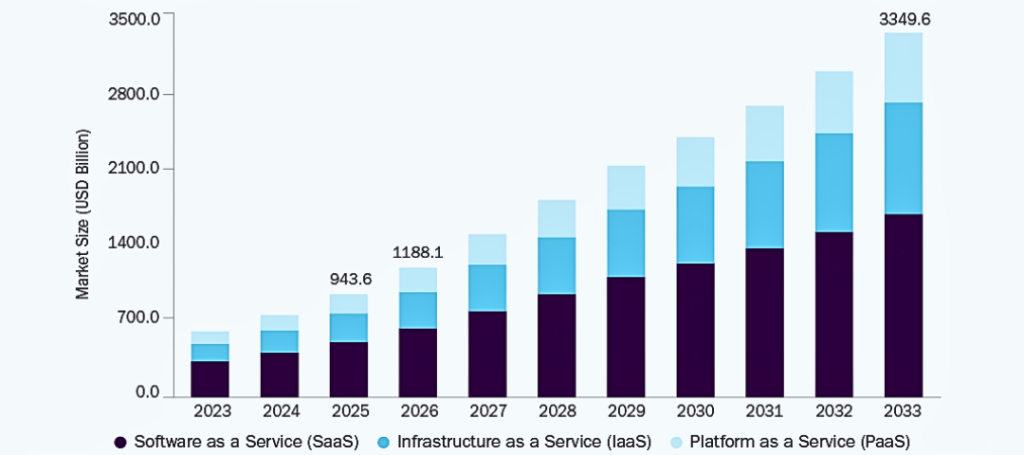
Source: Grand View Research
Growing market size of cloud computing security during the forecast period 2023 to 2033
Impact of Cloud Computing on Business Functions
Computations when processed over the cloud act as a catalyst for business transformation, and in this section, we will go through function-wise benefits of the same.
Information Technology
Many departments, such as IT infrastructure and operations, have shifted from physical servers and networks to virtual ones, cloud-based services, and resources. This eliminates the need for security, upgrades, and maintenance of data centers and on-premise servers and redirects the team’s focus over mission-critical corporate strategies that add value to the business.
Not only are the related costs reduced, but reliable disaster recovery solutions for data loss and outages allow automatic backup of data stored across multiple geolocations. It also paves the way for adaptation and quick responses to evolving market requirements, new application launches, resource scaling, and security implementation, thus enhancing agility and flexibility.
Business Development
Cloud managed services can enhance customer engagement and streamline business operations, such as sales and marketing. Customer Relationship Management (CRM) solutions in the cloud, including Salesforce, HubSpot, Zoho CRM, Freshworks CRM, Pipedrive, Microsoft Dynamics 365, Oracle CRM, SAP CX, etc., allow teams to gain real-time data. Cloud-based tools enable them to handle customer information, manage leads, close business deals, and track interactions, thus driving operational efficiency.
One gains access to marketing analytics for better conversions through such services, as these are useful for strategizing personalized and targeted campaigns, tracking performance, client behavior, and formulating data-driven decisions. Both sales and marketing teams can collaborate in an effective manner for project management, document sharing, and dynamic interactions using cloud computing services irrespective of geographies, leading to improved business outcomes, productivity, and function-wise coordination.
Product Innovation
In the field of research and development, cloud solutions enable an interactive and innovative environment that is scalable in nature. Such platforms assist R&D teams to accelerate development cycles through real-time collaboration and access to cutting-edge digital tools and solutions like AI, ML, IoT, and big data. Cloud also empowers them through continuous integration and delivery pipelines for rapid deployment and testing of apps and features via a pay-as-you-go model rather than upfront investment, fostering a culture of cost-efficient experimental innovation.
Human Resources
HR departments utilize the cloud to improve employee engagement through self-service portals, workforce efficiency or resource utilization, and the recruitment process (candidate screening, applicant tracking, and virtual interviews). They use cloud-based HR systems, such as Workday, SAP SuccessFactors, BambooHR, ADP Workforce Now, Zoho People, Oracle HCM Cloud, etc., to automate HR operations, including payroll and leave management, onboarding, cloud-based attendance system tracking, and administrative workload.
Platforms such as Moodle Cloud, Docebo, TalentLMS, Cornerstone OnDemand, SAP SuccessFactors Learning, Adobe Learning Manager provide options for learning and development to access training material on-demand, tailor training programs and learning paths, and roll out the process globally without any infrastructure limitations.
Financial Operations
Cloud-based ERP system, and finance and accounting software like Xero, QuickBooks Online, FreshBooks, Zoho Books, NetSuite ERP, Sage Intact, Microsoft Dynamics 365, Oracle Fusion Cloud ERP, SAP S4HANA Cloud, etc., make room for transparent and efficient operations, resulting in accurate and timely results. These streamline processes in a secure and compliant manner, including cost, invoice, and payroll management, reduce manual errors and time consumption. Accounting teams also utilize cloud-based tools for report generation in real-time, quick decision-making, budgeting, planning, and forecasting.
Others
Further cloud computing benefits can be observed in the domain of supply chain and logistics inventory management, where the cloud improves end-to-end chain visibility, tracking, and responsiveness across the supply network. Stakeholders gain insights through medical inventory management software on tracks, shipments, and supplier performance to plan and control better. Systems like SAP Integrated Business Planning, Oracle SCM Cloud, Blue Yonder, Infor Nexus, IBM Sterling Supply Chain, etc., fleet management system, improve demand forecasting through cloud analytics, which reduces overstocking, shortages, disruptions, and allows supply chain teams to quickly adapt to delays.
Solutions like cloud-based manufacturing executing system, can also uplift customer support teams to enhance client satisfaction with better response times, different response channels (email and phone) and service quality. All customer interactions and queries are centralized and consolidated from various channels in a unified cloud platform for enhanced tracking, categorizing, prioritizing, and resolution. Few examples include Zendesk, Freshdesk, ServiceNow, Salesforce Service Cloud, Intercom, HubSpot Service Hub, etc.
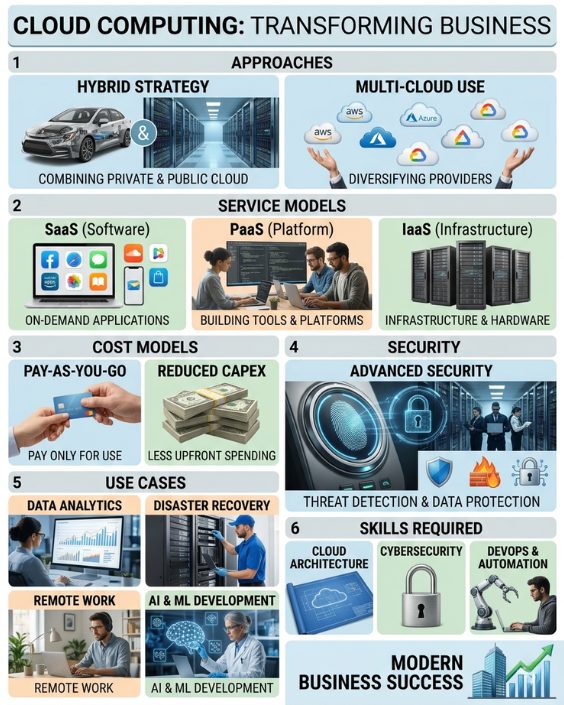
Diagram showcasing use cases, approaches, skills, cost models, and cloud computing security
Cloud Computing Benefits & Best Practices
Benefits
There are various advantages to utilizing cloud-based services in a business, such as the following.
- Availability: Employees can gain access to company data from any location or device across the globe, and such levels of accessibility foster collaboration even for remote and mobile functions.
- Cost Control: As capital expenditures on physical servers and software application maintenance are eliminated, pay-per-use cloud models, spot and reserved instances, and promote variable costs.
- Expandability: Businesses operating in the domains that vary with demand, seasonal fluctuations, and growth benefit from the agility and flexibility related to computing resources offered by the cloud.
- Novelty: Without the need to maintain IT infrastructure, the cloud enables swift experimentation through rapid deployment and testing of ideas, services, and applications, reducing time-to-market.
- Automation: One of the major cloud computing benefits includes workflow, order, ticketing, and approval automation via compliance monitoring, disaster recovery, and backups that consume time and cause errors.
- Security: Secure software engineering includes encryption, center redundancy, security monitoring, multi-factor authentication, intrusion detection, and protection against cyberattack, hardware failure, disasters, or data breach attempts.
Best Practices
Given below are the best practices for integrating cloud services for business transformation.
- Roadmap: Define a clear strategy, goals, risks, well-defined milestones, roadmap, timelines, and steps aligned with business objectives and client needs for extracting benefits from cloud services.
- Model: Select the right cloud deployment model from public, private, hybrid, and multi-cloud and service model from IaaS (computing resources), PaaS (development environment), SaaS (ready-to-use apps), and FaaS (individual functions).Consider cloud computing benefits as per workload and existing applications, which may need cloud migration solutions like refactoring, retirement, re-architecting, replacement, re-hosting, re-platforming, re-building, re-purchasing, or lift-and-shift for optimizations.
- Develop: Developers need to deploy cloud-native apps using AI-augmented software development, CI/CD pipelines, serverless architecture, containers, microservices and integrate with on-premise data stores.
- Monitor: User management software can automate and orchestrate monitoring of cloud-based resources and regular performance through tools and frameworks for visibility, control, optimization, and reliability.
- Governance: Teams need to establish security frameworks and cloud governance that define standards, policies for usage, adoption, data protection, IAM, incident management, compliance, and continuity planning.
Fuel Business Growth with KritiKal’s Cloud Computing Services
We now understand that the cloud refers to remote resources, systems, apps, data, services, etc., available through the internet or web instead of local computer storage, while cloud-based computing is basically the utilization of these resources in order to perform service delivery and computing tasks. These solutions bring in positive transitions by creating grounds for innovation and efficiency.
The paradigm of innovative business operations has been reshaped through a pervasive and continually evolving cloud revolution, leading to optimized workloads, consolidated data platforms, and cloud application modernization right from giant enterprises to local startups.
Partner with KritiKal Solutions to overcome day-to-day concerns over cloud computing security (vulnerability risks, data breaches, and misconfigurations); data privacy (remote servers, limited handling, and compliance); unpredictable costs (overprovisioning, unused resources, storage, usage, and data transfer); integration complexity (legacy systems, differences in APIs systems, and lack of expertise); multi-cloud complexity (operations, billing systems, tools, and APIs); and data migration (data loss, downtime, complexity, time consumption, and expenses).
We utilize strong encryption, access controls, cost management tools (AWS Cost Explorer and Azure Cost Management), integration strategy (middleware, APIs, and testing), migration strategy (re-platforming, lift-and-shift, backup, test migrations, and rollback plans), cloud management platforms (unified control, governance policies, and standardized environment processes), MFA, auto-scaling, contingency plans and conduct resource optimization; regular audits; spend governance, and compliance monitoring (GDPR, HIPAA, etc.) of our deployed solutions. Please get in touch with us at sales@kritikalsolutions.com to know more about our cloud and software-based products, platforms, services, and realize your business requirements.

Charan Sai Putta currently works as a Software Engineer at KritiKal Solutions. He is proficiently skilled in PyTorch, OpenCV, DL, LLMs, NLP, NumPy, Pandas, Git, and more. With his ability to work efficiently in teams and an enthusiastic approach towards solving real-world CV problems, he has assisted KritiKal in delivering various projects to some major clients.