

 Global
  United States
Introduction: AI in Consumer Electronics
As we are aware, there has been a tremendous rise in the production of consumer electronics in recent years. This remarkable proliferation, right from smart speakers to phones and home devices, can be accounted for by advancements in technologies. The breakthrough revolves around innovations in electronics manufacturing services that have become integral to our day-to-day experiences like machine learning (ML) and artificial intelligence (AI). These technologies not only reshape electronic functioning but also improve user device interactions, capabilities, and usage.
The expansion of smart electronic devices is characterized by the growing number of networked and internet-connected devices that communicate with centralized bases and each other. The overall impact of AI/ML has been transformative and profound, rendering connected consumer electronics smarter, upgraded, user-centric, and proactive. Businesses can look forward to the introduction of even more sophisticated tech in the future that would keep pace with this revolution through consumer electronic product development.
The process involves embedding ML models and AI processors like DSPs, NPUs, and TPUs into firmware or hardware through firmware development services for local data processing instead of cloud servers for better privacy and response time. The current global market of AI/ML integration in consumer electronics is estimated to be around ₹709.3 billion as of 2025 and is expected to surge and reach an approximate value of ₹5.48 trillion by 2035, increasing at a CAGR of 22.7% during this forecast period. Let us now go through the techniques, importance, and benefits of AI development services and ML integration in consumer appliances further in this blog.
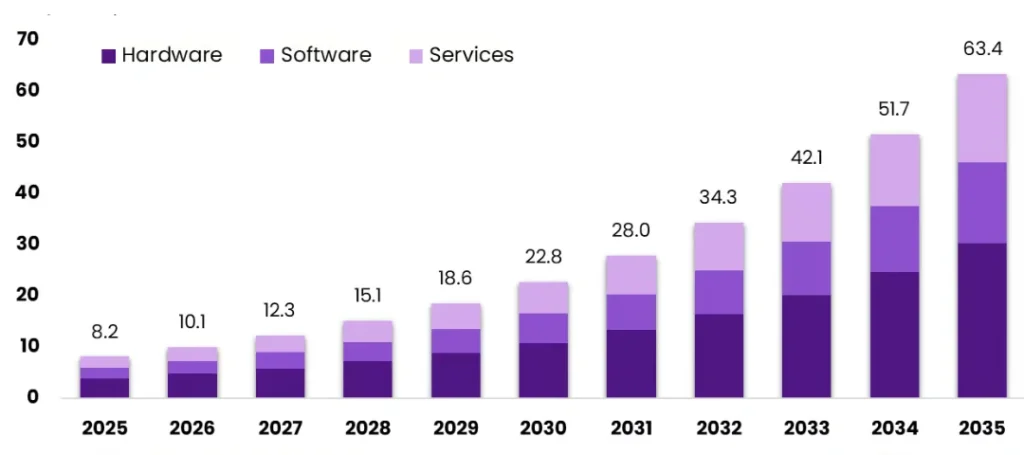
Source: market.us
Growing market size of smart consumer electronics during the forecast period 2026 to 2035
The Role of AI in Consumer Electronics
The following are some instances where AI model deployment has made consumer appliances smarter.
Connected Homes
A major impact of AI-powered electronics is visible in smart homes through automated devices, such as kitchen appliances, thermostats, security cameras, and lighting systems. All such home appliances can be controlled through voice commands and mobile applications. These appliances increase convenience, comfort, energy efficiency, and security. AI-enabled robotic mops and vacuum cleaners navigate while avoiding obstacles and identifying the most efficient cleaning routes. By using Simultaneous Localization and Mapping (SLAM), they provide better sanitation outcomes by improving operational time and mapping out spaces by using sensors and AI algorithms.
Health Monitoring
Wearable wellness monitoring and connected consumer electronics like smartwatches and fitness trackers offer Internet of Things (IoT) and AI-powered features, including a round-the-clock heart rate monitor, sleep and movement tracker, skin response and breathing pattern recorder, and step counter. Medical databases synchronized with advanced preventive health monitoring through hardware development services can provide immediate and personalized alerts to users and valuable data to healthcare providers for health issues, anomalies, vital signs, and recovery progress.
Retail Automation
Connected devices like smart refrigerators can automate tasks like tracking expiration dates, ordering groceries during shortages, suggesting recipes as per ingredients, etc. AI-based personal assistants can streamline information management and streamline activities as per learned user preferences. These algorithms also help in demand forecasting to anticipate changes as per market trends, sales data, external factors, and device strategies for delays, production schedules, and inventory management.
Entertainment & Gaming
Smart consumer electronics like smart televisions, smart speakers, and streaming devices can transform entertainment by user experience personalization. They take note of viewing history and adjust the music view playlist as per the household’s or individual’s taste. AI supports engaging, realistic, and immersive gaming scenes, landscapes, and quick character responses as per player’s inputs in real-time.
Manufacturing Quality
Quality control and industrial and product design services for electronics can be improved multifold when ML models analyze testing and production big data. This helps manufacturers to pinpoint defects, faults, pattern anomalies, optimize layouts, and product consistency faster as compared to manual testing methods. AI ensures precision and repeatability in electronics manufacturing, PCB inspection, and design, while avoiding the occurrence of expensive redesigns.
Key Aspects of AI in Consumer Electronics
Electronic devices can be made smart by customizing them according to user interactions, needs, and efficiency. The following are some of the common features that AI/ML integration in devices leads to.
Facial Recognition
Home appliances, smartphones, and security cameras are incorporated with face and image recognition that relies on technologies like computer vision (CV) developed through indigenous technology services. CV is useful in training devices to interpret the visual world and is applied to mobile phones for secure authentication and home security cameras to alert owners about anomalous occurrences.
Digital Voice Assistance
Voice assistants like Apple Siri, Google Assistant, and Amazon Alexa utilize ML and natural language processing (NLP) to respond to commands. Users can benefit from hands-free smart home device control, reminder setting, informational search, and more. They interpret user queries, engage in responses or conversations, and execute actions; for example, AI in consumer electronics can help in providing language commands to smart speakers like Amazon Echo and Google Home.
Recommendation Engine
Nowadays, AI models allow smart televisions, refrigerators, and music streaming devices to suggest movies, shows, and playlists. These recommendation systems suggest apt products and content as per the user’s browsing history, preferences, and habits.
Energy Management
AI/ML-powered consumer electronics, smart meters, and energy efficiency management systems can analyze environmental conditions and usage patterns to adjust settings of modern appliances like washing machines, air conditioners, and HVAC systems as per weather, occupancy, air quality, thermal conditions, etc. This saves energy consumption, maximizes performance, and optimizes operations of appliances for higher efficiency, lower environmental impact and bills.
Smart Texting
Tablets, smartphones and foldable smartphones, laptops, phablets, desktop computers, mini personal computers, smart televisions, smartwatches, wearable technology design, e-readers, convertibles, Chrome and Ultrabooks, handheld gaming devices, portable media players, AR/VR headsets, smart displays, rugged mobile devices, thin clients, etc., can be enhanced with AI. It incorporates predictive text or smart typing features in these devices with spell checks and suggestions for better accuracy, communication, and speed.
Automated Imaging
ML algorithms allow smartphones to capture images as clear as professional cameras, while AI optimizes low-lighting images through automatic modifications in settings and complex filters like color saturation. Smart gadgets identify, recognize, and enhance objects captured in the frame in real-time to generate colorful images per shot.
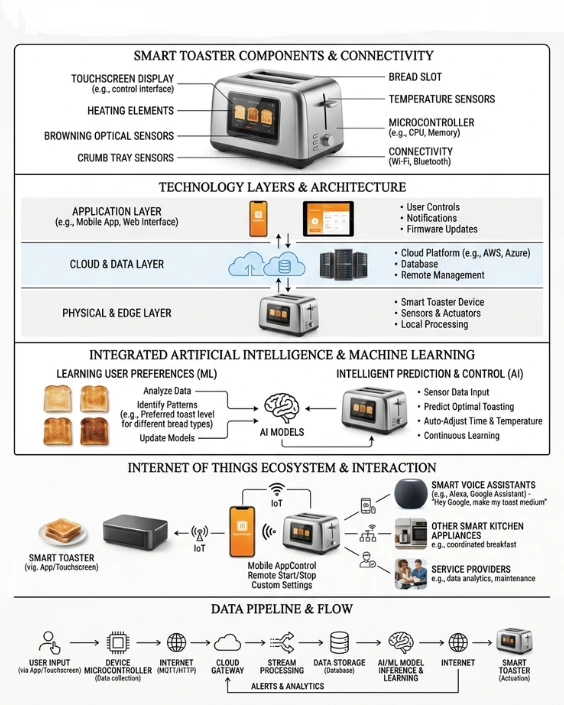
High-level architecture diagram of working of smart consumer electronics
Advantages of Integrating AI in Consumer Electronics
In this section, we will explore how integration of AI and ML enhances the capabilities, user interactions, and operations of electronic devices.
Optimized Performance
With AI/ML models controlling the functioning of smart devices, energy consumption can be minimized. For example, AI-driven thermostats can analyze user preferences, weather conditions, room temperature, and historical usage data to regulate cooling and heating cycles.
Better Connectivity
Smart home devices like smart appliances, home assistants, smartwatches, etc., can communicate and connect with each other over the internet. This interconnectivity enables seamless data sharing, inter-device synchronization, efficiency, and convenience.
User-Friendly UI/UX
AI, ML, CV, and NLP assist smart consumer electronics like voice assistants to showcase intuitive user interfaces for improved interactions. For example, gesture-controlled systems like Microsoft Kinect, Leap Motion Controller, Apple Vision Pro, Meta Quest, LG Smart TVs, Nintendo Wii, PlayStation Move, etc., render better user device interactions with AI-assisted interpretation and responses to commands.
Personalized Content
Streaming services, smart TVs, and music players like iPods recommend related content by adapting their functions to user behaviors, listening habits, interactions, viewing history, etc., for their satisfaction.
Assured Security
Connected smart home devices are built-in secured with AI and ML models that detect pattern anomalies and unusual behavior like unexpected remote access, security breaches, and other cyberattacks. They study traffic patterns, user actions, baseline performance, and identify anomalies against vulnerabilities and infiltrations, such as through AI webcams, baby monitors, and security systems.
Predictive Maintenance
Smart devices collect data to provide insights into user preferences, trends, and behavior, which is useful for manufacturers to enhance product functionalities and design. Moreover, valuable data-driven insights produced by connected appliances by analyzing operations and usage patterns help in failure prediction. Users can address maintenance issues to maximize device lifespan and avoid unexpected breakdowns and repair costs through connected consumer electronics. For instance, the Omron VT-S1080 is a 3D automated optical inspection system that is powered by AI programs to report measured fluctuations and visualize trends in detected defects. This enables proactive adjustments and high-quality production standards in manufacturing.
Lower Footprint
Both performance and energy utilization of these devices are optimized by using AI/ML models as they regulate memory usage and processing power as per demands in real-time. Alongside resource optimization, interaction paradigms and device capabilities are enhanced multifold.
Faster Processing
Intelligent algorithms enhance voice clarity, sound quality, reduce background noise, and unwanted sounds to generate clear audio. Super resolution algorithms compare, contrast, and understand the relation between sharp, appealing, high and low-resolution video frame inputs to upscale video quality.
Conclusion
Connected devices are made smarter, more responsive, and personalized using advanced technologies like edge computing, Reinforcement Learning (RL), AI, ML, CV, NLP, Robotic Process Automation (RPA), Generative Adversarial Network (GAN), and IoT development services. Edge AI enables consumer electronics to sense the environment, process, and analyze data locally, and make autonomous decisions for better privacy and speed. The impact of AI in electronic appliances revolves around smart home automation, personalized user experiences, predictive equipment maintenance, faster PCB design through circuit board and manufacturing services, voice, gesture, and facial recognition, automated quality inspection, improved cybersecurity, energy efficiency, image, and audio processing.
KritiKal can assist you in overcoming common challenges faced by businesses in developing smart products, such as storage, privacy and data security risks, increased vulnerability to data breaches, Digital Personal Data Protection (DPDP) Act compliance, high hardware and implementation costs, integration and debugging complexity, processing power and memory requirements, thermal management, the digital divide, affordability, and accessibility concerns. Our high-performance, reliable power supply units with features like overcurrent and overvoltage protection, active power factor correction, etc. Connected consumer electronics can optimize circuit, operating parameters, enhance thermal control, component lifespan, energy management, power conversion efficiency, system stability, and reduce costs, downtime, design cycle and lead time.
Our team of experts develops AI-powered consumer electronics that showcase predictive maintenance through fault detection in sensor data and control systems to reduce switching losses. Our next-generation component development processes involve simulation of complex materials like Gallium Nitride (GaN) and Silicon Carbide (SiC) semiconductors, material prediction, virtual testing, low-code AI platforms, 5G-enabled devices, advanced research, etc. We understand that hyper-personalized content, immersive technologies, clean, sustainable, responsible, and greener manufacturing and last-mile deliveries, and reducing environmental footprint hold the future. Please get in touch with us at sales@kritikalsolutions.com to know more about embedded system development and our AI-based products, platforms, services, and realize your business requirements.

Yuvraj Nagpal currently works as an Embedded Engineer at KritiKal Solutions. He is proficiently skilled in ROS, PLC, 3D modeling, robotics, automation workflows, network architecture, and more. With his ability to work efficiently in teams, extensive experience of working with microcontrollers (Arduino, NodeMCU, Micro Bit, Raspberry Pi) and embedded systems development, he has assisted KritiKal in delivering various projects to some major clients.