

 Global
  United States

What are Brownfields and Greenfields?
The brown and greenfield approaches are related to the launch of industrial projects in the USA, where in the former case, an existing project is redeveloped or reused, while in the latter, the project starts from scratch. The type of approach chosen, its benefits, disadvantages, timeline, approval-related risks, servicing costs, long-term value, and outcomes based on the community shape the entire venture. A greenfield project involves no constraints of legacy systems, existing codebases, outdated infrastructure, or technical debt. Developers can choose any architecture, tools, or frameworks and utilize modern practices for new innovative product development. A brownfield project developed using software development services involves enhancing existing systems through maintenance, upgrades, integrations, and even complete modernization. Although it requires existing codebase, infrastructure, integration with current systems, and features legacy constraints and technical debt, it primarily focuses on optimization, migration, and scaling.
Both types of projects represent alternate strategies for US-based organizations to set up operations over new platforms, using unrelated software, or in new geographies. A deeper insight into the properties of these approaches also helps narrow down the related implications faced by the investing company, especially in the case of Foreign Direct Investment (FDI). In this blog, we will look at the intricacies, pros, and cons of measurable trade-offs that define these brownfield and greenfield projects that may be useful in critical decision-making for your organization.
A Deep Dive into Brownfield vs. Greenfield Projects
Greenfield Projects
When we consider the greenfield approach, the environment to be utilized for IT operations or cloud-based ERP system (Enterprise Resource Planning) is developed from scratch. This includes installation of all necessary operations and software from the very beginning. This means this approach avoids any restrictions, dependencies, or prior burdens imposed by existing infrastructure or systems. As the greenfield technique involves re-engineering or redesigning the entire ecosystem, it can easily adapt and improve previous processes.
The whole solution precisely fits the needs of the operator and client, while data cleansing can also redefine the system. Customizing the newly built software or ecosystem as per the client’s project requirements also leads to the implementation of best practices, latest technologies, and benefits from contemporary innovations. One can ensure that the new environment or system developed is clean, efficient, structured, documented, and simplified in terms of application development and maintenance. Users can also react to future enhancements in a proactive and quick manner.
Other considerations related to this approach to evaluating brownfield vs greenfield projects include the time consumed during its implementation as compared to a brownfield project. This is because the process starts and builds from scratch and requires the developer to undergo the same set of all steps repeatedly. It is disadvantageous, given the changes are implicated in the entire planning, development, and even training phases. Therefore, it is fair to say that this approach needs to be backed up with aspects of intensive change management practices. Not to mention, an increased timeline due to complete re-implementation inevitably results in higher costs, majorly due to change in test processes in lieu of existing ones.
An example of a greenfield project includes the development of a new Software-as-a-Service (SaaS) platform or Android application development using microservices, cloud-native deployment, and modern development frameworks. Most common architecture patterns include –
- Microservices: Independent services communicating via APIs using Docker, Kubernetes, and Istio for resilience and scalability.
- Serverless: Features no infrastructure management and utilizes tools such as AWS Lambda and Azure Functions for event-driven systems.
- Event-Driven: In this type of greenfield architecture, systems react to events asynchronously, and EDA utilizes tools such as Apache Kafka and RabbitMQ.
- Domain-Driven Design: The DDD architecture focuses on business domains and encourages clean boundaries and modularity.
A typical greenfield process flow involves ideation, requirements gathering, architecture designing, technical stack selection, MVP development, iterative agile development, CI/CD implementation, scaling and optimization. In this case, the most common methodologies utilized in custom application development services are agile (Scrum or Kanban), lean startup, DevOps-first approach, etc. Common tech stack includes React, Vue, and Angular at the frontend, Node.js, Spring Boot, and Django at the backend, Jenkins, GitHub Actions, GitLab CI for DevOps CI/CD, Docker containerization, and Kubernetes orchestration. Cloud platforms used are AWS, Azure, and Google Cloud, while databases can be PostgreSQL, MongoDB, and DynamoDB. Commonly used testing methods include unit testing from the start, test-driven development, and automated CI pipelines, while ecommerce app development and deployment strategies include blue-green, Continuous Deployment (CD), and canary releases.
Brownfield Projects
Now let us delve into the intricacies of a brownfield project, an approach in which the existing system, IT infrastructure, or ecosystem is upgraded. These projects are based on the structure of processes that pre-exist in an organization, and the data and customizations are seamlessly and entirely adapted. Developers need to perform technical migration and process adaptations as per the new requirements and in-house operational solutions. An example of a brownfield project may include legacy app modernization of a monolithic banking application intro microservices while maintaining its operations using web application development services.
Considering brownfield vs greenfield projects, this approach is a lot simpler than greenfield projects and is easily implemented at low costs and at a faster pace. This is because the existing data and processes are retained during migration, leading to reduced costs and efforts compared to greenfield projects. This calls for simpler, manageable, and cost-effective training and change management since investments are effectively directed to existing systems. Although the main disadvantage of this approach is that as the existing structures and processes are retained, there is low or close to no scope of improvement. Legacy operations, such as in a stock monitoring system, may not be fully able to exploit the potential of newer technologies, innovation, optimization, and infrastructure as in the case of greenfield projects. Most common architecture patterns include –
- Strangler Fig Pattern: This type of architecture gradually replaces legacy system components, basically referring to the new system strangling old components one at a time.
- Anti-Corruption Layer: The ACL architecture protects new systems from any type of legacy inconsistencies.
- Migration: The monolith to microservice cloud migration solutions involves incremental decomposition of large systems.
- API Wrapping: In this type of architecture, the legacy systems are exposed via APIS without the need for rewriting.
A typical brownfield process flow involves system audit, code analysis, dependency mapping, risk assessment, refactoring strategy, incremental modernization, regression testing, and deployment with backward compatibility. The most common methodologies utilized are agile with strong quality assurance cycles, DevOps with emphasis on monitoring, and Information Technology Infrastructure Library (ITIL) for structure change management. The tech stack includes SonarQube and CodeClimate for code analysis and refactoring, MuleSoft and Apache Camel for integration and middleware, COBOL systems and Oracle databases for legacy systems, Prometheus, Grafana, and ELK Stack for monitoring and observability. Commonly used testing methods include critical regression testing, snapshot testing for legacy systems, such as medical stock management system, integration and system testing, and contract testing for APIs, while deployment strategies include rolling updates, feature toggles, and backward compatibility checks.
Brownfields vs. Greenfield Projects
As discussed in the above sections, the main difference between these approaches lies in associated costs, risks, migratory customizations as per IT project requirements, and considering factors such as procedure. In case of greenfield projects, the IT environment is developed and implemented from scratch, whereas in case of the brownfield approach, the existing system is upgraded. Greenfield projects cost much higher and require a longer timeline than the latter due to the conception of newer technologies and software.
Brownfield projects require fewer customizations as the old processes and systems are retained, leading to lower expenses and timelines. When we consider risks, greenfield projects may lead to delays and uncertainties in the development, while the latter involves the risk of missing out on innovations. Therefore, selecting the right approach solely depends on the capacity of the organization to handle risks, indulge certain timelines, and bear associated costs. The pros and cons of both approaches need to be evaluated individually and critically against business needs and requirements, that may require mobile app development services.
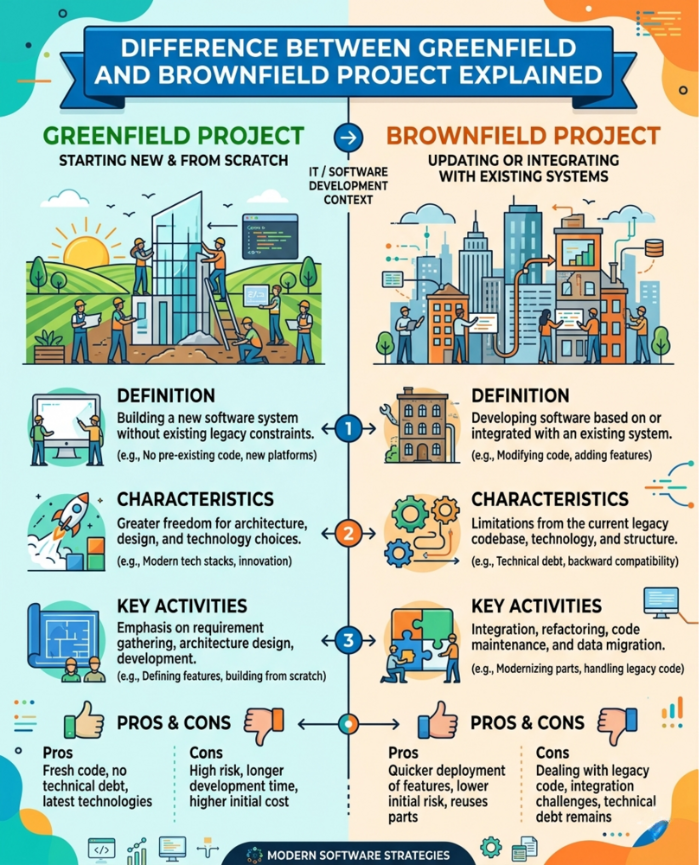
A deeper dive into brownfields and greenfields in terms of activities & characteristics
Considerable Factors for Brownfields & Greenfields
Business Objectives
The strategic business requirements and objectives need to be clearly defined for achieving project goals, such as digital transformation for manufacturing. If the needs revolve around customized solutions that need processes redesigning and complete change, greenfield projects are the choice. If the organization already has a standardized system or proven process in place, they may go for the brownfield approach to make the most of their current investments.
Material, Time & Costs
We have discussed in-depth that the greenfield approach requires more time, cost planning, budget, and technical understanding as compared to brownfield, so the choice can be made accordingly. However, if the organization also wants to consider long-term solutions and secure software engineering for digitization and unlocking advanced embedded technologies, it can go forth with the latter between a brownfield and greenfield project.
Shell Conversion
When the two methods or approaches are combined, it refers to shell conversion or a mix-and-match approach. In this case, the hybrid strategy involves combining the elements of both approaches into a single developmental concept. The newly developed system is partially redesigned while existing data and valuable processes are retained and optimized. Furthermore, such an approach allows the complete potential of software, advanced technologies, and ERP ecosystems to be exploited without the need for entirely abandoning the existing systems.
The Wide Spectrum of Brownfields & Greenfields
An organization’s international expansion is directly dependent on its choices of brownfield or greenfield, given the labor, production capacities, and sales potential that the region offers. We read in this blog how budget, lead time, and potential of the region can lead to environmental impact as per the chosen approach. Choosing the right approach is also directly linked to modernizing or migrating to ERP software like SAP S/4HANA or even the system’s customized web portal development.
Even in the case of logistics, the concept of a brownfield and greenfield project defines an investment starting point. In this case, greenfield may refer to a new warehouse development on undeveloped land, while, on the other hand, brownfield may refer to repurposing an existing site or project upgrade. Understanding the differences between these fields can prove to be useful for city planners to reinvigorate neglected passageways, organizations that are looking to analyze portfolio exposure, architects and developers who are weighing feasibility issues and due diligence risks, and even user management application developers.
KritiKal Solutions has assisted several organizations, right from Fortune 500 companies, small, medium businesses, to startups, in evaluating their approach choices for AI-augmented software development. We have uplifted and transformed their existing operations and resolved various bottlenecks that kept their processes from running at their full potential. We understand that every organization needs to conduct individual assessments as per their business requirements and objectives, such as for improving fleet management system. They need to weigh the pros and cons of opportunities put forward by the greenfield approach while evaluating the need to retain existing processes.
We not only ensure the demonstration of the benefits of tailored solutions in the former approach but also lay out the entirety of exploitable potential of newer deliveries alongside saving time and costs. We can conduct thorough analyses for you on a brownfield and greenfield project by presenting all relevant factors for an apt and informed decision-making as well as challenges for each approach. This may include overengineering risks, unclear objectives, high investments, and architectural decision paralysis in case of greenfield, and technical debt, poor documentation, tight coupling, data migration complexity, and downtime risks in case of brownfield projects.
It is necessary to consider resources to be involved, costs, objectives, existing operations, procedures, and timelines prior to planning and implementation. Please get in touch with us at sales@kritikalsolutions.com to know more about our software-based products, platforms and services, and realize your business requirements. We would be more than happy to support you in making the best choice for your upcoming projects and in successfully executing them.

Akash Panchal holds the position of Senior Computer Vision Engineer at KritiKal Solutions. He has extensive experience in the fields of Deep Learning, Cloud and Machine Learning and is profoundly skilled in Python, object detection and image classification. He has dedicatedly helped KritiKal in timely delivery of various projects to SMBs and Fortune500 companies.