


 Global
  United States

What is AI Predictive Analytics?
Today’s IT world requires organizations to intelligently process and leverage data to stay ahead in the market. To keep up with the competitive pace, data science and analytics solutions come at the forefront of growth factors that companies inculcate to avoid steep decline or plateau-like phases. They are adopting AI-powered business analytics for predictions and prescriptions to handle the unprecedented rate of data generation. To shift paradigms, businesses not only rely on detailed automated or manually operated dashboards but also analytics-based decision-making at shop floor and management levels.
Industry leaders have amalgamated the tendencies of generative AI and intuitive Natural Language Processing (NLP) to process data analytics. Such IT solutions for manufacturing help businesses to understand in real-time, measure, predict, and take prescriptive actions subsequently. In case of manufacturing, predictive analytics is integrated in demand forecasting, scheduled equipment maintenance checks, and uncovering customer preferences. Other than this, it is also being used in aspects that directly affect this sector, such as weather prediction, disease detection, medical diagnosis, sport performance predictions, financial and insurance-related risk management, and other business functions like marketing and human resources.
AI-based predictive analytics takes in data as the cornerstone of this digital age and extracts valuable insights to foresee results of complex situations via real-time analysis of the same. It utilizes the data sources for swift decision-making across varied scenarios, such as to avoid accidents by alerting drivers using AI-powered road safety pilots for prescriptive results. It has been a tremendous assist in different types of real-life business applications, like machine vision applications, and especially during the unprecedented pandemic for predicting future trends of protective equipment demands.
The current global market for predictive analytics in manufacturing is estimated to be around US $18.89 billion as of 2024 and is expected to surge and reach an approximate value of US $82.35 billion by 2030, increasing at a CAGR of 28.3% during this forecast period. Let us now go through use cases, benefits, and challenges of the same further in this blog.
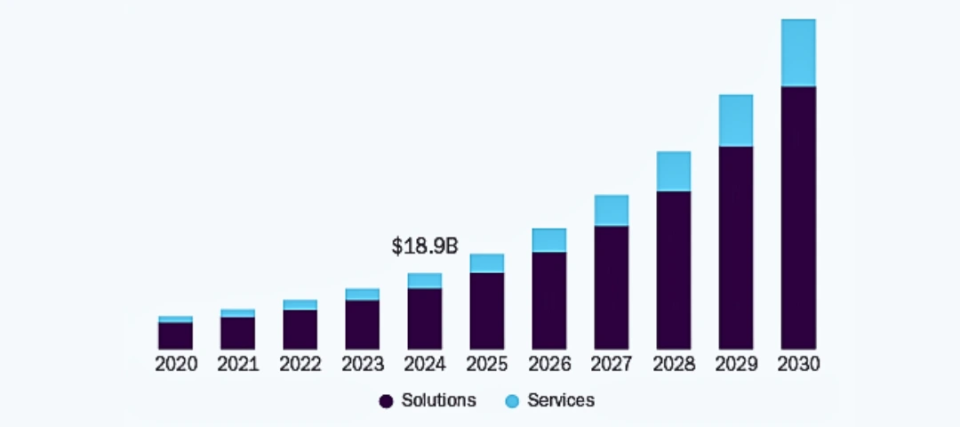
Source: Grand View Research
Growing market size of AI and predictive analytics during the forecast period 2020 to 2030
Use Cases of AI and Predictive Analytics
This type of advanced analytics focuses on data science, statistical modeling, machine learning (ML), big data, and data mining techniques to derive insights from vast amounts of historical data, including sensor-based information, videos and images, equipment log data, transactional databases, and other sources. In the context of manufacturing, predictive analytics has been widely used for improving operational efficiency, minimizing expenses, vision inspection system, and enhancing overall decision-making. Given below are the various related use cases.
Predictive Maintenance
Analytics obtained via IoT for predictive maintenance utilizes sensor data and patterns in historical data to predict any type of failures expected in equipment before they can occur. It is used to minimize the occurrence of unplanned downtime and maintenance-related expenses. With this, scheduled maintenance activities can be set up well in advance in case any machinery part is predicted to be worn out soon.
Quality Control
Prescriptive AI is also useful for controlling the quality of the operational environment and detecting defects. It works by identifying patterns that usually lead to product defects, therefore improving product consistency and reducing waste. Operators can perceive anomalies and even human action recognition in the process during production in real-time.
Demand Forecasting
Predictive analytics and AI take in historical sales data from stock monitoring system and market trends to predict customer demand. It helps in optimizing production planning and level of inventory, which can lead to reduced overproduction and stockouts.
Risk Prediction
Data from sensors, such as those used for noise monitoring, and recorded previous incidents can be utilized to predict safety-related risks. This helps prevent workplace accidents, improves worker safety, and ensures compliance with safety regulations.
Inventory Optimization
Predictive analytics can be used in forecasting and optimizing inventory requirements to reduce carrying costs while ensuring availability of material, thus supporting just-in-time manufacturing strategies.
Production Planning
Such analytics, when powered with AI, are deemed useful in optimizing production schedules based on demand forecasts and resource availability. This results in reduced idle time and improved utilization of machines and labor planning.
Supply Chain Optimization
This also helps in optimizing the supply chain by making predictions related to disruptions, shortages, and delays. It can also conduct supplier risk assessment and plan logistics accordingly, which in turn helps in improving delivery timelines and minimizing bottlenecks.
Energy Management
Predictive AI models can extrapolate energy consumption patterns and identify opportunities for minimal energy usage and costs to support sustainability goals.
Process Optimization
Historical and current production data help in analyzing and identifying inefficiencies to increase throughput. It reduces energy consumption and recommends optimal machine settings and workflows.
Failure Analysis
This type of AI analytics is useful in predicting warranty and product failure analysis after delivery to enable proactive customer service. It helps in improving product design and reducing warranty costs.
Yield Optimization
When the factors affecting yield of production are identified, output can be maximized, while the defects and scrap produced can be minimized through AI defect detection.
Product Innovation
Predicting models can assist in new product development by simulating product performance. It reduces the cost and time of prototyping and improves the success rate of innovation.
Fraud Detection
It analyzes transaction data to recognize patterns that may indicate fraud and predict potential fraudulent practices using historical data. This enhances security measures with the help of proactive fraud detection measures.
Customer Behavior Prediction
Customer data is analyzed for deriving insights and predicting preferences and behaviors. Predictions related to any potential churn can be made to develop retention strategies. This is necessary to improve customer segmentation and targeting based on the assessed insights.
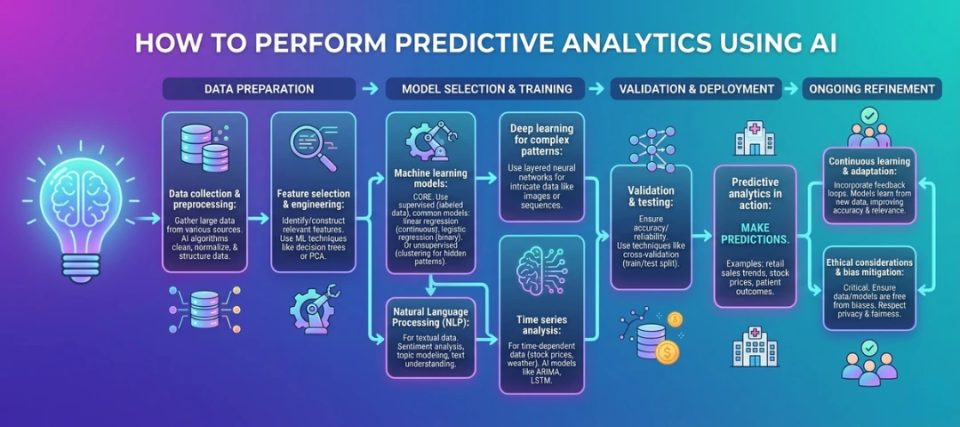
Diagram representing process to utilize predictive analytics and AI
Benefits of AI Predictive Analytics
The right set and method of analytics allow digital manufacturing transformation in terms of operations and decision-making. Let us now look at the multitude of benefits offered by these analytics.
1. Accuracy: Analytics powered by AI algorithms and machine learning have proved to be useful in increasing the accuracy of prediction-making. These process complex and huge datasets more precisely as compared to statistical processes. Analytical techniques can detect correlation within the data and subtle patterns that may not be recognized by analysts at times.
2. Management: AI is necessary to handle large, voluminous, complex big data, which is difficult to process using conventional methods and tools. AI swiftly interprets data, such as images, texts, and real-time streams, to derive important insights.
3. Decision-making: Time-sensitive decisions can be easily accomplished using AI-based data analysis in real-time for crucial insights. Rapid processing through video analytics for banking is important for financial and healthcare-related fields where swift decision-making has significant consequences.
4. Experience: AI-powered predictive AI models are used to improve customer experience by predicting customer behavior, including purchasing patterns, potential churn, and product preferences. Such insights can be used to devise marketing strategies and enhance customer engagement.
5. Assessment: Historical data can be assessed for potential risks using predictive analytics, where AI predicts various related scenarios. Businesses can take timely proactive measures for mitigation.
6. Efficiency: The time and costs previously utilized for manual data analysis are automated using predictive AI, thus resulting in cost savings and efficient operations.
7. Adaptation: As and when new data is provided, AI models can adapt dynamically and learn from the same. This helps to ensure that the derived insights stay accurate and relevant over time.
8. Unbiasedness: Fairer and equitable business outcomes can be predicted as the predictive analytics and AI models are designed and trained in a manner that reduces biases.
9. Planning: It eases strategic business planning by sharing forecasts into market trends, potential challenges, and opportunities.
10. Product Development: Product design and development processes take place in a more informed manner when supported by analytics on customer trends and preferences.
Challenges of AI Predictive Analytics
In this section, we will look at the various challenges in deploying such analytics.
1. Data Quality: As we are aware, AI video analytics models are heavily dependent on data, which at times may be inconsistent, incomplete, or inaccurate in nature. This data may have been collected from legacy machines with limited sensors or stored in silos across departments. When these models are trained on low-quality data, it leads to unreliable predictions and insights.
2. Integration: Scalability and adoption are limited as many smart factory solution utilize legacy software and older equipment. Therefore, integrating modern AI tools with these systems is time-consuming, expensive, and technically complex to execute.
3. Costs: Small and mid-sized manufacturers may face investment barriers as predictive analytics tools require high implementation costs. This is majorly because it involves sensors, IoT devices, data infrastructure over the cloud or on premise, and skilled personnel.
4. Skill Gap: The amalgamation of AI and predictive analytics, data science, and manufacturing processes creates a skill gap, as it may be difficult for professionals to comprehend. Also, existing workers may resist change and require retraining, leading to issues in workforce readiness.
5. Reliability: There is a possibility of production of false positives and negatives by AI models, thus creating uncertainty around model accuracy and reliability. These models require continuous tuning and retraining, the absence of which may lead to struggles with rare or unexpected events, errors, downtime, and even safety risks.
6. Risks: It is a known fact that connected systems powered with IoT and AI increase exposure to data breaches, ransomware attacks, and industrial espionage. It thus becomes necessary and critical to protect sensitive production data.
7. Scalability: Another major issue in predictive analytics in manufacturing is related to the shift from pilot projects to full-scale deployments. This may be due to limitations in infrastructure, variability across production lines, or high maintenance requirements.
8. Resistance: As discussed earlier, trust issues over automated systems may be raised internally related to change management and cultural resistance. Major shifts in decision-making processes and organizational culture are inevitable during the adoption of AI, as employees and managers may hesitate to rely completely on AI-based outputs.
9. Compliance: In industries such as aerospace and pharmaceutical, manufacturers need to ensure compliance with data privacy regulations, safety standards, and conduct thorough audits of AI decisions.
10. Uncertainty: As outputs derived using AI make it difficult to quantify benefits upfront, justify investment to stakeholders, and even measure long-term gains, the return on investment cannot be guaranteed.
KritiKal’s Prescriptive AI: A Boon
In this blog, we explored more about predictive analytics in manufacturing, how its use cases and transformative impacts are reshaping business outcomes through inculcation in redefined strategic planning and decision-making. We learned that such analytics are uplifting many industries through unforeseen trends across multiple sectors. One can now control the evolving markets due to their various respective advantages. KritiKal has been in the AI prediction game for decades, and we understand that incorporating AI into strategies is challenging; yet achievable; for example, we offer the best logistics analytics solutions for efficiency. We assist you to overcome issues related to data privacy, ethics, skill gap, infrastructure, and more during its deployment and rigorously inculcate a responsible approach for the productive utilization of AI-powered insights. Please get in touch with us at sales@kritikalsolutions.com to learn more about our AI-enabled solutions, products, platforms, services and realize your business requirements.

Ambuj Sharma currently works as a Project Manager at KritiKal Solutions. He is proficiently skilled in business transformation, project and program management, strategizing and execution, development of immersive learning architecture, dashboards, and more. With his ability to design process flows, define governance standards, establish metrics, and drive stakeholder alignment, he has assisted KritiKal in delivering various projects to some major clients.