


 Global
  United States
What is an Electric Vehicle Control Unit?
There is an undoubtable increase in the demand for sustainable development, efficient energy utilization, sensing capabilities, and advanced control innovations in automotive IT solutions across this global sector. This rapidly evolving domain is being continuously uplifted by cutting-edge technological breakthroughs that are redefining the way that vehicles are functioning.
The vehicle control unit of an electric vehicle (EV) acts as the mastermind of its subsystems/control system by coordinating between diagnostics, powertrain, battery, transmission, motor, charging, engine, anti-lock braking system (ABS), and thermal management. In modern software-defined vehicles (SDVs), VCUs are centralized, adaptable computing architectures that manage and optimize power conversion, delivery, and energy usage efficiency across such systems while ensuring safety and improving with time.
These next-generation intelligent control units reduce complexity, rigidity, and communication bottlenecks by not relying on dozens of electronic control units (ECUs) performing specific functions for a vehicle’s detailed, optimal performance in real-time as compared to traditional cars running on internal combustion engines (ICE).
It ensures reliable operations of power electronics components, such as telematics control unit, by handling precision timing, robust mechanical networks, high-frequency switching, and stable power delivery in demanding automobile conditions. The key circuits and components of the VCU include DC/DC converter, motor drive circuit (power inductors, capacitors, and chip resistors), and transceiver interface (chip varistors, electrostatic discharge suppressors).
The current global market for electric vehicle control unit is estimated to be around US $2705.7 million as of 2025 and is expected to surge and reach an approximate value of US $15279.3 million by 2035, increasing at a CAGR of 18.9% during this forecast period. In this article, we will explore how the VCU relates to various aspects of the EV’s control systems, its features, benefits, and its overall impact on the automotive landscape.
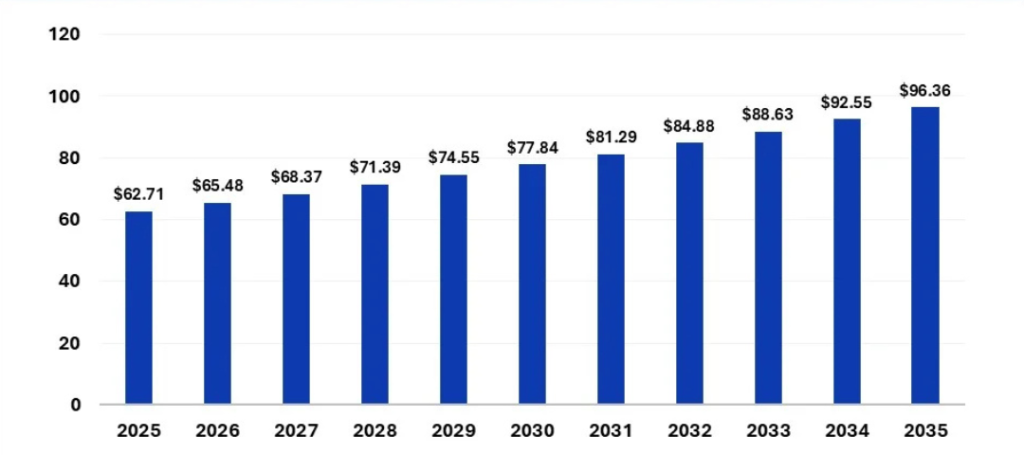
Source: Precedence Research
Growing market size of vehicle ECU architecture during the forecast period 2025 to 2035
Key Functionalities of VCU in Electric Vehicle
These units serve as the central controller of the electric vehicle by coordinating between BMS, CU, charging, etc., thus implementing vehicle-level control strategies amongst subsystems for desired vehicle behavior. They act as a communication gateway that exchanges information and updates within controllers through vehicle networks, such as the Controller Area Network (CAN), Local Interconnect Network (LIN), FlexRay, Ethernet Automotive, Vehicle-to-Everything (V2X), etc. Here are the main control systems of an EV that a vehicle control unit powers.
Powertrain Control
The main tasks of the powertrain control unit (PCU) and chassis control unit (CCU) are to regulate the electric motor’s speed, torque, direction, and steering; manage acceleration; regenerative braking; and optimize energy usage for better vehicle performance and energy efficiency.
Here, the VCU determines the amount of regenerative braking to be applied and controls the energy recovery through the MCU and braking system. It coordinates between vehicle dynamics, traction control, gear selection, driving modes (drive, reverse, eco, sport, etc.), acceleration, torque distribution, and stability functions.
Battery Management System
This electric vehicle control system, alongside the transmission control system, monitors battery voltage, current, temperature, state of charge (SOC), and state of health (SOH), protects the battery from overcharging, deep discharge, overheating; and balances individual battery cells to maximize battery life.
Alongside the battery monitoring system, the VCU receives battery status information like SOC, SOH, etc., and uses it to determine vehicle operating strategies, power limits, and requests. Although one must note that the VCU does not directly measure cell voltage or temperature, perform cell balancing, calculate SOC, SOH, or protect the battery.
Motor Control Unit
The MCU alongside the electric drive control unit (EDCU) converts driver commands into motor actions, regulates power flow between the battery and motor, and controls motor speed and torque through power electronics.
In the case of the EV motor controller, the VCU calculates the required torque as per the driver’s inputs and vehicle conditions to send torque-related commands to the MCU for motor operations. Although one must note that the VCU does not directly execute high-speed motor control algorithms, control inverter switching, or regulate motor torque and speed.
Charging Control System
This electric vehicle control system manages charging operations, communicates with charging stations, controls charging rates, ensures safe charging conditions, and supports fast and smart charging features.
Here, the VCU coordinates charging operations, initiates charging sessions, monitors charging status, and manages charging modes as per the battery and vehicle conditions. Although one must note that the VCU does not directly handle charging protocols, communicate with charging stations, or control charging current and voltage.
Thermal Management System
Thermal management regulates the temperature of batteries, motors, and power electronics, controls cooling and heating systems, and maintains optimal operating conditions in the EV. In this case, the VCU requests cooling or heating actions for the battery, motor, and power electronics to maintain optimal operating temperatures across the EV or fleet management system.
Safety & Diagnostics System
This automotive monitoring system, alongside the body control module (BCM), detects faults and abnormal operating circumstances, activates protective measures when necessary, and provides diagnostic information for maintenance and troubleshooting.
The VCU in electric vehicle monitors faults reported by subsystems, executes protective actions, limits performance whenever necessary, and manages shutdown procedures in case of critical vehicle failures.
Advanced Driver Assistance System
ADAS automates the vehicle and assists drivers in making the right driving decisions to prevent accidents through sensors, radar, LiDAR, a 360° camera for car, high-precision positioning, and state-of-the-art algorithms that monitor the automotive environment.
Therefore, it enhances vehicle safety by avoiding or reducing the impact of incidents and improves driving efficiency through sophisticated features like a vehicle detection system, lane departure warning, automatic braking, blind spot detection system, and adaptive cruise control.
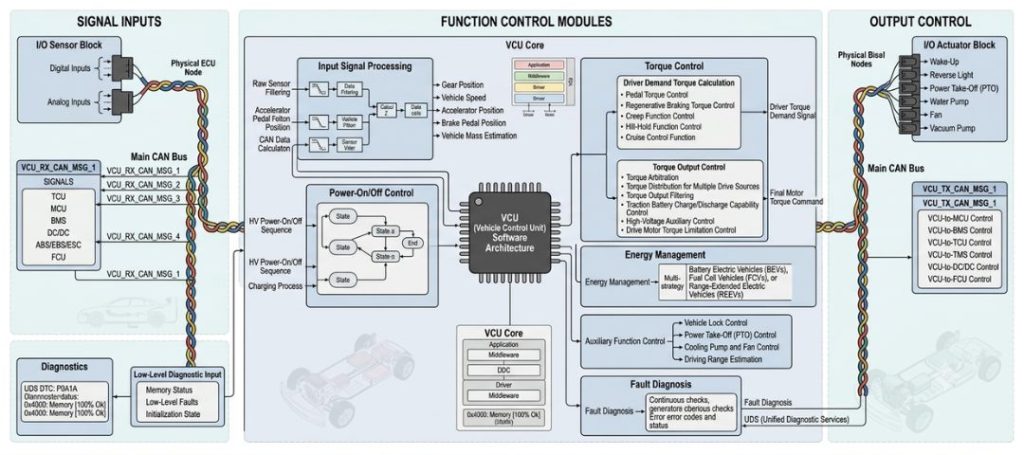
High-level vehicle ECU architecture diagram
Benefits of Electric Vehicle Control Unit in EVs
This unit provides balance between the wheel system, dual motors, and power electronics to save energy, increase traction, and promote stability. There are also other various advantages to using VCUs in electric vehicles and powertrains, such as the following.
- OTA Updates: Automatic over-the-air updates and remote software patches, improvements, and features without visiting the workshop.
- Diagnostics: Detects and records faults, abnormalities, errors, and performs predictive diagnostics and maintenance to alert the driver and reduce downtime.
- Performance: Dynamic power yield and torque distribution as per environment, load, and driving mode for enhanced electric vehicle control system responses and smooth acceleration.
- Health: Component (battery pack, motor) safety and longevity through continuous evaluation of temperature, voltage, SOC, SOH, discharge, overheat, overcharge, and heating and cooling system management.
- Charging: Intelligently manages charging and load balancing across varied infrastructure (Combined Charging System, Guobiao/Tuijian, CHArge de MOve) in high performance and temperature conditions.
- Regenerative Braking: Driving range can be increased by transforming kinetic energy into electrical and redirecting the same to the battery system.
- Flexibility: Automatic power delivery, intensity of regenerative braking, and throttle response adjustment across varied drive modes.
- Efficiency: Regulated energy usage by battery, auxiliary systems (lighting, climate control, vehicle security), and motor to increase vehicle range and smart power distribution.
Limitations of Electric Vehicle Control Unit
The communication protocols of the VCU may lack common standards, which lead to difficulties in integration, scalability, safety, and post-market compatibility with respect to warranty coverage. There can be some more drawbacks, such as the following.
- Security: Vulnerable attack pathways (charging stations, cloud updates, and logistics inventory management system) across connected VCUs are required to be secured through robust cybersecurity measures. These include encryption, authenticated updates, firewalls, secure boot processes, communication protocols, and intrusion detection against unauthorized access, bugs, and deterioration in performance.
- Reliability: In the absence of a resilient design, redundancy, and high fault tolerance, the entire powertrain can fall prey to abnormal vehicle behavior. Also, vehicle operations dependent on electronic modules and sensors are severely affected by electromagnetic interference, harsh climate, or technical failure.
- Scalability: Future advancements and upgradability in terms of sensors, microcontrollers, software, and processing power need to be accommodated in the designs and vehicle ECU architecture through scalable, modular architectures and building in headroom. Not to mention, an increase in ECU production and disposal generates more e-waste, ecological footprint, and environmental harm, which calls for sustainable initiatives.
- Integration: Each interface dealing with communication between the VCU, BMS, MCU, thermal management, sensors, etc., is designed carefully to avoid errors and delays, thus making the integration process for efficient logistics more complex. Moreover, retrofitting is not possible in automobiles with non-electric powertrains due to expensive rewiring.
- Maintenance: Thorough testing, rollback procedures, and safety certificate requirements can increase production, manufacturing, lifecycle, and maintenance costs, which calls for balancing improvements with costs to maintain a competitive stance.
Future Trends in Electric Vehicle Control Unit Development
KritiKal Solutions empowers automotive businesses to keep up with the upcoming future trends in this sector. This includes virtualization technologies, microservices-based architecture, AI/ML for predictive energy management, adaptive power optimization, and learning from driver behavior as per traffic patterns and road environment.
We enable vehicle software to become more adaptable, updatable, and scalable through independent development and deployment of vehicle functions. We understand the movement of market outlook towards industry-wide standardization of common human machine interface development practices, protocols, shared software protocols, improved interoperability among suppliers, OTA updates capabilities, software intelligence, and functionality in SDVs.
And thus, we develop highly centralized, domain-controlled, integrated computing and service-oriented architecture (SOA) based VCU in electric vehicle, that act as supervisory controllers of the vehicle.
These units will continue to coordinate interactions intelligently as the central platform between BMS, MCU, charging, chassis, and comfort systems, thermal management systems, brake and safety systems to optimize vehicle performance, driving dynamics, safety, efficiency, and enable centralized decision-making that considers the interdependence of multiple next-generation electric and autonomous vehicle subsystems.
Deliver consistent and optimized driving experiences to your customers through our embedded development systems. Please get in touch with us at sales@kritikalsolutions.com to know about our embedded products, platforms, services, and realize your business requirements.

Padma Kumari currently works as a Senior Embedded Engineer at KritiKal Solutions. She is an experienced embedded systems developer with extensive work in C++, C, Linux Kernel, System Design, UML, alongside a proven track record of delivering results, leading teams, and optimizing product performance. With her passion for innovation and commitment to continuous learning, she has helped KritiKal in delivering various major projects.