

 Global
  United States

What is Agentic Automation?
When working with legacy systems, a lot of time gets consumed in collecting information from different data sources, data cleaning, organization, and compilation of reports to deliver business outcomes and overall performance. To overcome this challenge, digital automation and agentic AI solutions can come in handy, where the agent accesses such systems to collect and analyze the data, generate reports, and provide insights.
An AI automation agent is autonomous in nature as it adapts to new scenarios, takes decisions in real time, and works towards achieving an objective. Processes that are automated using agents do not require human intervention, as the agents do not follow fixed rules and directives; rather they dynamically carry out business workflows autonomously.
Unlike traditional methods, such automation can assist in adapting to altering business environments at a fast pace while handling surging amounts of customer data and market demands. For example, robotic process automation (RPA) can accomplish mundane tasks but fail to adapt in such situations due to deficiencies in reasoning capabilities. A software entity or AI agent performs this type of automation by perceiving streams and other digital environments autonomously and making and acting on decisions.
The current global market for agentic process automation is estimated to be around US $7.36 billion as of 2025 and is likely to surge due to the transition of ML-based augmentation of enterprise IT architectures to multi-step, autonomous execution workflows and reach a value of about US $55 billion by 2036, increasing at a CAGR of 22.28% during this forecast period. Let us now go through the importance of automation through agents, their working, use cases, advantages, and future possibilities in this blog.
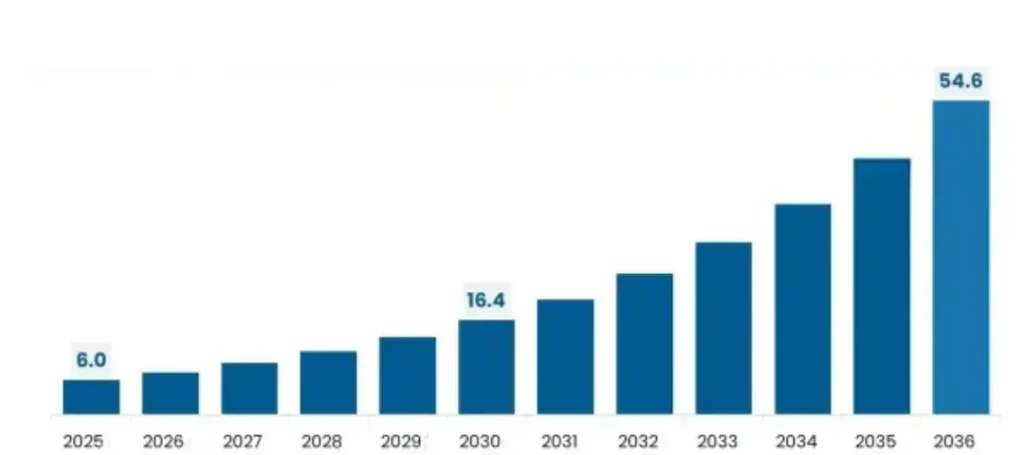
Source: Future Market Insights
Growing market size of AI agent automation during the forecast period 2025 to 2036
How Does Agentic AI Automation Work?
Automating business operational workflows through agentic AI tackles various challenges, as they can be customized and adapted as per the problem-solving requirement. Their functioning combines various technologies for delivering designated tasks and achieving goals, but the path of execution is selected in real-time.
Characteristics
Autodidacticism
AI agents operate on feedback loops for self, continuous or reinforcement learning to get more intelligent with time. They analyze the conditions and inputs they need to work with and utilize strategies to make the best decisions and achieve results.
Agility
An AI automation agent can dynamically change its operations, responses, and actions to respond to altering incoming information, environments, and market demands. Being adaptive in nature, it can render apt utilization of resources, alter and adapt to processes, and change priorities autonomously, without any reprogramming or manual intervention.
Self-Governance
These agents act sovereignly and autonomously as per the defined operational business ethics and limitations, although they decide and execute them independently. On the occurrence of changes, they prioritize tasks, their order, and responses, even probabilistic issues, all on their own.
Others
Alongside these, agents exhibit goal-oriented behavior (optimized sub-goals to achieve user-created objectives), reasoning, complex problem-solving, ML-powered adaptive and reinforced learning, decision-making, weighing trade-offs, assessing risks, initiating workflows, automating processes, scheduling tasks, making dynamic adjustments in strategies and responses, anticipating, and proactive behavior.
Agentic Automation v/s RPA
Both traditional RPA and automation through agents developed through AI development services simplify processes and enhance operational efficiency, although their competencies are divergent. While the former focuses on executing tasks, the core function of the latter is to achieve goals. RPA, or pre-configured bots, are based on if-then rules and are pre-programmed through defined rules, while autonomous processes can change their functioning and decisions as per objectives and real-time inputs. For example, RPA handles extracting invoice data from email PDFs and feeding the same to accounting systems. At the same time, agents address fraud detection, handling, payment optimization, invoice receipt validation, and the entire accounts payable procedure.
RPA lacks flexibility as it fails to execute tasks during unforeseen issues. Agents, on the other hand, are highly adaptive to dynamic environments and can navigate through new scenarios. The former is suitable for working in predictable, structured, and stable situations, while the latter handles unpredictable, complex, and dynamic environments. RPA may need human operators to resolve errors and exceptions on a frequent basis; meanwhile AI agent automation escalates matters that require high-level strategy while reducing human intervention for all other decisions.
Automation Agents v/s AI
AI-powered automation that doesn’t involve agents is majorly based on pattern recognition and machine learning and model-assisted decisions instead of goal-driven reasoning or strict rules. These models estimate best results but do not work towards attaining an outcome, such as in the case of agents, or follow exact instructions, as in the case of RPA. Both AI models and agents can handle unstructured data, unlike RPA, while the latter can even combine data from multiple sources in a dynamic manner. Although AI automation can handle some form of variation, unlike RPA that fails during changes in workflow, it cannot replan or readjust its functioning between performances like agents. RPA or AI models cannot conduct self-planning or sub–goal creation like agents and therefore do not work well with multi-step resolution.
Agentic Automation v/s Gen AI
On comparing Gen AI models developed through generative AI services, these agents execute any type of goal autonomously, while Gen AI produces content, such as text, images, and codes. Agents plan in a goal-driven manner to execute tasks and decision-making, while Gen AI generates natural language. The former can act and orchestrate end-to-end execution independently as per set goals, while the latter only responds to prompts to perform surface-level tasks. Applications of generative AI act in isolation, whereas there could be multiple AI agents or non-AI systems working together to accomplish a task. Agentic solutions require strict governance involving HITL, audit, and policy engines as compared to generative AI.
Working
Artificial intelligence has led the pathway of transition from rigid rules-based RPA that mimics system interactions with humans to digital, intelligent agents. Today, AI agents for automation perform much more than simple application logging, data copies, and transactional processing. A multi-agent orchestration involves various agents, each specializing in respective tasks, that function across silos, integrated applications, APIs, and external systems (ERP, CRM, file transfer systems, ITSM, cloud, and data platforms) to automate workflows. They are integrated with advanced technologies as follows that let them learn, reason, and act through cognitive abilities.
- Generative AI: Gen AI, Large Language Models (LLMs), Large Action Models (LAMs), or Multimodal Large Language Model (MLLM) let these agents create better solutions, personalized content, and publish them. This is especially useful in the context of email campaigns in marketing while addressing vulnerabilities in engineering, coding, and other activities that involve active creation or problem-solving.
- Machine Learning: It forms the foundation for continuous learning and adaptability exhibited by these agents. ML-based algorithms and subsequent feedback help these agents identify patterns, anomalies, abnormalities, dataset analysis, result prediction, and refining strategies. ML allows them to improve their performance over time for optimizing processes.
- Natural Language Processing: Agents gain the ability to interpret, understand, and generate human languages through NLP. For example, reading customer complaints, understanding their emotions, sentiments, intent, and formulating relevant responses by comparing older results from retrieval-augmented generation.
As multi-agents combine these technologies to function in the real world without any manual involvement, agentic process automation requires the following steps.
1. Perception:An agent collects data from its surroundings by using databases, APIs, sensors, and user interactions, where the information stays up to date for analysis and decision-making.
2. Reasoning:The collected data undergoes AI-based processes, such as extraction of insights, interpretation of queries using NLP, computer vision transformer, etc., pattern detection, and context understanding.
3. Defining Goals: Once the actions are determined as per the scenario, the agent sets objectives based on user inputs or predefined goals. Further, agents formulate AI-augmented development strategies to achieve the same by using reinforcement learning, decision trees, and other algorithms.
4. Decision-Making: It then performs evaluation of various possible steps and chooses the best action based on factors like accuracy, predicted results, and efficiency.
5. Execution: The action is then executed by the agent as it interacts with robots, data, APIs, and other external systems to provide the user with responses for human-in-the-loop (HITL) AI integration services.
6. Learning: Upon execution, the agent evaluates the results, gathers the feedback, learns better mechanisms to render the best compliant and ethical results, and improves its decisions in the future. It builds and refines its strategies and task handling by following different types of unsupervised learning, self-supervised or reinforcement learning, over time.
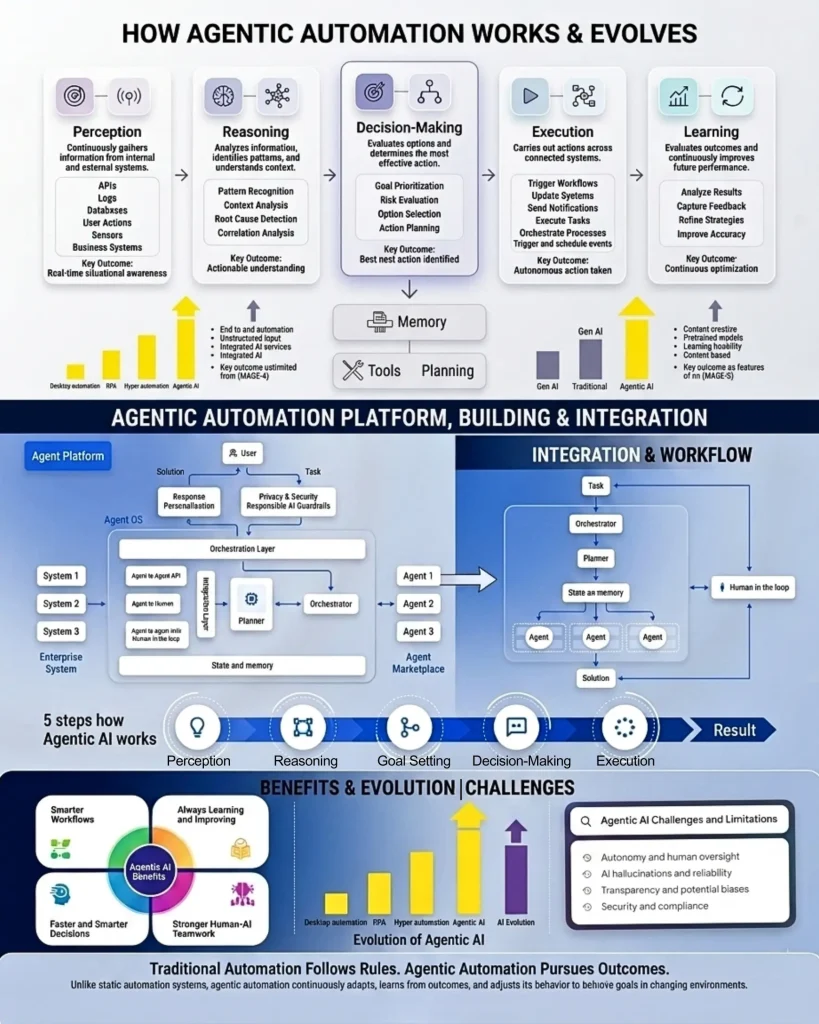
Agentic process automation: Working, Evolution, Integration, Benefits & Challenges
Benefits of Agentic Automation
We observed earlier that automation using agents can save time, costs, improve efficiency, and decision-making, thus rendering a proactive and better model for accomplishing sustainable operations. There are various advantages to automating business and operational processes through agentic AI, such as the following.
1. Security: As these agents function on rules that are based on compliance, industry regulations, and standard policies, sensitive information remains safe at all times. Furthermore, regular audit trails, documentation, and strict role-based access controls reduce security risks and assure adherence.
2. Automation: AI agents for automation can handle end-to-end tasks in workflows autonomously, right from data collection, analysis, and decision-making to on-time actions without any manual intervention. These agents can lower exception and error rates and data processing time while improving compliance.
3. Allocation: These agents can intelligently allocate resources with distributed tasks as per organizational capacity, priority, and efficiency rate. They help reduce overall expenses and bottlenecks during the operation while improving employee empowerment and visibility into workflows.
4. Resolution: With real-time monitoring functions, an AI automation agent can adjust the system or process to new raw inputs and dynamic conditions. It monitors workflows in real-time and detects any type of inefficiency or anomaly to proactively solve problems even before they occur.
5. Personalization: User experience is personalized through conversational AI agents as they record their preferences and behavior to automate their commands, requests, and deliver recommendations. Such autonomous actions can improve customer satisfaction, engagement, and loyalty.
6. Scalability: AI-based automation through agents can future-proof and enhance operational productivity and business scalability without the need for hiring resources. Digital agents can work automatically, continuously, and manage new workloads that may fluctuate.
7. Competitiveness: Agents enable consistent forward innovative motion across businesses in analyzing complex big data, identifying patterns, and providing recommendations. They can help in finding new markets, launching new products, and finding ways for cost-effective deliveries as the team focuses on tasks.
Use Cases of Agentic Workflow Automation
Automation through agents can help in monitoring supply chains globally and pinpoint complex issues prior to their occurrence. This aids in determining the next steps from a series of actions for resolving the same. Moreover, it increases resource productivity by taking up repetitive activities so that the employees can focus on creative and strategic tasks. In this section, we will delve into more such industrial use cases and AI applications in real life rendered by these agents.
Retail
Common challenges observed in the retail and supply chain sector include shipping delays, issues with orders, low operational speed, inventory levels, and client satisfaction, all leading to loss of sales. Agentic management, such as Flexport and Maersk AI, can surpass such challenges through automation of status updates, problem flagging, order tracking, and other proactive measures for better retail, supply chain, and in-store customer experience. Any changes in weather, inventory, delivery time, vendor performance metrics, and more can be detected using AI solutions in retail by monitoring real-time supply chain data. Furthermore, the agents plan remedial actions to overcome such issues, for example, shipment rerouting, alerts to customers, alternate delivery date options, etc.
In brick-and-mortar or physical retail stores, AI-powered agents like the Klarna AI assistant can easily handle policies, product details, and promotions amongst walk-in customers, leading to increased sales. They can transform the in-store experience through on-the-spot, accurate answers to their queries as per the retail environment or product portfolio. It ensures that informed decisions are made as per the connected information gathered from the latest data sources, training materials, and inventory. Digital associates can minimize customer wait time, answer their inquiries without extensive training while delivering expert service, and even render dynamic pricing on e-commerce sites, like Walmart AI. AI in food industry may also be used in the production of fast-moving consumer goods.
Healthcare
Electronic healthcare records (EHR), regular patient updates, charts, test results, and vital signs altogether form large volumes of data. This at times leads to healthcare attendants overlooking critical alerts, high-risk health conditions, lab reports, etc. AI agents for automation, such as Ellipsis Health Sage, deployed in healthcare settings address this issue through continuous monitoring of records. Use of medical note summarization and clinical documentation agents, such as Microsoft Dragon Copilot, leads to personalized, real-time, improved patient care and formulated treatment plans as per risk-based prioritization, for example, AI skin cancer detection.
Agents working on multimodal AI in healthcare can flag priorities by scanning inputs, cross-referencing the same with patient histories, and generating alerts for irregular test results, escalations, and urgent requirements. The agents can detect abnormal patterns in EHR or vital signs to trigger the same through mail, integrated applications, or SMS. Such a reactive approach for medical AI diagnosis in real-time helps attendants stay focused even during a rush, reduce time to response, and errors. In addition, agents like OpenEvidence DeepConsult can even provide AI integration services and brief health insights, and others can take care of administrative deliverables, including follow-up schedules, insurance verification, discharging as per criteria, and more.
Customer Service
Businesses may lose customers due to delay in response times and increase in wait time of support queues during peak hours. In such cases, chatbot agents can automate repetitive tasks like ticket scanning, query or FAQ responses, escalation handling, etc. Agentic workflow automation can identify customer sentiments, behavior, keywords; prioritize as per the issue, and share required resources instantly. In case of IT support, they check for system logs, user-reported symptoms, and network statuses to run diagnostics for software bugs, system outages, schema changes, upstream delays, missing files, and unexpected input.
In the context of telecommunications, seamless connectivity and uninterrupted services can be maintained by highlighting and resolving network issues to lower downtime. All incoming requests, including password resets, order tracking, etc., are triaged, analyzed, cross-referenced as per the intended knowledge bases, and responded to. It forwards or escalates complex issues to higher management as and when required alongside improving its response accuracy, learning, and adapting to different kinds of interactions. All in all, AI agents can reduce waiting periods, tackle nuanced issues, and handle sudden surges in complaints or queries across businesses and industries.
Manufacturing
Agentic workflow automation has proved to be useful in predictive maintenance in manufacturing for machinery and equipment working on IoT sensors. The automated agents receive and analyze sensor data streams of temperature, energy utilization, pressure, and vibration in real-time. They quickly learn the modus operandi of each machinery, facility, product, equipment, or fleet, perform self-healing tests, and monitor the same in a continuous manner. Even a minute deviation observed through AI predictive analytics with respect to baseline generates alerts for AI defect detection, diagnostic data, and potential failure to the maintenance department and initiates a workflow to address the same.
Human Resources
The modern scenario in recruitment faces challenges, such as unexpected delays in paperwork, impending uncertainties for new hires, and excessive workloads for internal teams. The onboarding process can be simplified by using automated agents for sending forms, follow-ups, and completing tracks for payroll, data access for new hires, automatic ad creation, etc. Agents can take historical hiring trends, business growth projections, turnover rates, and workforce projections into consideration for devising talent acquisition.
Agentic AI automation involves extraction of data from HR management systems, verification of the same, highlighting sections to be completed, forwarding documents, interaction with training platforms, and assignment of role-based modules. It can also screen resumes, perform interviews, create job descriptions, and negotiate contracts. Any delays, compliance issues, and time consumption of the team in mundane tasks are cut down profoundly. Critical internal communications can be enhanced through instant employee escalations, comments, and query resolution; automated blogs; summaries; mail; announcements; and resource assignments.
Finance
A multi-agent system, such as AgentFlow can easily handle financial tasks, such as fraud detection, periodic reporting, invoice processing, and compliance monitoring. It can orchestrate validation of extracted data from invoices against purchase orders and begin approval workflows in accounts payable. They prevent risks by analyzing huge volumes of transactional data quickly and detecting abnormal patterns that indicate fraud. Insurance companies can benefit from the same by automating claims processing, validation, filing, payout, and even communicating with customers while reducing administrative burden.
Furthermore, they flag anomalies and suspicious transactions to add an additional layer of generative AI for cybersecurity. While humans focus on building relations, AI agents process financial market research, trends, and data to execute trades in the investment management domain. Without any user aid, agentic tools can predict and execute the same at optimal times. These agents have also been useful in portfolio management, as they can analyze client profiles and the associated risks and provide custom investment strategies in real-time.
Education
Co-pilot agents can personalize lessons and learning paths, grade assignments, provide feedback instantaneously, track students’ progress, and curate content as per their SWOT. They can provide round-the-clock support while working on their gaps in context understanding. They can detect disengagement and perform targeted interventions to avoid the same. Multi-agent systems can monitor performance, schedule tasks, allocate resources, and manage interactive environments in virtual classrooms.
Future Trends in Agentic Process Automation
Automated agents have evolved from rule-based orchestration of repetitive tasks in the 1990s to RPA that mimics human behavior in the 2010s to autonomous perception and decision support in the 2020s. Ultimately, reaching a stage of independent reasoning, actions, and end-to-end business execution in the present day. Let us have a glimpse at the emerging dawn of agentification and what the future holds for agentic workflow automation in this section, as it is necessary to address new types of challenges and foretake opportunities that these agents are likely to introduce in the workplace or global market.
1. Micromanagement: Since agents are becoming more autonomous in handling decisions, lowered micromanagement and simplified summaries can be expected while handling bigger tasks.
2. Partnerships: A sync between technical resources and agents is likely to be observed across tasks, industries, jobs, and departments in lieu of attrition. This is because tedious tasks would be handled by agents, whereas creative, strategic initiatives, and complex challenges would be taken over by humans.
3. Transformation: Hybrid teams consisting of agents and humans would mean innovation and an increase in investments for WLA/SOAP, upskilling, fine-tuning of automation, and training data collection.
4. Decision Engines: Multi-agent systems powered by LLMs and GenAI-based collaboration leading to enterprise automation and continuous strategy optimization.
KritiKal: Shaping Next-Gen Enterprises
KritiKal’s AI agent automation represents the next big evolution, with orchestrated agents capable of reasoning, learning, adapting, and autonomously executing difficult processes rising. This goes far beyond the common, reactive, prompt-driven, and traditional AI model development as these agentic systems function across workflows. They enhance decisions, efficiency, ROI velocity, and scalability of businesses when adopted using high-quality data, strong access controls, audit mechanisms, explainable decision-making, established accountability, and robust government frameworks for security. Please get in touch with us at sales@kritikalsolutions.com to know more about our AI-based products, platforms, services and realize your business requirements.

Neeti Bathla currently works as a Senior Project Manager at KritiKal Solutions. She is proficiently skilled in project execution and delivery; client and stakeholder communication management, agile methodologies (Scrum and Kanban); management tools (MPP, Jira); and more. With her ability to manage teams efficiently and more than 20 years of experience working in the IT field, she has assisted KritiKal in delivering various projects to some major clients.