


 Global
 United States


“In the SDV era, success is determined by effective software validation rather than how much software is contained in the vehicle. Only when businesses invest in automated, scalable, and rapidly evolving validation techniques will they be able to minimize risks, accelerate launches, and redefine the future of mobility itself.”
What is a Vehicle Control Unit (VCU)?
Modern automotive systems are becoming more software-defined day-by-day, and the Vehicle Control Unit (VCU) takes up a critical role in ensuring vehicle safety, user experience, and performance. A significant transformation in automotive IT solutions is reshaping this industry with the increase in development and production of electric vehicles (EVs), intelligent automobile technologies, and hybrid two, three, and four-wheelers.
As we are aware that vehicles of today rely heavily on electronic control systems like VCU for energy utilization, power delivery management, and the overall driving performance. The VCU forms an important component of the driving ecosystem as the central embedded coordinator and orchestrator of various vehicular-level functions in hybrid or electric vehicles.
It collects and processes driving data by using several sensors, telematics control unit, vehicle communication networks, and Electronic Control Units (ECUs) which are then processed as per predefined logic. It then takes decisions in real-time around torque delivery, energy management, regenerative braking, fault handling, and drive modes.
The information is transferred to actuators and contactors as commands, such as the EV motor controller, powertrain, braking systems, battery monitoring system (BMS), thermal management, body electronics, and other subsystems like HVAC, doors, charging systems, lights, etc., for efficient vehicle operations.
Thus, a defect in the VCU can directly impact the vehicle’s performance, safety, and driving range. With increasing complexity in software, robust validation and testing techniques have become necessary. These ensure functional safety, reliability, regulatory compliance, and cybersecurity readiness. Let us now go through the importance of VCU testing and validation, the working process, commonly used tools, and what does VCU stand for in the context of testing and validation further in this blog.
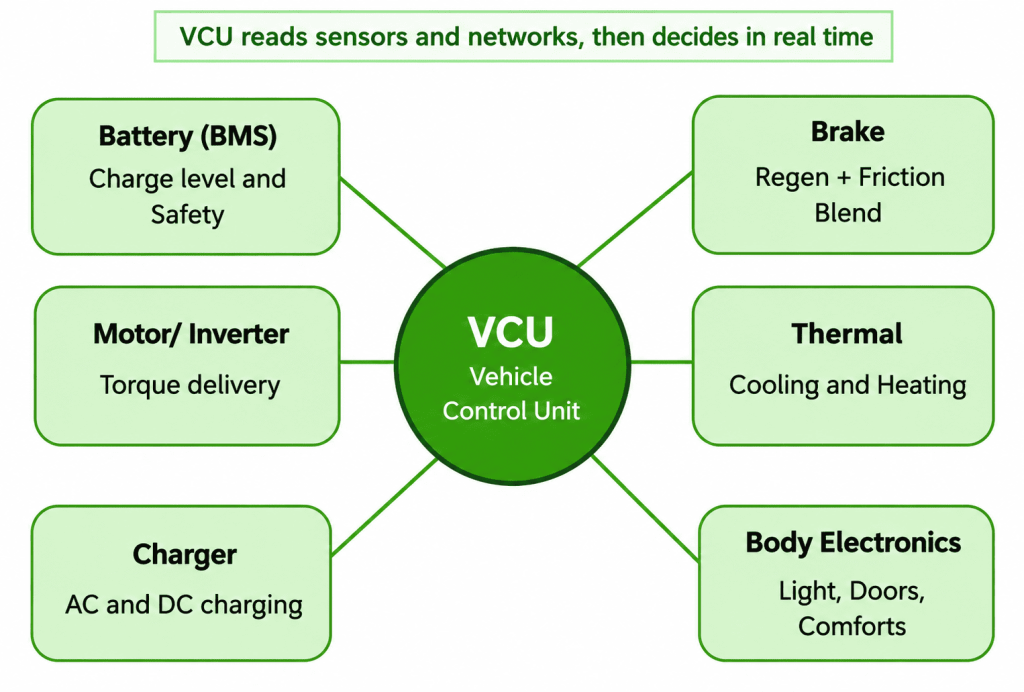
The vehicle control unit central intelligence
Key Functions of the VCU
VCUs coordinate between various vehicular domains as compared to individual ECUs that manage a single function, respectively. It controls the following actions, and thus its behavior shapes the whole driving experience.
Torque Management
VCU can coordinate and calculate driving torque as per the vehicle speed, driving mode, accelerator input by the driver, and other operational constraints. It interprets system limitations and inputs to distribute torque requests as per calculations.
Operating Mode
It is responsible for managing vehicle operating conditions and states, including charging, shutdown, ready-to-drive, startup, and fault handling with respect to the vehicle’s architecture. It manages various drive modes, such as Eco, Reverse, Normal, Sport, Limp-Home, and Charging.
System Coordination
The VCU can exchange information between the BMS, Power Distribution Unit (PDU)/HV Control Box, Powertrain Control Unit (PCU), Traction Control System (TCS), Electric Device Control Unit (EDCU), Chassis Control Unit (CCU), Body Control Module (BCM), and motor controller for better coordination and ensure that the required power is within the permitted operational limits. It performs ECU coordination and also syncs communication between inverters, BMS, brakes, chargers, and thermal and body controllers.
Regenerative Braking
It coordinates the requests between the powertrain and regenerative braking control systems, wherever and whenever applicable. It can combine friction and regenerative braking while ensuring driver comfort and maintaining stability.
Internal Communication
The vehicle control unit controls the coordination between ECUs by using the Controller Area Network (CAN) with Flexible Data Rate (CAN FD) and other automotive communication networks.
Fault Handling
VCU monitors system health and status information in real-time and selected signals to detect abnormal conditions and initiate an appropriate defect handling response and protective driving operations.
Energy Management
It coordinates usage of battery power and operational strategies as per the vehicle design that can support the vehicle’s performance range and overall energy efficiency.
What is VCU Testing and Validation?
Basically, VCU testing involves a systematic procedure for verification of software functions, evaluation of communication between control units, inspecting hardware interfaces, fault identification, and verification of safety and technical requirements. The process checks VCU performance as per its specified functions under the intended operating conditions.
The objective of VCU testing is to identify defects before they can affect the vehicle’s reliability, safety, integration, and performance. During this, certain inputs are provided to the VCU to obtain observable outputs and compare real-time behavior with desired outcomes while examining internal variables.
The current global market for vehicle control units is estimated to be around US $10.4 billion as of 2024 and is expected to surge and reach an approximate value of US $20.7 billion by 2034, increasing at a CAGR of 7.8% during this forecast period.

Source: Wise Guy Reports
Growing market size of VCU testing during the forecast period 2019 to 2035
Why is VCU Testing and Validation Important?
Reliability and accuracy of VCU performance influence the whole vehicle behavior and interactions. Any VCU defect can affect the entire vehicle’s performance, drivability, energy efficiency, and safety. It is directly linked to issues like software defects, failed communication, or misinterpretation of signals, communication noise, heat stress, incorrect torque calculations, voltage spikes, software bugs, sensor faults, power management errors, and real-world unpredictability. This can result in unexpected vehicle behavior, faulty regenerative braking, acceleration, vehicle safety, and energy management.
Therefore, VCU testing and validation play a critical role in hybrid and other modern vehicle production. They verify functional requirements, validate communication within ECUs, assure safer vehicle operations, improve energy efficiency and performance, detect software and integration defects at earlier stages, and support compliance with automotive standards. Robust VCU testing is a requisite for enabling OEMs to perform functionality validation, support safety, verify system interactions, maximize reliability, and accomplish regulatory compliance across the vehicle lifecycle.
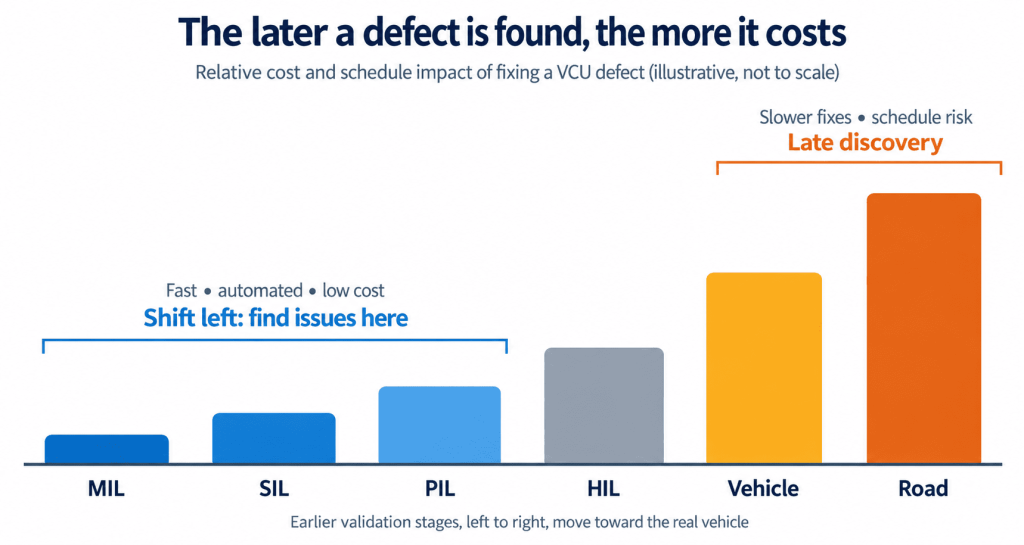
How VCU testing and validation make a difference in automotive production
How Does VCU Testing Ensure the Reliability and Safety of a Vehicle’s System?
VCU Validation
It is the process that confirms that the operations of the controller are developed and ensures that it can satisfy the requisite vehicle application for intended performance as per the targeted functional environment. The process may include simulation, integration and hardware testing, vehicle trial, and measured data analysis. It is bound to be conducted throughout the software and hardware development phases, calibration, vehicle integration, and more.
Objectives of VCU Validation
- VCU validation confirms that it meets the required vehicle-level requirements.
- The validation process evaluates communication between various ECUs.
- It can verify vehicle system behavior under realistic driving conditions.
- It conducts performance assessment around voltage, load, operating temperature, etc.
- VCU validation confirms the specific fault response as per the intended work.
- It can identify integration issues that may not appear in isolated software testing.
- It can generate evidence to support decisions of design approval and releases.
- It helps to simulate abnormal conditions like lost CAN messages, invalid sensor values, high temperature warnings, and battery power limitations to check if the VCU can respond as per the operational requirements.
VCU Testing vs. Validation
Both operations are closely connected, where the testing process ensures that the controller’s behavior is as per the specific requirements. The validation process assures whether the controller meets the vehicular requirements and its operational environment. Per se, testing affirms that the VCU transmits a torque request as per the correct timing and value.
At the same time, validation affirms that the required acceleration is delivered by the vehicle all while ensuring that the motor, traction, safety, and battery constraints are kept in mind. Therefore, an end-to-end development process can combine integration testing, requirement-based testing, and fault testing, as well as system-level validation.
Therefore, it is notable that VCU testing checks individual functional behavior as per the specifications, whereas VCU validation confirms if the VCU meets the requirements and is used at the vehicle level. Testing focuses on individual fault cases, interfaces, and functions, where validation focuses on system operations in realistic conditions.
Tests may utilize software simulations, automated test cases, and benches, whereas validation involves hardware benches, vehicle integration, simulations, and road and track tests. An example of VCU testing would be checking whether the VCU sends the correct torque requests, while that of validation would be whether the vehicle safely delivers the expected acceleration under realistic driving conditions.
Both are interchangeable, although they assure different functionalities within the vehicle development lifecycle, thus complementing each other. In short, testing proves that the software performs as per the given specifications, while validation proves that the specifications can deliver the expected vehicle.
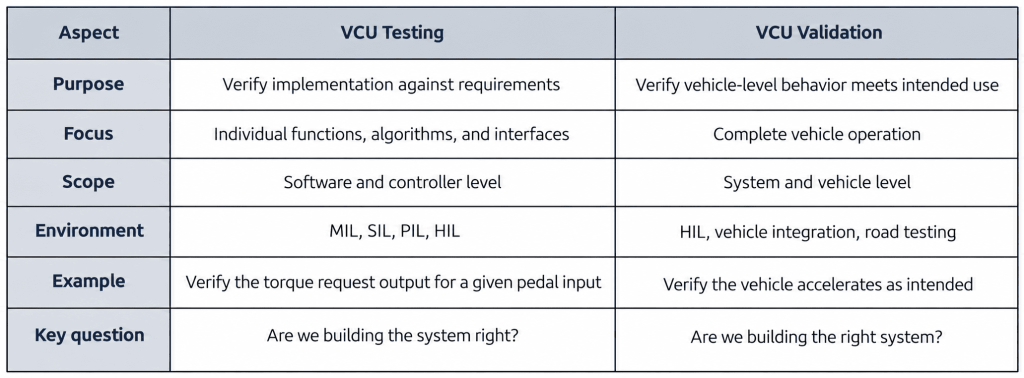
Comparison between VCU testing and validation
What are the Main Components of VCU Testing?
Here are the main steps of VCU testing and validation methods, which are divided on the basis of different testing environments, realism level, and the maturity of the software required. Per stage performs a distinct role and renders closeness to the real automobile. Defects are detected in the earliest stages at the lowest costs possible.
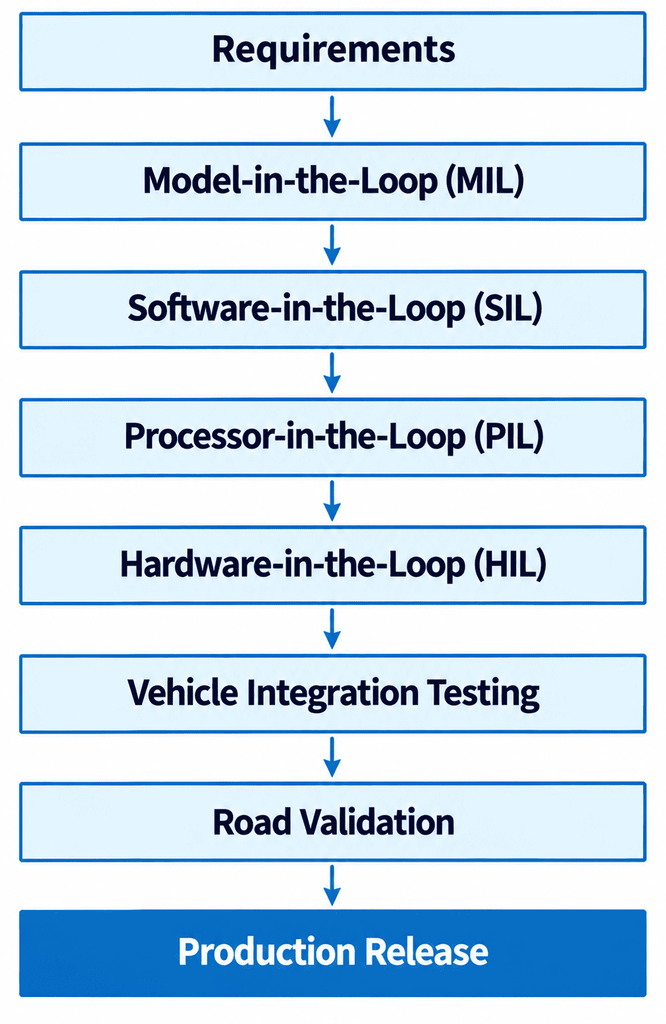
The modern VCU validation workflow
Requirements
Clear requirements are defined, which can be traced and tested, as each of these is needed for ISO 26262 safety audits and arguments. Thus, every requirement needs to be mapped to at least one test.
Model-in-the-Loop
MIL testing is the earliest validation stage where requirements are made executable, and ambiguities in the specification document tend to surface upon modeling. It is therefore an effective testing practice to check design issues, enhance the quality of requirements, and avoid expensive rework along the downstream. It uses mathematical models of control algorithms and vehicle systems built in MATLAB/Simulink. Here, the inputs are simulated, and the control model is simulated.
Control algorithms run in a closed-loop simulation with respect to plant models before any code is developed. Ultimately, the results are compared with the expected behavior. This testing practice is useful during early development as issues are identified prior to the production of software or when the hardware is available.
Engineers can thus check control strategies, interpret requirements, and state machine behavior ahead of coding. For example, testing a torque management model against various accelerator inputs, vehicular speeds, and limitations of battery power.
Software-in-the-Loop
SIL testing involves executing software code in a simulated environment (automotive ECU validation in virtual ECU i.e., vECU) which can help to verify the control logic, torque mapping, safety states, and behavior of the implementation. It also helps recognize issues that might occur during code generation, software integration, or compilation. It can include automated testing, code coverage analysis, regression testing, and boundary testing.
SIL runs the manually written or generated code over a host system against simulated inputs to confirm if the code matches the model. This enables requirement traceability, automated regression, and a reduced debug cycle without the need for any hardware. It does not require any physical bench, so the same test suites are run in parallel over a build server. Engineering teams can execute various text cases per code change for continuous VCU software integration.
Process-in-the-Loop
PIL testing includes executing software on the representative or target processor platform during simulation environment interactions. It helps to examine numerical behavior, execution constraints, processor-specific effects, and other implementation-related differences. It is helpful if the software behavior on the intended processing platform needs to be evaluated prior to hardware integration completion. This is to answer the query related to what are the key stages involved in VCU testing and validation?
It showcases real execution time, shared processor compiler-related behavior, and memory utilization that affect functions, which are especially useful during real-time performance. It provides a high-level overview of the ability of the design to meet the required timing budget to perform diagnostics, torque control, and communication prior to the costly HIL stage.
Hardware-in-the-Loop
HIL testing is a widely used approach for automotive monitoring system and electronic controller validation. Here, the real-time simulation system is connected to the VCU hardware. Battery, motor, brakes, and other vehicle components are represented by the simulator for signal generation as expected by the controller. Repetitive operating scenes and hazardous fault conditions can be tested without the need for a complete vehicle per test.
The VCU processes inputs of the simulated test environment, such as battery voltage, power limitations, motor speed, PCB, power stages, connectors, operating conditions, accelerator, estimated load, vehicle speed, controller CAN network, sensor fault, and communication failures. The test system observes the output after the VCU completes processing, thus simulating a vehicular connection.
In this case, ECU interactions, sensor behavior, CAN communications, functional safety mechanisms, and fault management strategies are validated at a scaled level. Various automated driving systems, scenarios, fault conditions, and corner cases can be run automatically in a repetitive manner, which may be dangerous and impractical on an automobile. It provides a regression baseline, checks behavior change, and reruns the same scenarios around new software releases in a shorter duration.
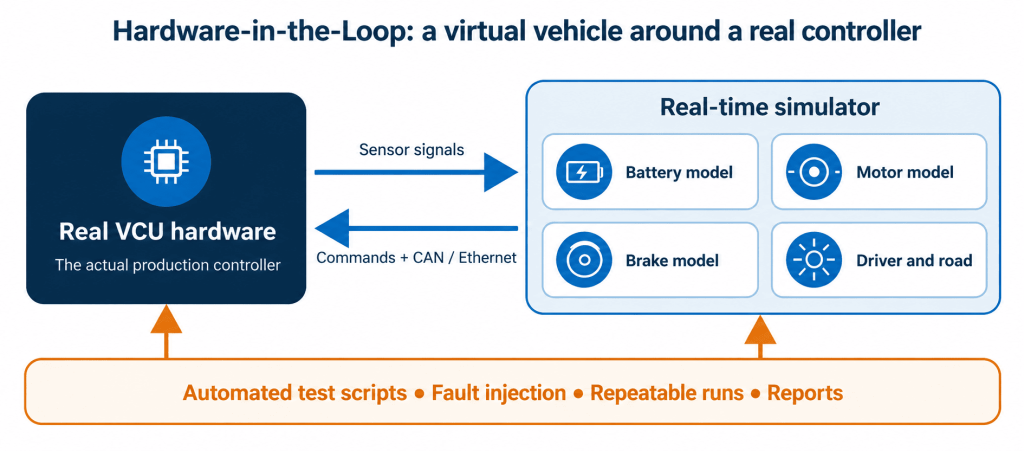
Hardware-in-the-Loop testing process
Vehicle Integration Testing
In this testing, the VCU is evaluated as a part of the fully integrated vehicle. This includes drive cycle validation, cover startup, acceleration, deceleration, regenerative braking performance, transitions in the drive mode (Eco, Power, Normal, Hill-hold, and Creep function), charging transitions, thermal performance under load, and energy efficiency measurement, as well as fault handling.
During system commissioning, heavy trucks undergo vehicle control unit testing for battery pack durability, high voltage integration, and liquid cooling by calibrating torque maps on a dynamometer which ensures UN38.3/ECE R100.3 homologation.
Although every controller passes on its own, modular interactions can highlight unexpected behavior. Vehicle integration testing can verify end-to-end use cases, network performance, multi-ECU communication, fault propagation, and diagnostic services at the vehicular level.
Road Validation & Release
Tests can be conducted on chassis dynamometers and test tracks, which are controlled, proving grounds, and public roads as per approved procedures. This validation is necessary to record real vehicular behavior, which depends on the interactions between controllers, mechanical systems, software, hardware, and calibration.
This is because simulation may not replicate real-life conditions while road validation confirms regenerative braking, drivability, and acceleration practically. This includes changes in altitude, humidity, dust, high/low temperatures, realistic driving usage profile, and reliability runs for longer durations for final release.
What Types of VCU Testing are There?
Testing the vehicle control unit involves various activities that evaluate the controller part’s interactions with other systems.
Functional Safety Testing
It verifies if the VCU feature can perform as per the intended requirements. Its test cases may include ASIL B or C level requirement verification, redundancy check, safe state validation (against other vehicle states like Key OFF, Accessory, Pre-charge, Park, and Fault), and diagnostic cover measurement.
It also checks vehicle shutdown, charging operations, startup, ready-to-drive conditions, accelerator pedal processing, torque request calculation, power management, drive mode selection/transition, regenerative braking coordination, fault injection testing, and recovery. The tester in this case records the input conditions, required behavior, actual response, and outcomes.
Communication Testing
It checks the informational exchange between ECUs and VCU using CAN 2.0, CAN FD, Automotive Ethernet, RS485/UART, UDS/J1939 interactions, Vehicle-to-Everything (V2X), FlexRay, and LIN (Local Interconnect Network) automotive system communicational technologies. Communication analysis tools can be used to inspect messages and verify the correct transmission and retrieval of the needed information. Let’s say the BMS sends the maximum permitted discharge power value; it is to be checked whether the VCU received the information and applied the predefined power limitation.
Some of the test cases in this case include message timing verification, bus load testing, Diagnostic Trouble Codes (DTCs) error frame injection, gateway functionality testing, checking CAN message identifiers, signal validity, range, bus fault recovery, network robustness, VCU response to missing and invalid messages, simulating communication timeouts, confirming message transmission periods, and verifying signal values and scaling.
I/O Testing
Input and output testing can verify the signal-processing behavior and electrical interfaces of the VCU. Inputs may include accelerator pedal signal, brake signals, temperature recordings, ignition status, and other sensor information depending on the hardware design.
Whereas the outputs may include analog outputs, digital control signals, relay commands, and communication-based requests. One needs to check signal threshold, range, scaling, polarity, fault responses, and electrical characteristics as defined in the hardware and software requirements.
Diagnostic Testing
In this case, it is tested against the specifications, whether the vehicle control unit can detect, record, communicate, and resolve diagnostic faults. It includes diagnostic communication services, session management, UDS services, trouble codes, fault status transitions, storage, and clearing or resolving conditions.
Per se, simulated sensor input (radar, LiDAR, and 360° camera for car) is disconnected, or a communication message is suppressed. Then, it is tested whether the expected fault is detected within the specific timeframe, and reports include correct diagnostic status and improved serviceability. This is to answer the query related to what type of tests are typically performed during VCU validation?
Boundary Value Testing
Boundary value testing conducts VCU behavior evaluation around the maximum and minimum permitted input values or operating parameters. This approach is useful for uncovering calculation errors, incorrect comparisons, missing range checks, and unexpected transitions. For example, an acceptable input range is defined as per the software requirement. The values are tested below the lower limit, within the range, at the limit, and above the upper limit.
Fault Injection Testing
In this case, an abnormal condition is introduced to establish whether the response of the VCU is expected. Some test cases may include missing CAN messages, voltage fluctuations, controller resets, invalid signal sensors, out-of-range measurements, bus interruptions, implausible signal combinations, sensor failures, communication errors, and power supply interruptions. The applicable requirements determine the expected response. The VCU sets a diagnostic code, restricts function, request controlled shutdown, or enters another specific safe state on the basis of the fault.
Regression Testing
Regression testing verifies if the previously verified functions were affected by software changes or unintended issues. Whenever a defect is fixed, calibration is updated, a control algorithm is modified, or new software is integrated; test cases are selected and executed repeatedly. Automated regression testing suites can identify unplanned changes in a faster manner, which is needed in projects with practically high software update frequency.
Environmental Testing
In the environmental and reliability testing, the VCU needs to undergo temperature-based testing (hot and cold), thermal cycling (-40°C to 85°C or higher), humidity exposure testing, voltage transient testing, and load dump conditional testing. It also involves vibration and shock testing, dust and water ingress (IP testing), EMC/EMI testing, salt spray or corrosion testing, performance validation under electrical stress, and altitude or pressure testing to ensure compliance with automotive standards.
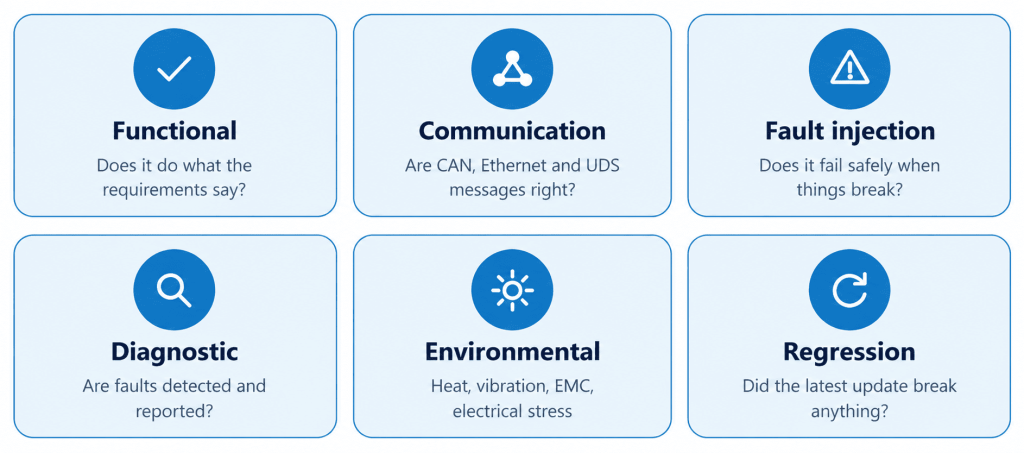
Major types of VCU testing
What are the Benefits of VCU Validation?
The overall vehicle behavior must remain coordinated when multiple vehicle systems are involved; therefore, there are various important advantages of the same, such as the following.
- Safety: Vehicle safety is dependent on incorrect control decisions, which can be verified with testing to handle invalid inputs, operational restrictions, and communication failures of the approved design using watchdog timers, fault detection, and interlock logic.
- Performance: Vehicle performance is directly proportional to the VCU’s influence on vehicle-level requests in coordination with the powertrain. Testing detects incorrect torque calculation, delayed responses, improper mode transitions, etc., performance defects.
- Efficiency: Electrical energy is efficiently utilized in EVs, which can be verified with testing, proclaimed energy management, and regenerative braking strategies under the specified conditions.
- Communication: Electronic controllers exchange information in real-time, which is validated through testing. The process uses signa values, timing, message identifiers, timeouts, counters, and more.
- Diagnostics: Simulation or test bench helps in early detection of defects and reduces rework and manual effort required for issue diagnosis during vehicle integration while improving development efficiency.
- Quality: Product quality and reliability are verified using symmetric testing around boundary, normal, and fault conditions, which prove reliability over typical driving scenarios.
- Compliance: Testing and validation need evidence which is traceable for automotive development. It showcases software, hardware, and system compliance; quality and safety requirements have been addressed.
- Cost-Effectivity: VCU testing eliminates the need for separate ECUs, thus reducing hardware and wiring costs. It minimizes new EV model time-to-market as the development process is streamlined.
- Compactness: The need for multiple ECUs is reduced, thus diminishing the additional weight and space and rendering a lighter, compact vehicle.
- Scalability: The VCU can be customized to adapt to various vehicular platforms and powertrain configurations, such as in the VCU in electric vehicle, EV two-wheelers, commercial vehicles, passenger EVs, and client requirements.
OEM-Focused Advantages of VCU Validation
- Not only does an automated and structured validation approach detect defects, but it also provides the confidence for release-related decisions and launch dates.
- OEMs and Tier-1 suppliers identify defects in integration at earlier stages and minimize field defect escape route, and vehicle launch risks while accelerating SOP readiness.
- VCU validation improves software quality and OTA deployment, increases test automation coverage, and supports ISO 26262 compliance activities.
What are the Common Challenges Faced During VCU Testing and Validation?
Since EV controller testing involves handling different operations and interaction with various power electronic systems, it becomes a complex process. Automated and scalable infrastructure for validation needs to be applied from the earliest development stages. Although various methods and tools are available, VCU validation can still prove to be demanding. Here are the related challenges of conducting the same.
- Interactions: Each of the various VCU functions, like vehicle operating mode, thermal conditions, motor status, and battery limits, depends on a number of controller pieces ofinformation. This renders accounting for these dependencies rather than isolated signal examination.
- Integration: Software that may function well in a simulated environment may behave differently during multi-domain real hardware deployment. For instance, differences in communication behavior (powertrain, charging, ADAS, vehicle detection system, thermal, blind spot detection system, and connectivity domains), electrical signals, timing, and processing constraints may lead to newer issues.
- Field Conditions: It may be difficult or unsafe to reproduce certain faults and environmental conditions inreal automotive settings. Thus, HIL testing with typical simulations can assist in investigating such cases.
- Maintenance: Test cases need to remain accurate and relevant with evolving software. This can be done by maintaining test scripts, simulation models, expected outcomes, and regression suites as needed.
- Traceability: Requirements or engineering objectives need to be linked with each test, which can be difficult to demonstrate test coverage due to poor traceability, thus making it unable to highlight defects that affect critical functioning.
- Complexity: VCU testing involves synchronized processes across a huge number of coded lines distributed over various controllers, all of which work together on modern software platforms.
- Coverage: The number of scenarios to be verified keeps expanding with newer variants, operating modes, and use cases introduced.
- Safety: Extensive evidence for verification and end-to-end traceability are requisite for ISO 26262 and improved functional safety.
- Production Cycle: Manufacturers require quicker releases while assuring quality.
- Others: Certain other challenges may include late requirement changes, poor calibration management, incomplete fault matrix coverage, CAN database inconsistencies, software-hardware version mismatch, and limited regression automation.
Best Practices for Effective VCU Testing
- Early Detection: Engineers need to shift left and detect issues at earlier stages like MIL and SIL, which are useful for cost-effective fixes.
- Automation: HIL frameworks and regression can be automated to enhance speed, coverage, and consistent performance.
- Traceability: All requirements should be traceable in terms of respective tests and results, and the same should be maintained and documented extensively.
- Validation: Continuous validation as an ongoing activity should be prioritized in lieu of considering it as a project end milestone.
- Fault Injection: VCU behavior should be confirmed under abnormal conditions through extensive fault injections and not just regular environments to ensure safety.
- Real-World Data: Road and field data need to be fed in the test scenarios to improve coverage and relevance.
VCU Validation for Software-Defined Vehicles
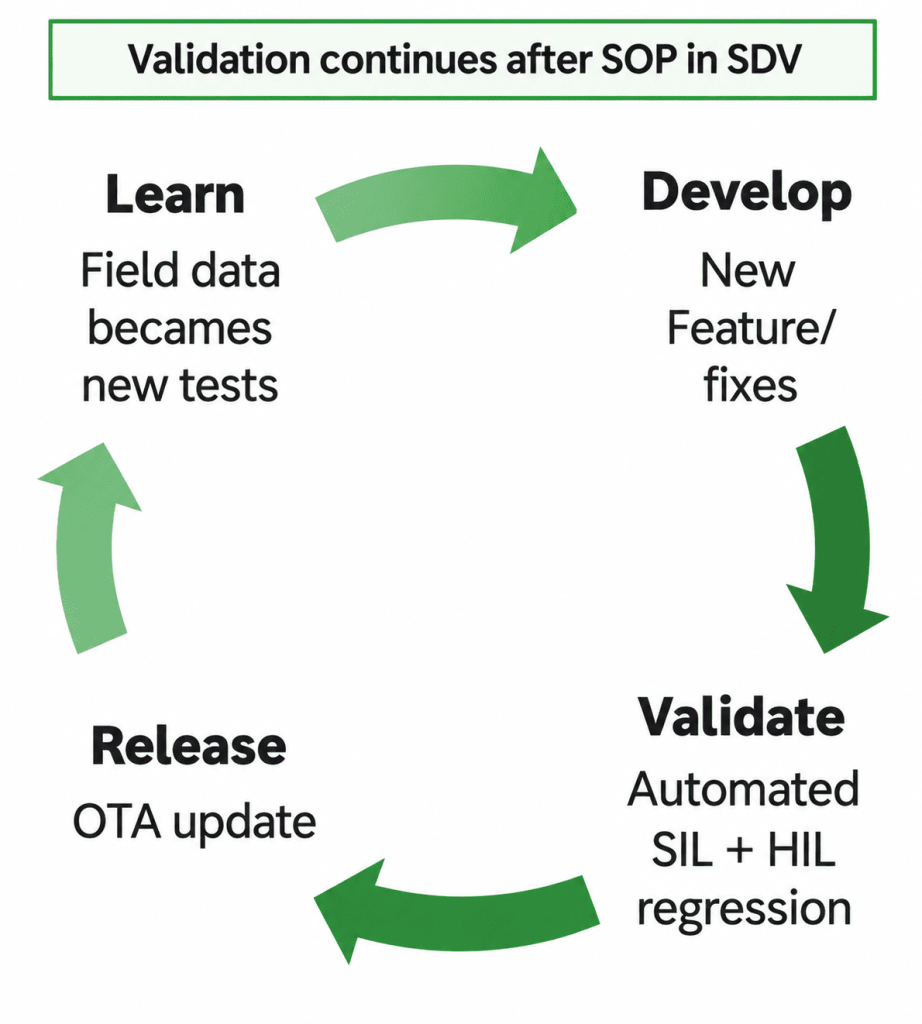
As we know, software-defined vehicles are altering the existing validation strategies fundamentally. Nowadays, production vehicles can retrieve OTA software updates, cybersecurity patches, on-demand feature deployment, functional improvements post SOP, and algorithms for new energy management. The validation process shifts to a continuous lifecycle discipline from one-time pre-production activities.
The objective is to build an automated validation backbone that traces requirements across shared SIL and HIL environments. One needs to maintain compliance with regulatory standards, quality and safety, and establish automated frameworks for validation that can support highly frequent software releases. This includes automated regression testing around every software change; HIL testing focused on integration cases and safety.
In SDVs, safety and security are checked throughout the vehicle lifecycle as OTA releases change behavior. The SDV VCU validation backbone needs to feature a regression suite equipped with functional, safety, and security tests. It also means virtual validation scenarios for scaling build numbers, field data to enhance test environment coverage, and rapid feedback loops for developmental defect detection.
Well-developed VCUs ought to answer questions about the safety of the vehicle during failure, its security during attacks, and validation of the changing software post-launch. The update requires an impact analysis, safety and security case evidence, and automated regression to ensure apt functioning.
Functional Safety
In SDVs, functional safety (ISO 26262) validation proves normal functioning of VCUs even during faults, right from hazard analysis and risk assessment. This rates hazards as loss of drive torque (ASIL level A to D), unintended acceleration, and generates safety requirements and goals. These goals are validated post-implementation to check the working of safety mechanisms.
Furthermore, coverage and diagnostic evidence with respect to targeted ASIL, requirement-based tests that are traceable from goal to result, fault injection on HIL benches (bus loss, corrupt signals, sensor faults, and voltage dips), and safety mechanism verification (watchdogs, safe state to limp-home mode transition, plausibility checks, and redundant signal comparison) are included in this case.
Cybersecurity
Cybersecurity validation begins with threat analysis and risk assessment (TARA) as the VCU connects with various cloud services, networks, and controllers, thus becoming a possible target. Alongside TARA that checks controlled functioning even during attack, certain regulations are mandatory for VCU development in the automotive market.
This includes ISO/SAE 21434, UNECE R155 (cybersecurity management), and R156 (software update management). Cybersecurity checks ensure message authentication and access to protected diagnostics (SecOC and UDS security access), secure boot and software authenticity checks, and fuzz testing of Ethernet, CAN, and diagnostic interfaces. Other measures include key management validation, secure update flow, penetration testing, and VCU, and its connected cars‘ interfaces vulnerability scanning.
From Distributed ECUs to Centralized Future Architectures
The future of automotive architectures is being revolutionized from distributed electric control units to centralized and more powerful controllers. This reduces wiring expenses and system complexity while enhancing software scalability. Many OEMs are running mixed architectures, while some are working within the four stages towards centralization, which are as follows.
- Distributed ECUs: One ECU per function with CAN and LIN for signal-based communication.
- Domain Controller: These are grouped as per domain, like powertrain, body, chassis, infotainment, ADAS, etc., and function over Ethernet.
- Zonal Architecture: The wiring is simple at the central compute, which is connected to actuators and sensors at the physical location aggregated by the zone controllers.
- Centralized Compute: Limited number of high-performance computing systems run vehicle software as services as zonal controllers handle distribution of power, output, and input.
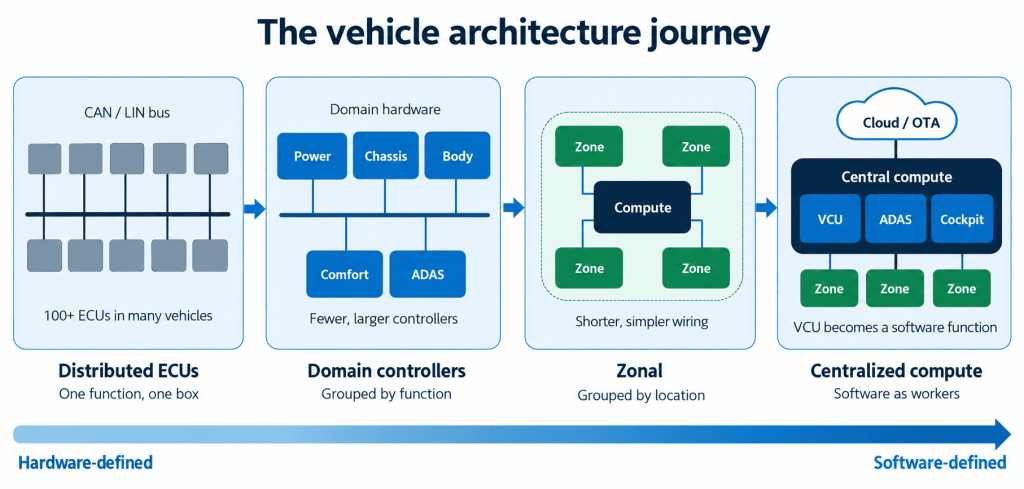
Types of vehicle architecture and related VCU testing mechanisms
Thus, in a centralized architecture VCU’s torque, mode management logic, and energy can run on a shared vehicle as software instead of a dedicated box, along with ADAS and infotainment functions. Real-time deadlines and security needs can be met while safety-critical control protects other lowly critical software from interference and partitioning through hypervisors.
Businesses need to invest in virtual scalable ECUs and SIL environments across multiple builds and HIL benches for emulating Ethernet services and many domains. Validation teams ought to focus on timing and interference testing, end-to-end latency, jitter, and security validation by zone and interference. Such teams building automated and virtual validation can move vehicular functions to the central compute. By investing more in regression coverage across software and hardware variants, they can restart their testing strategy.
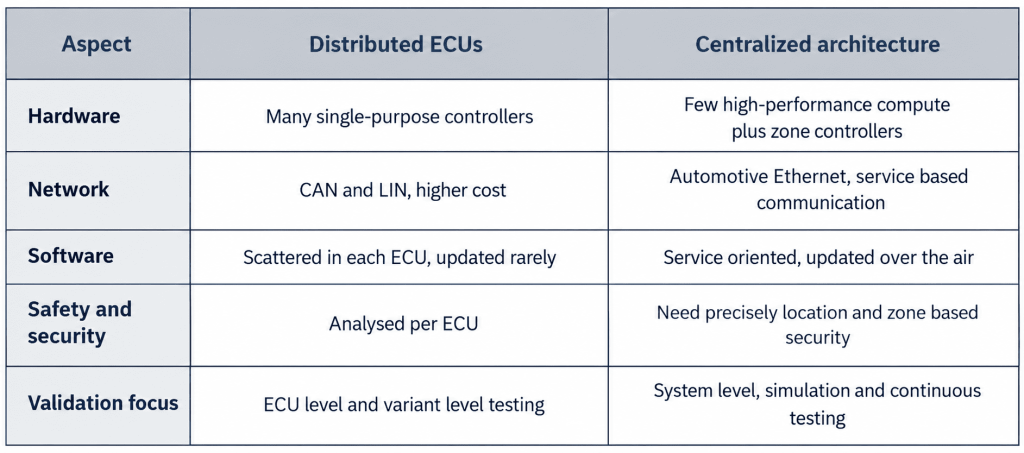
How validation changes the future of VCU architecture
KritiKal: How We Support VCU Development & Validation
KritiKal Solutions takes VCU software from the requirement stage to production readiness to assist OEMs and Tier-1 suppliers in reducing related risks and increasing their confidence in production release. We combine model-based development, automotive test engineering, and embedded software in one engagement.
Expertise
- Development: VCU requirement analysis, embedded application software, and software architecture
- Validation: Automated frameworks for MIL, SIL, PIL, and HIL validation to increase coverage while reducing manual efforts.
- Safety: Functional safety requirement analysis, ISO 26262 compliance support, and fault injection.
- Diagnosis: DTC, UDS, and communication validation across Ethernet, LIN, CAN FD, and CAN.
- Integration: Testing of multi-ECU vehicle integration and vehicular-level issue resolution.
- AUTOSAR: Application software integration along with software checks.
Tools
KritiKal’s testing team utilizes software applications, real-time simulators, measurement equipment, and communication interfaces for vehicle control unit testing and validation. These include MATLAB and Simulink for mathematical modeling, simulation, test automation, and control algorithm development in MIL and SIL workflows.
We also have expertise in Vector CANoe and CANalyzer which support automotive network simulation, analysis, testing, and observing communication traffic. This is useful for inspecting CAN messages, decoding signals with DBC files, simulating communication participants, and test scenario automation, other than AUTOSAR utilization.
Other than these, we also utilize dSPACE for real-time simulation and testing in automotive development, where the systems support HIL testing, automated test execution, and rapid control prototyping. Further, our expertise on ETAS INCA allows measurements, data acquisition, and calibration in electronic stability control (ESC) development workflows, and its functioning is dependent on the project toolchain, interface hardware, and ECU.
We have developed numerous projects using Python and CAPL for automating test sequences, process measurement data, generating reports, integrating testing activities with software tools, and comparing expected and actual outcomes.
Standards
We strictly follow regulations and standards in our testing procedures, such as ISO 26262, which addresses the functional safety of electrical and electronic systems. Also, Automotive SPICE, which provides an assessment framework for automotive software evaluation and system engineering processes. ISO 21434 is related to cybersecurity in vehicle engineering, VCU’s connected functions, and communications interfaces.
We also follow ISO 16750 which relates to environmental conditions and testing of electronic and electrical equipment in vehicles. Other important standards that we follow include UNECE WP.29, ISO 14229-1, ISO 15765-3, GB/T19596, QC/T413, GB/T27930, GB/T20234 (Parts 1 to 3), QC/T897, and GB/T18384. (Parts 1 to 3), and GB/T18385.
Services
We ensure that all best VCU testing practices are followed, such as in human machine interface development, combining repeatable processes with technical rigor. We clearly define your testing requirements, test purposes, and measurable expected results. We test both normal and abnormal conditions, state nominal operations, boundary values, invalid signals, communication faults, and recovery behavior. We use the right levels of testing, like simulation for early development, HIL for verification at the controller-level verification, and vehicle testing for system behavior post Real-Time Operating System (RTOS) integration.
We not only automate repetitive tests in Model-based Design (MBD) for efficient regression testing execution but also maintain configuration control by recording hardware revision, software versions, calibration, and testing environments. All safety-connected failures in AI in self-driving cars are systematically investigated; logs and measurements are preserved; issues are reproduced for root cause identification; and fixes are verified. We ensure traceability by connecting requirements, test cases, outcomes, and defects for assessing coverage.
We can be your partner in conducting the various tests mentioned in this blog. As fleet management systems, EVs, and hybrid vehicles continue to become more sophisticated, the need for validated, reliable control software is bound to grow. And due to this, the ultimate goal of VCU testing and validation becomes not only to confirm controller operations but also to establish that it is able to perform its required functions well when integrated within the vehicle system.
Unlike traditional Internal Combustion Engine (ICE), the future of integrated VCU testing encompasses Autonomous, Connected, Electric, and Shared (ACES) mobility; AI/ML-based real-time sensor-to-camera decisions, Over-the-Air (OTA) updates to address security vulnerabilities; cloud-connected VCUs; Advanced Driver Assistance System (ADAS); and Vehicle-to-Grid (V2G) integration that support sustainable energy through renewable energy.
We also render OEM-focused capabilities, including a validation approach that enables customers to identify integration defects at early stages. Alongside this, it also reduces vehicle launch risks, accelerates SOP readiness, increases test automation coverage, and improves software quality. We support ISO 26262 compliance, improve OTA deployment confidence, and reduce field defect escape rates.
Business Outcomes We Deliver
We offer faster software release cycles, higher validation coverage through automated frameworks, and improved compliance readiness. As automobile programs are becoming increasingly validation-intensive and software-defined, the need for the hour is more than technical excellence. What differentiates KritiKal is our prowess to bridge program leadership and engineering execution. Thus, helping customers to minimize development-related risks, achieve predictable launch outcomes, and accelerate validation.
Are you planning a VCU program or looking to scale your validation? Let’s discuss. Talk to KritiKal’s automotive team about the roadmap for VCU development and validation. We can help accelerate delivery while maintaining high-value safety, quality, and performance. Please get in touch with us at sales@kritikalsolutions.com to know more about our embedded products, platforms and services and realize your automotive business requirements.
Conclusion
The VCU forms the central intelligence of modern EVs and hybrid vehicles. It is therefore necessary to ensure its safe, efficient, and reliable performance throughout the lifecycle of the vehicle. This can be done through comprehensive checks, simulation, automation, HIL testing, and real-world validation.
Automotive businesses can minimize risks related to launch readiness and accelerated product development. The ultimate future of automotive validation has become vehicle, software, and lifecycle-centric, rather than traditional controller-centric approaches.
As the sector moves towards developing SDVs, continuous software deployment models, centralized compute platforms, and zonal architectures, organizations need to build scalable validation strategies that can be applied to complex systems. Though the objective is not simple verification of proper functioning of software, but to ensure that the vehicle remains secure, safe, performant, and predictable all through its operational lifecycle.

Azad Ansari is a Project Manager at KritiKal Solutions with 19+ years of experience in automotive embedded systems, vehicle electronics, telematics, instrument clusters, functional safety compliance, ASPICE-driven development and large-scale project execution. He has led multiple global automotive software programs across OEMs and Tier-1 suppliers, supporting concept-to-SOP delivery, validation strategy, quality management, and zero-defect product launches.