

 Global
  United States
What is a Smart Hybrid Inverter?
The global markets are witnessing a rapid increase in electronics manufacturing services, electric vehicles, and energy storage solutions, to which electric vehicle (EV) batteries are unable to cater. This is because of the stringent performance needs of these vehicles and low-capacity retention after decades of being in use. Another issue that arises from this is the premature discard and recycling instead of second-life repurposing. To overcome such challenges that have arisen alongside the global energy landscape shift, automated, resilient, flexible, simplified, and cleaner solutions like hybrid inverters are being adopted.
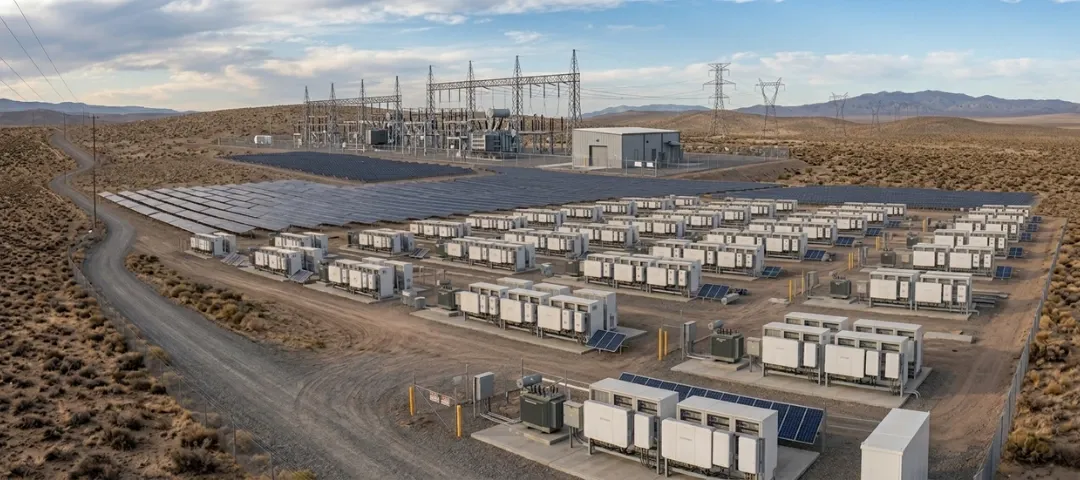
Battery energy storage solutions form the transformational center of demand peak management, electricity usage alternatives, outage backups, and excess solar power storage. Hybrid inverter technology integrates smart energy control, battery management, and energy conversion in a unified, singular unit of solar-plus-storage system or a versatile device. Such inverters developed through indigenous technology services can perform combinatorial functions of traditional battery inverters and solar or photovoltaic (PV) inverters by converting the direct current (DC) generated by solar panels into alternating current (AC) power for everyday use in households and offices.
A hybrid solar inverter embedded with software, sensors, and communication protocols like Automated Demand Response (OpenADR) is responsible for managing the discharging and charging in energy storage systems, and coordinating energy flows between home appliances, the grid, the battery, and the solar array. Due to their efficient and streamlined approach of integrating energy storage, unlike standalone systems, they are ideal for businesses, homes, and other places that seek value maximization of renewable energy solutions and intermittent distributed energy resources (DER). They offer flexibility in off-grid and grid-tied configurations and are considered ideal for microgrids and modern power management systems.
The current global market for the solar power hybrid inverter is estimated to be around US $10.43 billion as of 2024 and is expected to surge and reach an approximate value of US $16.04 billion by 2032, increasing at a CAGR of 6.1% during this forecast period. Let us now go through the critical role of hybrid inverters across energy storage solutions and how organizations are redefining intelligent renewable energy system standards in this blog.
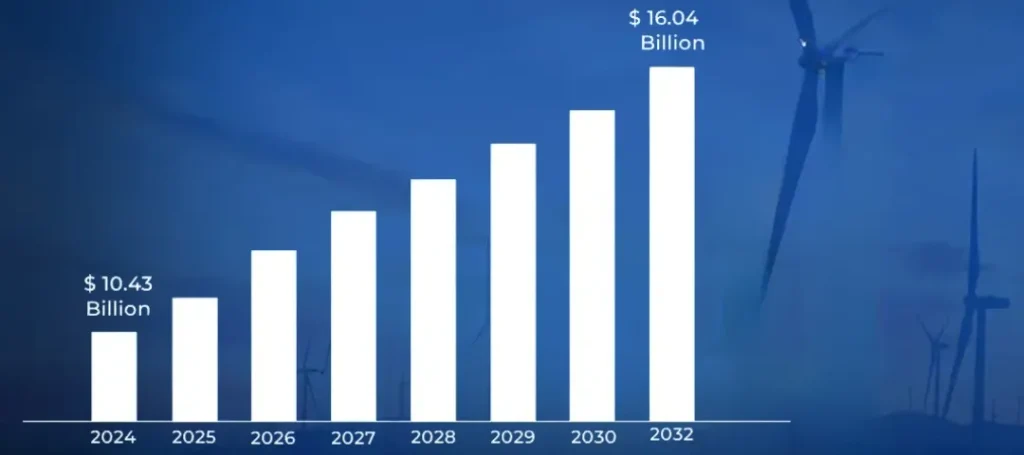
Source: Verified Market Research
Growing market size of smart hybrid inverter during the forecast period 2024 to 2032
Working of Hybrid Solar Inverter
The earlier versions of mechanical inverters simply involved passive DC to AC conversions, which have now been replaced with smarter renewable energy storage solutions and solar inverters. Reliable solar power technologies have helped in meeting energy demands. The need for smooth, grid-integrated electricity management and power optimization embedded systems and Internet of Things (IoT) has led to home and business owners switch to versatile and modern hybrid inverters. It is always important to check that the rated power (kW) of continuous AC output is greater than peak household or commercial office load to avoid shutdowns and oversizing.
Post rigorous quality engineering and testing against extreme weather; the reliability of an inverter is determined by its effectiveness and performance over time. The durability and longevity of the inverter translate to advanced thermal management and handling of fluctuations in temperature, for example, Deye and Sun-5G. DC-coupled hybrid inverter systems merge traditional solar (string) inverters and battery backup solutions for complete and seamless grid connectivity, battery storage, and solar power usage.
Not only do they convert DC from solar panels into usable AC power for running businesses and households, but they also manage battery discharging, charging, and power outages by converting AC from the grid to storing it in the battery as DC (anti-backflow as per grid status, battery charge, switching mode, real-time load, and sunlight using a CT current sensor). Installing a hybrid inverter stands to be more complex than a standard grid-tied inverter since additional wiring is required to accommodate solar panels, battery storage, and input and output wirings of other energy sources. Also, it is recommended to choose a durable model that carries quality assurance certifications from third parties like Clean Energy Associates (CEA), has an IP65 enclosure rating, UL 1741, IEEE 1547, NEC Articles 690 and 706, and Order N. 841 and 2222 by the Federal Energy Regulatory Commission (FERC).
Given below are the main components of these inverters that are important for their functioning and energy savings.
Battery Storage
These systems store additional generated energy during daytime to be utilized later at night, on cloudy days, or during power fluctuations, outages, or peak demand. Battery storage for Lithium Iron Phosphate, Nickel Manganese Cobalt, and Nickel Cobalt Aluminum (LFP/NMC/NCA) batteries is key to these inverters as it allows users to cut down on grid usage, benefit from continuous solar energy, and boost energy security.
Grid Elements
The local power grid connection allows extra energy flow to grid-tied inverters, while off-grid inverters keep the power supply continuous even during outages. Selecting the right grid connection elements with a battery inverter affects system performance in terms of cost savings, energy independence, and a cleaner energy supply.
Solar Panels
Different types of solar panels, such as polycrystalline, monocrystalline, bifacial, and Topcon panels, as per system functionalities, cost and can be integrated to form the base of these inverters and turn sunlight into electricity.
Connectors & Controllers
Multi Contact 4mm (MC4) connectors provide reliable connections between the inverter and panels to reduce energy loss and ease installation. Charge controllers are compatible with both Pulse-Width Modulation (PWM) and MPPT controllers for longer battery life and efficient charging.
Solar Kits
These are pre-packaged commercial and residential solar kits that can be utilized with hybrid inverters to maintain optimal performance and simplify setup of devices based on IoT in renewable energy.
Given below are the different types, modes, or applications of hybrid inverters deployed across commercial and residential settings as per IoT device configuration management requirements.
Off-Grid Models
Off-grid capable hybrid inverter systems are used in underserved, rural, remote, or isolated regions that do not have functional grids (sometimes generator backup) for supplying power in conjunction or independently by using a battery inverter and solar panel. This functionality supports power supply to high-demand appliances, such as EV charging stations, pumps, ECU in electric vehicle, and refrigeration units.
Multi-Mode Systems
These hybrid systems can function with and without a grid and switch instantly whenever required to source reliable solar power and reach green energy goals. In case of surplus energy storage or recharge mode, the battery is charged through a bidirectional DC/DC module rather than the grid, where the former is recharged at night through cost-effective grid power. This enables peak-valley arbitrage, reduced bills, and energy storage for outages and high-rate periods.
Grid-Tied Hybrid Inverters
These models are optimized by MPPT modules for peak shaving and function with the electricity network and grid as they supply solar energy DC after conversion to local loads, households, commercial offices, and industrial businesses while still having grid power. They seamlessly switch between battery and grid power to ensure continuous power supply in case the grid goes down or otherwise. If the battery drops lower than the protection threshold, the grid backup mode reconnects to the grid to directly power the load and recharge the drained battery.
Others
Grid-tied homes, villas, apartments, and residential setups receive a power range of 3-10 kW and benefit from lower bills, backup power, net metering, and smart monitoring from hybrid inverters. Commercial buildings, retail stores, hospitals, schools, and offices receive power ranging between 10-50 kW and benefit from peak shaving, cost savings, and improved reliability due to hybrid inverters.
Industrial facilities like factories, warehouses, and manufacturing plants receive around 20-200 kW of power range, and hybrid inverters help them with high load handling, power stability, and load optimization. The typical power range dispensed to rural homes, cabins, islands, off-grid, and remote locations is 3-30 kW and is dependent on hybrid inverters for battery-backed power and complete energy independence, while th receiving range is between 1000-1500V from solar farms.
Portable and mobile solar systems, such as RVs, boats, camps, and mobile workstations, receive power ranging between 1-5 kW, where hybrid inverters are usually lightweight, compact, flexible, and easily deployable. In case of telecom towers and remote monitoring stations, the power received ranges between 3-20 kW, and hybrid inverters (Integrated Gate Commuted Thyristors – IGCT vs. Insulated Gate Bipolar Transistors – IGBT) provide them with round-the-clock reliable power supply for reduced diesel-generated energy usage.
Hybrid inverters render benefits like lower operating costs and sustainable energy generation for irrigation pumps, farm buildings, cold storage, irrigation pumps, and other agricultural and farm operations where the power received ranges between 5-50 kW. For EV charging communities, electric vehicle control system, EV chargers, backup hubs, and microgrids receive a power range of 5-100 kW where they are assisted by hybrid inverters in smart load balancing and achieving a sustainable future.
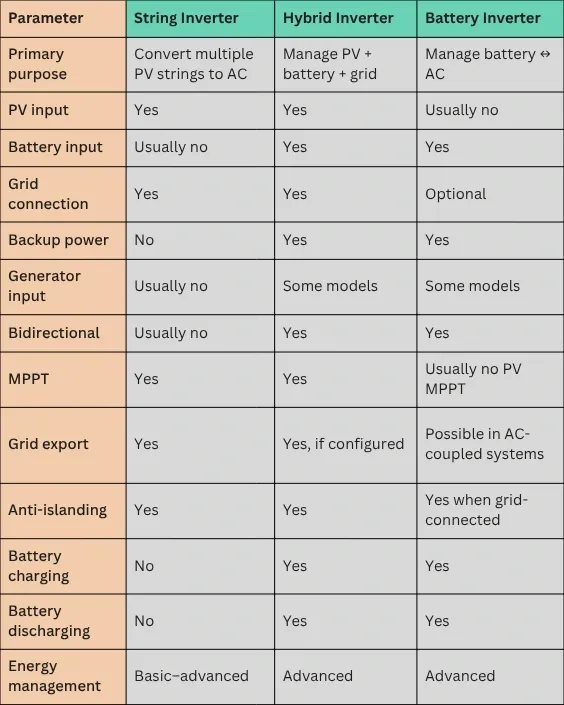
Comparative table of renewable energy systems and types of inverters
Key Functions of a Smart Hybrid Inverter
Given below are the main functions that support the need for hybrid inverters in energy storage systems. These can also be considered as the specific advanced features or modules of hybrid inverters used in smart energy management across solar installations.
Battery Management
Smart battery management system in electric vehicles, and other capabilities allow efficient battery discharge, charge, and monitor the battery energy storage system (BESS). Hybrid inverters like EG4 FlexBOSS21, Nova 6500-S, Solis S6-PRO, and others developed by Huawei, SolarEdge, Fronius, SMA, Growatt, and Enphase can guarantee that the batteries enable cost savings while always keeping up their maximum performance for a longer duration. The battery charge/discharge module (bidirectional DC/DC) charges the battery from the sun and produces DC output while controlling current and voltage for battery protection.
Maximum Power Point Tracking
MPPT (DC/DC) assures maximal functioning of solar panels and the efficiency of hybrid inverters irrespective of the weather. It allows the system to adjust the settings in such a manner that it receives the utmost solar energy and improves its performance. The MPPT PV boost module takes DC from the solar panels, monitors the sun to increase generation, and directs a stable voltage towards the next stage.
Smart Grids
Integrating hybrid inverters with smart grids supports grid functionalities, variable generation from rooftops and solar parks, and net metering, which ensures grid stability and high-quality power supply. Businesses and homeowners can sell additional solar energy generated while minimizing their electricity bills.
Power Export
Hybrid inverters link integrated grid systems with hybrid renewable energy systems for users to attain maximum power from solar setups. With features like net metering and automatic power export after charging a connected battery, users can utilize these inverters to flow additional energy back to the grid and gain credits leading to increased solar investments from consumer electronic product development.
Grid Support
Grid support functions performed by Silicon carbide (SiC) inverters include maintaining grid stability and reliability by providing voltage control, reactive power, remote monitoring, updates, and power handling during outages and changes. They can communicate with the grid, support its stability, and respond to changes in frequency and low-voltage ride-through (LVRT), allowing them to handle high solar penetration with assured reliability.
System Monitoring
These inverters offer advanced visibility, commandeer electric vehicle controller, monitor battery status, energy production, pumped hydro storage, compressed air energy storage (CAES), and consumption patterns through digital platforms for smarter decision-making.
Power Backup
During electricity outages, these inverters can isolate the grid for uninterrupted supply to necessary loads when paired with battery storage systems like Tesla Powerwall, LG Chem RESU, and Enphase Encharge. Grid independence and backup power features can essentially support remote applications and rural areas that are prone to and grapple with unstable power supply, availability, and blackouts, thus paving the path to their complete energy autonomy.
Energy Flow
These intelligent inverters control energy flow in real-time to manage the power supply to households, export to grids, and charge batteries. They feature grid code-compliant bidirectional power flow (bidirectional invertor module – DC/AC), that is, DC from panels and battery into grid-frequency AC for loads and vice versa for recharging the battery. They avoid colossal damage to commercial businesses, and prioritize renewable energy conservation, energy waste reduction, efficiency optimization, and overall performance improvement.
Grid Integration
These inverters enable the seamless integration of solar battery storage systems for cohesive functioning. They can increase energy consumption while reducing the need for costly utility power. They store excess solar energy generated during the day and use it during grid outages and at night instead of sending the same back to the grid to optimize financial returns related to solar systems in the long run.
Energy Independence
As discussed earlier, sunlight may not always be available across all regions, weather, and times at cheaper costs, but this can be tackled by using hybrid inverters that store surplus energy. This reduces grid load and enhances energy independence even during intermittent sun rays. Smart inverters adjust output in fluctuating scenarios to actively support grid stability and prevent blackouts and voltage spikes.
Energy Arbitrage
Modern hybrid inverters are powered by smart hybrid inverter software features that showcase automatic energy arbitrage and load shifting. Power sources can be optimally used as per electricity rates, where the system is programmed to charge the battery with cost-effective grid power in case of low demand intervals. Similarly, the system can discharge the battery during peak demand hours to power electronic appliances, thus reducing utility costs.
Scalability
Users can participate in demand response initiatives and grid support programs, which allow them to send energy back to the grid during peak demand. These inverters uplift businesses to scale and expand easily and flexibly from batteries to solar and infrastructure.
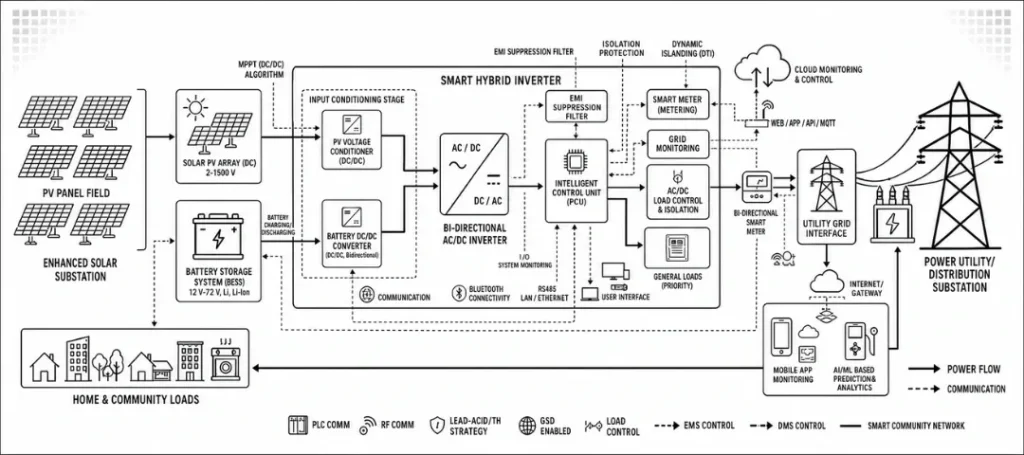
High-level architecture diagram of hybrid renewable energy systems
Advantages of using a Smart Hybrid Inverter
There are various practical applications and benefits of using these inverters, such as the following.
- Sufficiency: Home and business owners with these inverters experience increased self-sufficiency.
- Low Emissions: Greenhouse gas emissions can be reduced for a cleaner energy suppl
- Easy Maintenance: Remote monitoring and IoT for predictive maintenance of solar-plus-storage.
- Assured Backup: Home and business owners can back their assets against sudden power outages.
- Reduced Bills: Peak shaving and load shifting result in lowered electricity bills and economic viability.
- Grid Independence: Improvement in renewable energy with more independent yet steady usage.
- Low Footprint: Optimized utilization of solar power systems to reduce carbon footprint.
- Easy Installation: AC-coupled systems can be added to old or existing solar systems.
- Better ROI: Solar-powered batteries and technologies render better return on investment and LCOS.
- Reliability: Rigorously tested to withstand extreme weather and deliver consistent performance.
KritiKal’s Role in Next-Gen Solar Energy Solutions
In this blog, we discussed how hybrid inverters act as engines for energy storage and play a central role in contemporary energy systems amidst rising power expenses, imbalances in supply and demand, and excessive utilization of renewable resources. They form the conduit between household power supply, grid demand, solar production systems, and charging batteries by handling complex interactions and making renewable energy cost-effective, resilient, and practical in terms of its usage. They revolutionize solar energy usage by storing the produced energy from a diesel PV or battery inverter, making users self-sufficient even in case of low energy production spells and scaling up local setups for uninterrupted power supply.
KritiKal Solutions can deliver advanced energy management systems, applications, and inverters for commercial, industrial, and residential areas that lie at the forefront of innovative energy solutions. We offer design, development, and product engineering services for high-efficiency power electronics that can reduce conversion energy losses in addition to seamless integration with EV chargers and battery systems. Our single- and three-phase solar hybrid inverters with future-proof design can predict weather conditions and energy usage and consumption patterns for smarter and definite control, while supporting intelligent grid interactions and scalable storage expansion.
We rigorously follow industry-leading design and interconnection standards for protection of property and users, robust hardware development services, and incorporate AI-based digital control, compatibility for battery-less operations, anti-backflow control, bi-directional solar power conditioning units (PCUs) and power conversion systems (PCS, warranted whole home vs. essential loads backup, and solar energy systems that enable secure solar power ecosystems.
Our hybrid inverters feature dual-independent battery ports for easy battery capacity expansion; bus and multiport architectures for minimal grid impact; ModBus protocol, PV modules; BESS; wide-bandgap Generative Adversarial Network (GaN) devices for high power density, low total harmonic distortion (THD); high Locked Rotor Amp (LRA); MPPT algorithms; microgrid and generator mode support for grid independence; built-in surge protection for both AC and DC sides; rapid emergency shut down; vehicle-to-everything (V2X) and vehicle-to-grid (V2G)-ready smart energy management; and Virtual Power Plant (VPP) compatibility for energy trade and efficiency maximization.
We strive to design, develop, and deliver future-ready, accessible, safer, and smarter energy storage systems; IoT-based remote monitoring; control inbuilt isolation transformers; and hybrid inverters tailored to EPCs, installers, and end users as per their business requirements. Please get in touch with us at sales@kritikalsolutions.com to develop multifaceted hybrid inverters that combine grid-connected operations, battery discharging/charging, and off-grid sustenance.

Niraj Kumar currently works as a Senior Embedded Engineer at KritiKal Solutions. He is proficiently skilled in embedded C, C++, Linux, RTOS, device drivers, BSP, bootloader, firmware development, and debugging. With his ability to work efficiently in teams and more than 11 years of experience working on embedded system development, he has assisted KritiKal in delivering various projects to some major clients.