

 Global
  United States

What is Cybersecurity Management System?
The automotive industry is being transformed with data collected from various vehicles equipped with telematics systems using IoT sensors, cloud, and cellular networks. With data flow at the epicenter of this revolution, securing its transmission through the telematics control unit (TCU) further generates concerns.
This is where automotive IT solutions and telematics cybersecurity come into play, as they perform an important role in establishing a secure connection between the cloud and the device. It is responsible for reliable transfer and protecting the data between the same from hackers and third-party interception or manipulation attempts. Its framework and suitable application can avoid risk-prone data transmission between different modules of the telematics unit using development and operations.
The global market for cyber security management services was valued at ₹15.92 trillion in 2025 and is predicted to increase up to ₹27.86 quadrillion by 2034, expanding at a CAGR of about 6.42%. The cybersecurity services market in India might experience a jump from its current value of ₹499.22 billion as of 2025 to ₹1.16 trillion by 2030, translating to an approximate CAGR of 18.33%. The market revenue of automotive cybersecurity was valued at ₹493.86 billion in 2024 and is surging at a CAGR of 15.2% to reach a value of about ₹1.66 trillion by 2033.
The main growth factors that are driving this market include an industry-agnostic rise in cyber threats, breach volumes, digital transformation services, cloud-first public programs, demands, standards in regulatory compliance, and data protection rules for vehicle control unit development. In this blog, we will unravel the cybersecurity mechanisms involved in securing data flow between the telematics infrastructure and cloud components used by the fleet management system and automobile owners.
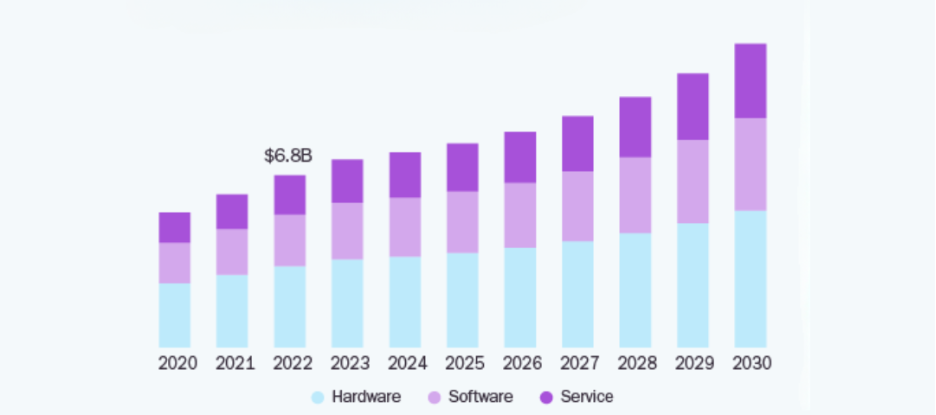
Source: Grand View Research
Growing market size of automotive cyber security management services from 2020 to 2030
The Role of Cybersecurity Management System
- Cyber-physical safety and control assurance in modern Software-Defined Vehicles (SDVs) is of prime importance as a considerable shift has been observed in recent years from mechanical control to drive-by-wire and level 2+ autonomy. In the context of the automotive domain, this shift introduces critical attack vectors in the system, such as EV motor controller.
- In this case, the cyber breach allows lateral movement from the infotainment system to steering or powertrain. In other words, the safety-security paradox in SDVs can result in shifting the risk from data exfiltration to kinetic impact, which is loss of control of the vehicle.
- Therefore, from the customer’s lens, the key embedded cybersecurity ask becomes cyber resilience from silicon to cloud and a mathematical guarantee that a cyberattack on any ECU does not cascade into loss of steering, power control, braking authority, or battery monitoring system.
- With current advancements, vehicles are no longer air-gapped and act as active nodes in a grid. The grid represents a hyper-connected environment between the traffic infrastructure, cloud backends, and charging stations, backed by the IT security management system.
- A notable trend to diminish the connected fleet key management system trust gap between cloud and ECUs includes feature-on-demand or subscription-based unlocks. These are useful for dynamic configuration management, which is tamper-proofed using advanced cybersecurity measures. Thus, another key embedded cybersecurity ask from the customer comes out to be prevention of tampered or unauthorized configurational changes on the edge or at the machine level.
- United Nations Regulation Number 156 (UN R156) by UNECE mandates that Original Equipment Manufacturers (OEMs) must manage software updates for 10 to 15 years in a secure manner. This highlights the high level of complexity, liability, and frequency of updates.
- Failure of updates in real-time can result in a bricked vehicle fleet or a non-functional vehicular state that might need a tow truck and result in heavy losses through warranty claims. This all together calls for a push for critical patches simultaneously for large fleets without any risk of operational downtime, resilient lifecycle management, and OTA integrity as a part of robust cybersecurity measures.
- Today’s vehicles are driven by control key systems, including steering, acceleration, braking, collision warning systems, and more. A vehicle once compromised and controlled by an attacker can have tragic consequences, hinder human safety, and endanger lives.
- This framework is necessary to protect personal and sensitive data collected in vast amounts by the vehicle. This includes driving behavior, location history collected as per Automotive Industry Standard 140 (AIS 140), user preferences, biometric inputs, payment information, inferences from the blind spot detection system, etc. It avoids misuse of such data, privacy violation, and prevents it from being stolen against financial and reputational harm.
- Automotive cybersecurity is governed by regulations and standards, such as GDPR data protection laws, UNECE WP .29, and ISO/SAE 21434. An effective IT security management system or service can assist manufacturers in maintaining compliance with mandatory regional regulations, requirements, and standards.
- Moreover, publicized data security breach, technical failures are reputational risks and deplete client trust and sales, resulting in expensive recalls and legal penalties. This framework can preserve brand reputation as it keeps up with customer expectations of owning safe and secure vehicles.
- It makes the vehicle future-proof for automated driving, over-the-air (OTA) updates, and vehicle-to-everything (V2X) communication. Its resilient architecture secures data channels and avoids cloned components to ease the implementation of emerging technologies in vehicles.
Key Features of Cybersecurity Management System
The TCU acts as a gateway across complex operating systems and plays a key role in managing and securing wireless communication between the in-vehicle and external networks. If the TCU data communication flow is intercepted, it leads to exposure of the Controller Area Network (CAN bus) to threats across these networks that may include Wi-Fi, GPS, Bluetooth, cellular connectivity, vehicle diagnostics, and emergency services. Let us discuss various components of cybersecurity that can avoid the occurrence of its data-compromising misdemeanors.
Technologies
1. DFA Logic: Deterministic fail operation logic, a concept of Deterministic Finite Automata (DFA), is a set of states and transitions that maintain basic controllability. In a case where the vehicle is moving at a high speed and an intrusion is detected, the compromised node is isolated. Furthermore, the system transitions to a secure limp-home mode instead of dangerously shutting down to ensure driver safety.
2. Safety-Security Handshake: This refers to ISO 21434 and ISO 26262 standards, which include real-time validation of safety controllers as per Automotive Safety Integrity Level D (ASIL-D). It involves continuous auditing of command integrity within connectivity controllers and rejecting commands that may violate envelopes of physical safety.
3. Communication Protocols: Data in motion can be encrypted using cryptographic protocols, such as Hyper Text Transfer Protocol (HTTPS), Transport Layer Security (TLS), and Internet Protocol Security (IPSec). In-vehicle networking protocols are used to protect internal buses, for example, Secure CAN, FlexRay security extensions, and more.
4. Hardware Security Modules: HSMs are modules that store cryptographic keys, encrypt and decrypt data to resist tampering. These are integrated with Electronic Control Units (ECUs) and TCUs to safeguard sensitive keys against physical malicious attacks.
5. Intrusion Detection & Prevention Systems: Intrusion detection and prevention systems (IDS/IPS) are signature-based or anomaly-based tools that indicate an attack. They analyze traffic patterns to recognize anomalies, including unauthorized attempts to access and unusual command sequences. Network-level heuristics on Ethernet or CAN act as the backbone for detecting spoofed messages and anomaly injection even before they can execute.
6. Integrity Checks: Digital signatures of firmware and bootloaders are checked using secure boot mechanisms in the IT security management system. These boot and firmware integrity checks validate authorized software runs on ECUs, such as in the 360° camera for car, and verify if no tampering was done to the firmware during runtime.
7. Endpoint Protection: Endpoint security software features whitelisting of trusted processes while blocking suspicious activity. The automotive monitoring system monitors and defends every ECU, module, and gateway against unauthorized access and malware attacks.
8. OTA Framework: Secure over-the-air framework ensures that updates are encrypted, digitally signed, and verified prior to installation by using version control and mutual authentication.
9. Distributed Ledgers: Blockchain and distributed ledger technology are used to secure vehicle-to-everything communication and critical data logging. These provide tamper-proof records of audits, updates, and commands.
Tools
1. Vulnerability Scanners: Inherent vulnerabilities present in communication protocols, firmware, and network interfaces can be identified using automotive-specific scanners and tools, such as Nessus, OpenVAS, etc.
2. Network Analyzers: In-vehicle network traffic can be analyzed to capture anomalies using tools like Wireshark, CANalyzer, Vector tools, etc.
3. Code Analysis: Tools for static code analysis can scan source code vulnerabilities prior to compilation. On the other hand, dynamic code analysis tools can detect unsafe behavior while testing running software, for example, Coverity, Fortify, Checkmarx, etc., that ensure the vehicle detection system runs safely.
4. Penetration Testing: Tools like hardware-in-the-loop platforms, TCU and ECU testing labs can simulate real-world attacks and validate defenses in network security and management.
5. SIEM Platforms: Security information and event management (SIEM) platforms and tools can collect and correlate logs. Such data obtained from vehicle subsystems can be used to identify trends, compliance issues, and threats.
6. Anomaly Detection: Machine Learning (ML) and AI-powered anomaly detection alerts concerned stakeholders to any detected deviations. These systems learn normal vehicle behavior and trigger notifications indicating malfunctions or intrusions.
Algorithms
1. Cryptography: These algorithms include symmetric encryption that are fast encryption techniques for resting and transmitting data, for example, Advanced Encryption Standard (AES). It also includes asymmetric encryption for key exchange and digital signatures, for example, Rivest-Shamir-Adleman (RSA), Elliptic Curve Cryptography (ECC), etc. Furthermore, hash functions such as Secure Hash Algorithm – 256 bits (SHA-256) can provide integrity checks and secure authentication.
2. Machine Learning: ML algorithms can discern patterns in network behavior, detect anomalies, and flag unusual activities for efficient logistics. These algorithms may include random forests, neural networks, clustering algorithms like K-means, support vector machines (SVM), etc.
3. Protocol Validation: These algorithms ensure expected state transitions and formats are followed by packets as per protocol. By validating such compliances, these algorithms protect in-vehicle networks against malicious and malformed messages.
4. Blockchain Consensus: These include algorithms, such as Practical Byzantine Fault Tolerance (PBFT), Proof of Authority (PoA), etc., in blockchain. These algorithms ensure secure and efficient distributed validation for financial transactions and logs.
Best Practices of Cybersecurity Management System
Telematics control units need to remain secure for long vehicle lifecycles and continuous connectivity. They function with limited processing power and energy input while handling safety-related communications in real time. Such constraints render conventional IT security measures impractical and call for embedded-focused cybersecurity solutions. Given below are the various best practices for managing automotive cybersecurity to avoid the same.
Multi-Layered Defense
This practice is useful as defense in depth ensures that although a single layer may be breached, other layers can remain intact. Compliance reports generated using generative AI in cybersecurity need to be aligned with industry standards, such as ISO/SAE 21434, ISO 26262, and other regulatory requirements to ease audits.
Zero Trust Connectivity
- These principles highlight the authentication and authorization of every communication right from internal modules to external networks. Manufacturers can secure connectivity by implementing encrypted and authenticated communication channels as per the latest cryptographic standards.
- This helps in preventing tampering with vehicular data, spoofing, and eavesdropping. Zero trust principles across V2X or vehicle-to-cloud (V2C) communications feature hardware-anchored identity. This involves a Trust Zone or Hardware Security Module (HSM) that generates and stores keys. These keys are used for signing V2C transactions, and HSM prevents their exposure in RAM.
- Mutual TLS (mTLS) is used for encrypting V2X data pipelines and authenticating all external communications. This verifies entities that push commands to the gateway or TCU later on. On-board diagnostics, second generation (OBD-II), and diagnostic ports are locked down using seed-key authentication. Secure or Unified Diagnostic Services (UDS) feature role-based access controls to prevent unauthorized physical access to tools.
Lifecycle Management
- This involves securing the management of the lifecycle, right form development to deployment, using embedded cybersecurity in every stage. Systems must be able to comprehensively log critical events with secure timestamping. Cyber security management services support forensic analysis in case of anomalies, as timelines can be reconstructed using the same, and root causes can be isolated.
- Resilient lifecycle management and OTA integrity feature atomic updates and automatic rollback. As we are aware that the update process is transactional in nature and involves A/B partitioning. This means if at any time, signature verification fails, the network drops, or the power malfunctions; the system reverts to the last recorded image automatically.
- A robust lifecycle management process also features controlled vigilance across the current fleet, supply chain and continuous monitoring of Software Bill of Materials (SBOM). In this process, proactive mitigation is triggered whenever new Common Vulnerabilities and Exposures (CVEs) are found or identified in a third-party library.
- Another nuanced embedded requirement featured by holistic lifecycle management includes implementing a secure boot chain of trust. Here, the bootloader verifies the digital signatures of the filesystem and the kernel. This is done before execution after every update to prevent persistent rootkits.
Continuous Monitoring
This practice involves detection of suspicious patterns against baselines, threats, and anomalies through real-time monitoring of the inputs and outputs of telematics control units. Robust behavioral analysis of TCU traffic can assist in contemplating predefined response actions that can isolate affected modules, perform event logging, and warn administrators.
Vulnerability Management
Secure boot mechanisms can verify digital signatures at every startup, while rollback protection and mutual authentication allow firmware updates to be securely delivered without any tampering. Manual assessments and automated scanning can help in identifying vulnerabilities against exploitation by attackers. Threat intelligence feeds and workflows for patch management can be integrated for keeping systems up-to-date and running.
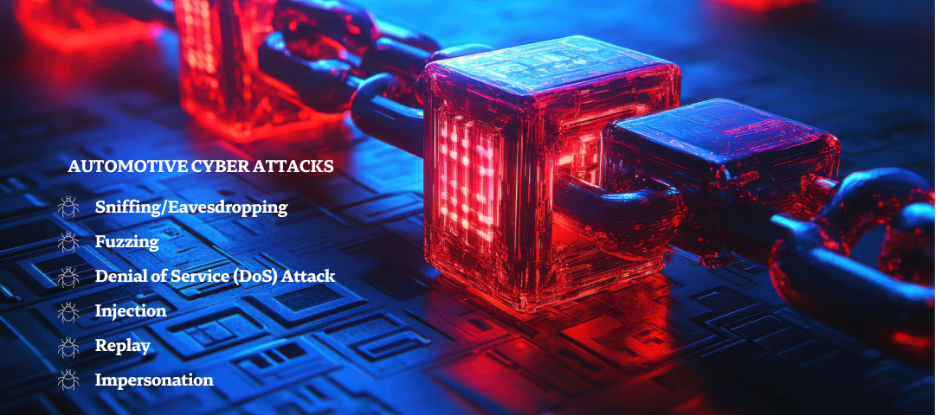
Commonly observed malicious attacks that are prevented using network security and management
Challenges of Implementing Cybersecurity Management System
- Contemporary automobiles integrate many ECUs (100-150 in Mercedes-Benz S-Class and BMW 7 series), wireless communication stacks, sensors with different protocols, TCUs, third-party apps, and infotainment systems. This heterogenous architecture can result in a rise in the number of human machine interface development, and attack surfaces that need to be secured at all times.
- Vehicles need to respond in real-time and therefore operate under stringent timing restrictions. It is necessary that real-time performance and safety-critical functions like steering and braking do not get affected by security measures.
- Backward compatibility between old and newer versions of systems, protocols, platforms, applications, and operations is a necessity. Integration of modern security mechanisms in legacy software and hardware can be difficult, as it might disrupt their functionality, user data, and integrity.
- Attackers are continuously developing new cyber threats and techniques, such as machine-to-machine attacks, zero-day vulnerabilities, etc., that may even affect logistics inventory management. Manufacturers are required to stay ahead in the evolving threat landscape by integrating adaptive defenses, continuous monitoring, and threat intelligence.
- Network and security management techniques also need to be implemented across the supply chain consistently. This can be quite a complicated process, as vehicular components are outsourced from different suppliers with variances in maturity levels related to security.
- In the absence of secure delivery and verification mechanisms, OTA updates that are important for rapid patching can also introduce risks when intercepted.
Diminish Cybersecurity Gaps with KritiKal
KritiKal Solutions can assist you in securing your automotive portfolio and address present challenges faced in connectivity and complexity. We surpass traditional IT practices through end-to-end protection of data flows, communication channels, intrusion detection, and update management. Our advanced TCU integrated with robust cybersecurity measures has enabled various SMBs, startups, OEMs, and Fortune 500 automotive companies to ensure compliance, resilience, trust, and implement solutions, such as license plate recognition system, as vehicles turn into software-driven platforms.
We offer advanced software updates, and cyber security management services for software-defined vehicles. Our systems support tamper-evident audit logs, threat analysis and risk assessments, secure boot chain verification, hardware serial binding, incident handling, and continuous improvement. We utilize cryptographic algorithms in our solutions to avoid deprecated cryptography and support future advancements like polygonal geo-fencing, cloud-based management, predictive analytics, and mobile app-based digital keys. Please get in touch with us at sales@kritikalsolutions.com to know more about our products and realize your automotive requirements.

Mohamed Wasif currently works as an Associate Architect at KritiKal Solutions. He is an experienced software developer with a decade of work in C++, C, Linux Kernel, System Design, UML, alongside a proven track record of delivering results, leading teams and optimizing product performance. With his passion for innovation and commitment to continuous learning, he has helped KritiKal in delivering various major projects.