


 Global
 United States

What is Edge AI in Surveillance?
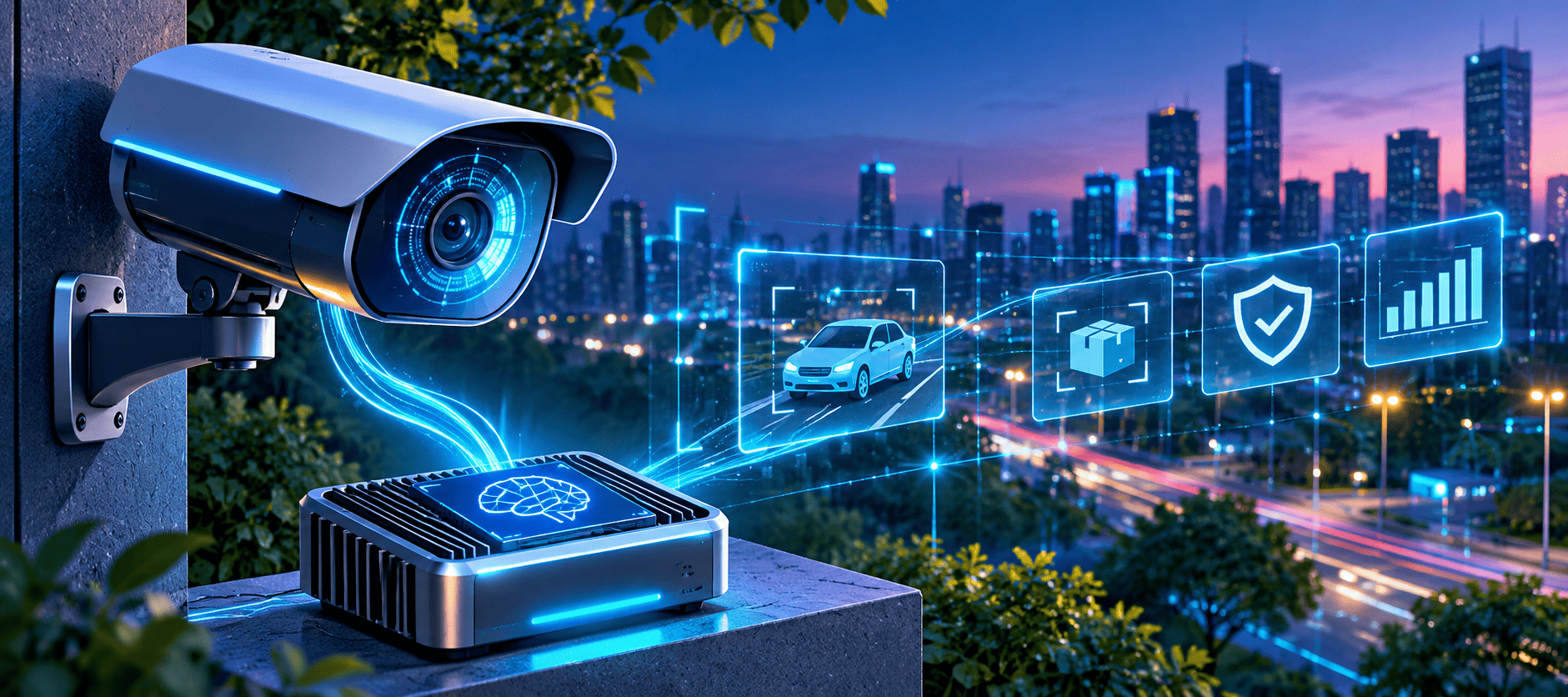
Next-gen security systems feature not only basic recordings with intelligent surveillance solutions. These camera systems are made proactive with edge AI video analytics. Such embedded systems and IoT solutions render real-time detection of threats without any constraint of latency for instant decision-making. These systems surpass conventional, centralized cloud surveillance server architectures that struggle with increased latency, concerns over data privacy, and demand continuous cloud connectivity.
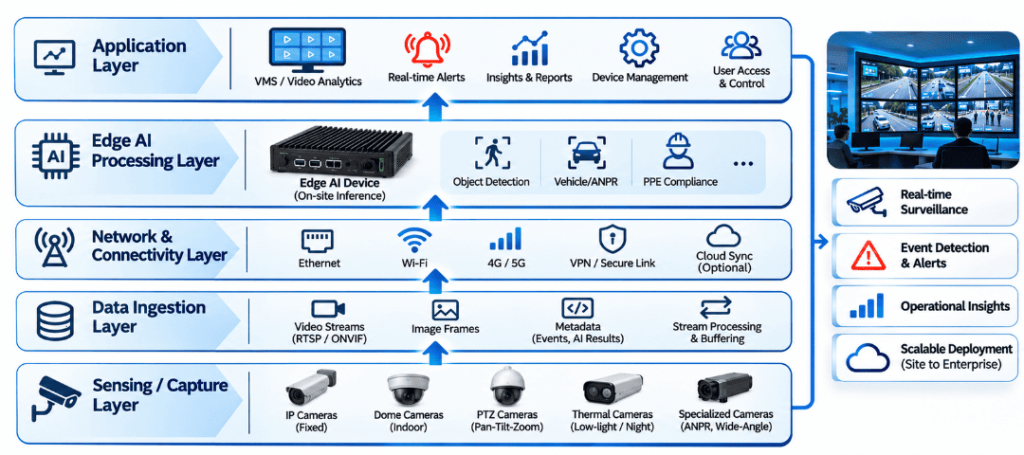
Here, edge AI refers to the deployment of AI models on edge devices, including smart gateways, AI-powered cameras, and edge AI boxes for local processing of raw video information. It assists surveillance systems in real-time to detect abnormal behavior, unauthorized access to property, intrusion, crowds, and more. It can be integrated with existing security infrastructure and IP cameras when implemented through edge AI boxes. Another approach is to implement edge AI through AI cameras that feature advanced built-in AI accelerators to maximize infrastructure value provided by consumer electronic product development services.
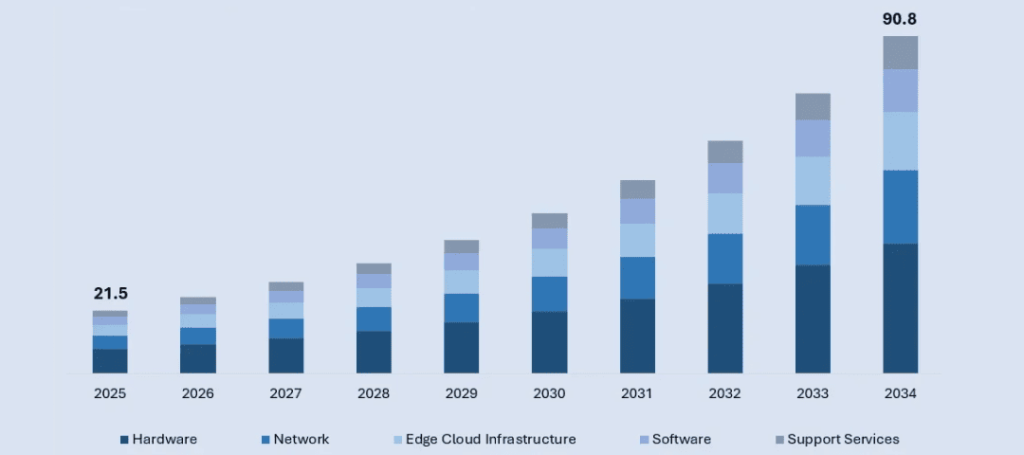
The current global market for edge AI in surveillance systems is estimated to be around US $46.96 billion as of 2026 and is expected to surge and reach an approximate value of US $445.75 billion by 2034, increasing at a CAGR of 32.5% during this forecast period. Further, the market for edge AI in surveillance is reported to be valued at US $4.61 billion as of 2026 and is expected to surge to reach a value of US $16.43 billion by 2034 at a CAGR of 17.2%.
The rapid increase in market demand for edge-deployed intelligence and AI in security and surveillance is driven by surge in smart city programs, Industry 5.0 applications, public safety use cases, and autonomous systems. Let us now go through the importance of edge AI in surveillance developed by computer vision and image processing services further in this blog.
Source: IMARC
Growing market size of edge AI development services during the forecast period 2025 to 2034
Working of Edge AI in Surveillance
Here is the step-by-step working process of edge AI-based applications.
Data Acquisition
Surveillance cameras, which can be smart cameras, drones, IP cameras, or connected CCTV systems, continuously capture raw video streams. This generates video frames in real-time for further analysis. The generated video is received by edge devices, which can be nearby, on-premises, or built in cameras instead of a distantly placed server and cloud IoT solutions. A few examples of such devices include NVIDIA Jetson, Intel Movidius, Google Coral TPU, edge-enabled CCTV cameras, etc.
Preprocessing
The edge AI in surveillance systems and devices prepares images for AI inference by frame extraction from the video stream and preprocessing. This includes image resizing, noise removal, color normalization, and compression optimization to reduce computational load, complexity, and enhance model accuracy.
Inference
A pre-trained DL model analyzes the video frame-wise, such as YOLO, SSD, MobileNet, EfficientDet, etc. This is to perform tasks like detection of objects, vehicles, animals, and persons with a certain confidence percentage. Detected objects’ paths or the count of people and vehicles by edge AI solutions can be tracked across multiple frames using algorithms like Deep SORT, ByteTrack, and Kalman Filter, where unique IDs are assigned to each. Predefined rules, events, and behavior are analyzed by AI for crowd monitoring and detection of intrusion, abandoned objects, restricted area access, and loitering.
Decision-Making
When inference is concurred, the edge device takes immediate action, without latency due to dependence on cloud engineering services. Certain actions may include alarm triggers, gate access lock and unlock; floodlights turned on/off, and security notifications. On detection of events, alert messages and metadata are created, and snapshots are extracted from video clips saved.
Storage
Important data is stored or transmitted by smart surveillance systems while non-event video frames are filtered and discarded to save bandwidth and local storage. Specific events can be sent to and synced with cloud platforms for long-term storing, dashboard monitoring, fleet management, model retraining, and advanced analytics, for example, Azure IoT Edge, AWS IoT Greengrass, and Google Distributed Cloud Edge.
Optimization
Models can be periodically and continuously improved through techniques, such as model quantization, which reduces the model size to speed up AI model inference. Another technique developed through indigenous technology services is pruning, which removes redundant parameters, alongside knowledge distillation, which creates more efficient smaller models. Such techniques can enable deployment on low-power surveillance devices and maintain accuracy.
Applications of Edge AI Solutions
Here are the main industrial applications of edge AI.
Smart Cities
In smart cities, edge AI development services are useful for automatic license plate recognition (ALPR and TRAZER), intelligent traffic monitoring and adaptive management, incident detection, energy management, environmental monitoring, and public safety monitoring. This helps authorities reduce emissions, detect congestion patterns, improve public safety, traffic flow, response time, and operational efficiency across the city by using IoT sensor-based data.
Drones
Edge AI in surveillance systems-based approaches are useful for the supply chain industry for managing resources, vehicles, and operations. Drones utilize the same to run AI algorithms on onboard processors developed through circuit board assembly services that analyze sensor data from LiDAR, GPS, and cameras for computer vision object detection, decision-making, and navigation in surveillance applications.
Healthcare
Edge AI is utilized to maintain stringent data privacy compliances across healthcare centers and facilities. Medtech solutions have been proved to be useful for detecting elderly falls, remote patient safety monitoring, and surveillance in restricted areas. AI-powered wearables and devices gain access to biometric data processed locally for real-time monitoring, diagnostic accuracy, disease detection, and reducing cloud-based processing.
Retail
Real-time edge AI video analytics running edge-deployed devices can be utilized for surveillance in retail setups. This assists in automated self-checkout, customer behavior analysis, queue monitoring, shrinkage reduction, store layout optimization, and enhancing overall operational efficiency.
Manufacturing
Across the manufacturing, oil, and gas sectors featuring Industry 5.0, cobots, robots, and other advanced technologies, industrial imaging and machine vision and edge AI-based smart surveillance systems are deployed for detecting Personal Protective Equipment (PPE). Other use cases developed through electronics manufacturing services include equipment monitoring, perimeter surveillance, detection of fire and smoke, worker safety monitoring, and predictive safety and maintenance analytics in remote, unconnected sites.
Automotive
In the automotive sectors, edge AI-based surveillance is used by self-driving cars and telematics control unit to navigate, detect objects in real-time, and avoid collisions without any reliance on cloud infrastructure. It is also used for road condition analytics, fleet surveillance, driver monitoring, incident detection, and occupancy monitoring to enable intelligent and safe transportation.
Challenges of Edge AI in Surveillance
There are certain challenges associated, such as the following.
- Security: Local processing lacks centralization and may introduce cyber threats and data breaches, overcome using robust device security measures and protocols to protect sensitive data.
- Standardization: Different edge devices, systems, and platforms developed through edge AI development servicesmay lack interoperability and compatibility, overcome by AI software framework standardization using open-source development tools.
- Optimization: Running Deep Learning (DL) models on edge devices with limited computing power, energy, and memory can pose challenges, overcome using model quantization, pruning, and knowledge distillation.
Benefits of Edge AI in Surveillance
There are various advantages, such as the following.
- Decision-Making: Security-related decision-making and response fasten with locally performed AI inference on detection of crowds, suspicious activities, intrusions, access violations, and other critical incidents.
- Low Latency: Using edge AI solutions, devices, and AI cameras directly process captured video, eliminating the need to transmit it to cloud servers, which enables rapid surveillance applications, event detection, and response.
- Cost-Efficiency: As only relevant metadata, events, alerts, and recorded video are transmitted by smart surveillance systemsin lieu of constant raw video streaming, bandwidth, networking costs, and cloud storage are reduced significantly.
- Scalability: The overall dependence on centralized computing resources is reduced as edge AI-based real-time intelligence is distributed across multiple edge devices and cameras for efficiently scalable applications.
- Privacy: Alongside minimized ownership costs and cybersecurity risks associated with transmitting to thecloud, edge AI enhances data privacy regulatory compliances and safeguards confidential information over networks.
Automate with KritiKal
KritiKal Solutions can be your end-to-end design and development partner for edge AI-powered surveillance systems. We can engineer and empower AI-based cameras and devices for intelligent surveillance using self- and federated learning techniques over energy-efficient devices and chips. Our teams of experts can build customizable edge AI platforms that transform analog cameras and traditional networks with edge running advanced algorithms.
We offer complete product lifecycle services, right from mechanical designing, hardware development services, fine-tuning of existing camera systems, embedded firmware development services, integration of AI algorithms, testing, and validation to pilot manufacturing. Such services, when combined with lightweight AI models, 5G networks, and neuromorphic computing, enable swifter time-to-market and assist businesses to build and scale secure high-performance AI security solutions.
Reduce complexities related to deployment with us as we develop next-generation AI-powered cameras, edge AI box-based infrastructure, edge AI video analytics platforms, and upgrade legacy surveillance systems. Explore more of our edge AI-powered offerings and capabilities around the security, surveillance, and other related industries to accelerate innovation across global deployments. Please reach our experts at sales@kritikalsolutions.com to realize your business requirements.

Shashank Thakur currently works as a Senior Software Engineer at KritiKal Solutions. He is proficiently skilled in working with Artificial Intelligence, Machine Learning, Computer Vision, Algorithmic Designing, Statistical Data Analysis etc., and holds hands on experience in various programming languages such as Python, C++, SQL and more. He has dedicatedly helped KritiKal in delivering many successful projects for some major clients.