


 Global
 United States


What is Smart Ring Wearable Technology?
There are various forms of health monitoring wearables available in the global market, amongst which Internet of Things (IoT) services-powered smart rings can be considered a powerful and personal information-wise discreet category. They have emerged as one of the most comfortable wearable devices that are simply worn around fingers when compared to fitness bands and smartwatches. An IoT wearable device collects valuable health information accurately round-the-clock by using certain medtech solutions, sensors and technologies to monitor the same while enduring extremely tight limits of heat, memory modules, computational resources, and power.
A smart ring wearable device requires minimal user interaction while supporting continuous vital tracking and other functions, which may include heart rate monitoring and variability analysis, stress and recovery and insights, etc. Consumer electronics product development services can engineer such devices that perform major roles of tracking sleep duration, stages, quality, activity, movement, steps, energy expense, as well as body temperature trends. These rings have proven to be useful for long-term wellness analytics, non-invasive women’s daily health monitoring, cycle trends, and more.
Being lightweight, compacted, screenless, unobtrusive, port free-chargeable, and waterproofed, consistent wearing is made easier, such as during sleep and other activities, for uninterrupted analysis. The current global market for smart rings powered by cloud IoT solutions is estimated to be around US $518.9 million as of 2026 and is expected to surge and reach an approximate value of US $3772.4 million by 2034, increasing at a CAGR of 29.3% during this forecast period. Let us now go through their importance, use cases, challenges, and working further in this blog.
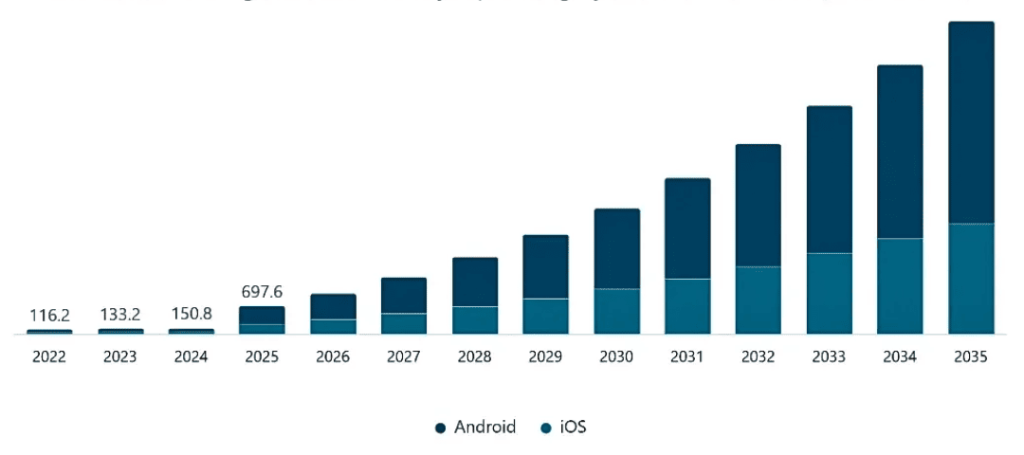
Source: GM Insights
Growing market size of smart ring wearable device during the forecast period 2022 to 2035
Features of Smart Ring Wearable Technology
The various features or health metrics tracked through smart rings are as follows.
- Sleep Monitoring: Wearable health monitoring devices like smart rings detect micro-movements and BPM using sensors to rate sleep efficiency, duration, cycles, habits, quality and generate trends overnight.
- HRV Monitoring: Smart rings can analyze heart rate variability, resting, and nighttime heart rate trends. This is important, as HRV using RMSSD technology indicates stress levels, autonomic nervous system balance, and recovery status in sports and rehabilitation, preventive healthcare, and wellness programs.
- Gesture Control: Mobile apps and other smart devices are integrated and paired with loT in wearable technology like rings to recognize motion gestures, including tap, twist, and more.
- Activity Tracking: Activity types, duration, calories burnt, steps taken, and total distance covered are detected, tracked, and logged using accelerometers and gyroscopes to monitor daily movements.
- Biometrics: Using near-field communication (NFC), contactless and cashless one-tap payments are enabled through smart rings. Wearable technology solutions feature secure fingerprint identification on the ring face for logins and access control.
- Notifications: Users can customize subtle haptic feedback and vibrations for app alerts, texts, calls and even send emergency alerts with location by pressing the ring button to designated
- Others: Smart rings feature user-centric design, a holistic health dashboard, engagement tools, real-time data visualization, personalized recommendations against shoulder stiffness, and seamless connectivity powered by a technology stack inclusive of AWS, Kotlin, Android, MySQL, Java, etc
How Does a Smart Ring Wearable Device Work?
In this section, we will go through the main components and the working of smart rings and understand their AI-based data processing, connectivity techniques, and sensor technologies.
Sensor
These rings consist of photoplethysmography (PPG) sensors that use tiny infrared light-emitting diodes (LEDs) and photodetectors to analyze HRV, blood oxygen saturation level estimation (SpO2), and heart rate by detecting subtle variations in light absorbed with respect to the changes in blood volume across the macrovascular tissue of the finger. Arteries and capillaries located here are closer to the skin surface and thus deliver reliable pulse wave signals and noiseless data as compared to fitness bands.
Wearable technology solutions are also powered by temperature sensors (NTC thermistors) that track variations in the skin temperature and detect fever. This data can be used to analyze sleep quality, assess recovery status, detect illness onset, circadian rhythm changes, and other related cyclic trends. This differs from absolute body temperature measurements by occasional thermometer readings, and more meaningful insights can be obtained through temperature deviations recorded over time against individual baselines and physiological data.
Motion sensors, gyroscopes, and accelerometers embedded in rings can detect sleep posture, steps, restlessness, subtle movement (up, down, left, right, forward, and backward), running, walking, intensity, and inactivity. This type of motion data is used to differentiate between physical activity, sedentary behavior, and sleep stages. Other advanced sensors are integrated in smart rings, such as EDA sensors for sentiment analysis, multiwavelength optical sensors, sensors for ECG signals, and bioimpedance sensing.
Data Collection
These rings perpetually collect physiological information through fingers where there is higher blood flow density. They offer stabilized overnight contact, signal consistency, longitudinal health monitoring, and lesser motion noise during sleep. This is crucial for multi-day, round-the-clock gathering trends in lieu of isolated assessment, as an IoT wearable device features portless charging by using NFC that may also support authentication and payments. Some of the smart rings commonly available in the market include Oura Ring, RingConn, Samsung Galaxy Ring, Aivela, Ultrahuman, Circular Ring, Aabo, Luna, BoAt, etc.
Preprocessing
Sensors are low-powered and duty-cycled in nature and are activated through Microcontroller Unit (MCU) based on detected events and pre-determined runtime schedules. The raw analog signals collected through sensors are subjected to digitization, filtering, and feature extraction processes which involve statistical aggregation and peak detection, and more. These actions are mainly taken by a Digital Signal processor (DSP) or the MCU in order to reduce data volume prior to AI-based inference and data analysis.
Data Analysis
On gathering data, these rings digitize, process, and analyze the sensor data and signals by subjecting them via various layers either on the device powered by MCU DSP or over a connected smartphone using edge AI accelerator models. The smart ring architecture involves on-device processing, where embedded algorithms perform preprocessing of raw data collected from sensors.
Thereafter, the data is transmitted through a gateway device or smartphone in a secure manner by using ultra-low power Bluetooth Low Energy (BLE) antennas and microprocessors in embedded hardware. Here, it refers to miniaturized circuit boards present in the IoT in wearable technology or smart rings made of smart glass, ceramic, crystal, or metal. Advanced algorithms deployed across cloud analytics platforms and wireless connected applications engineered through mobile app development services, then reduce noise, combine, analyze, and generate trends, metrics, correlations, and patterns.
Furthermore, Machine Learning (ML) models and neural networks (LSTM and CNNs for time-series analysis) analyze and understand data to state AI-driven actionable GLP-1 insights, such as sleep quality scores and recovery readiness. Thus, smart rings deliver health analytics supported by miniaturized computing System-on-Chip (SoC) architecture that sustains longer rechargeable battery life through magnetic or USB charging docks.
Runtime Scheduling
The obtained metrics and aggregated insights, such as sleep score average BPM, etc., are stored over a non-volatile memory on the chip. Through low-power BLE, these low-bandwidth, high-power data packets are transmitted to a paired mobile app, long-term storage, or cloud-based AI analysis upon user request. The main functions of SoC are conducted during its deep sleep stage.
Whereas the wake cycle includes activities, such as external interruptions, inference cycles, and scheduled sensor readings. Other power management and ultra-low power budget-based functions like clock gating, task prioritization, and dynamic voltage frequency scaling (DVFS) are managed through RTOS.
Use Cases of Smart Ring Wearable Technology
There are various use cases of smart rings, as given below.
Sleep Management
These rings can efficiently track sleep disorders and insomnia, as they can be easily worn during the same and record subtle physiological changes during sleep. Smart rings can analyze total sleep duration, quality, efficiency, and consistency over time. They monitor sleep stages (characteristic phases of transitional light sleep patterns, deep sleep stillness, and REM sleep subtle movements) and heart rate data at nighttime.
Health Insights
Smart rings can determine sleep stage, resting heart rate, such as diabetes, recovery/stress levels, daily activity, calories, and Basal Metabolic Rate (BMR) for preventive health and are used by fitness enthusiasts. IoT in wearable technology is used to state temperature trends and provide women’s health insights, such as analysis of hormonal pattern insights, menstrual cycle trends, ovulation patterns, or subtle physiological changes detection that may not be noticeable through on-the-spot measurements.
Recovery Tracking
Recovery readiness can be effectively monitored using smart consumer electronics like rings, which help athletes avoid overstraining as per biometric and haptic feedback motor and adjust workouts accordingly. Wearable technology solutions can be used for tracking daily activities, detecting low-intensity movements, counting steps, and recovery analysis to determine physical readiness.
Others
High-end smart rings are utilized for medical and research applications, therapeutic medical equipment, and clinical studies for detecting early signs of illness by monitoring changes in HRV, temperature, and long-term health trends. Some smart rings developed through medical device engineering services can also support device unlocking, contact payments, and secure digital authentication and identity verification.
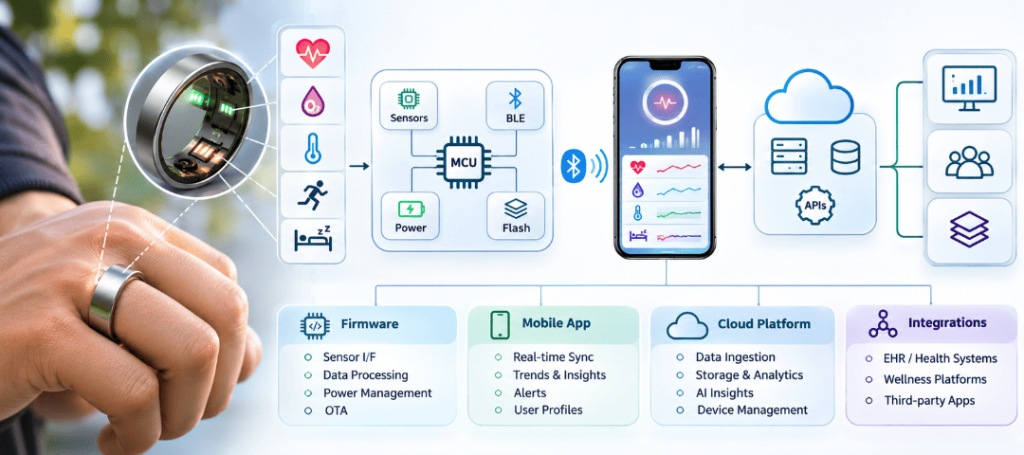
High-level architecture diagram of connected smart ring wearable device
Advantages of Smart Ring Wearable Device
- Accuracy: Properly designed smart rings by OEMs, electronics manufacturing services, and product developers ensure sensor quality, algorithm calibration, ring fit, sizing, and data filtering methods to deliver reliable health trends and insights. As the ring collects data from fingers 24/7, precise and consistent biometric tracking is possible.
- Diagnostics: IoT in wearables like smart rings can be used as consumer wellness wearable technology design and medical-grade diagnostic devices upon medical supervision. They play a major role in preventive healthcare, health trend analysis, Remote Patient Monitoring (RPM), AI-based medical diagnosis, clinical validation studies, and post-treatment recovery observation.
- Universal: Smart rings can be used by any consumer and wellness user focused on improving sleep, optimizing stress and recovery, and tracking lifestyle health. Such electronic product design can even be used for corporate workforce wellness programs, insurance programs, risk reduction initiatives, and health data-driven incentives.
- Versatile: IoT in wearable technology like rings developed through indigenous technology services can be easily deployed in healthcare settings and RPM for long-term patient observation, data-driven preventive care, and supporting chronic condition management. As compared to a smartwatch, a ring is lightweight, tracks sleep trends, operates for 5-10 days, is screenless, and is highly discrete.
- Comfort: As these rings offer less distraction and data accuracy while consuming ultra-low power, they feature multi-day battery life and healthier tech use. Key design considerations focus on comfortable user fit, multiple ring sizes, medical-grade materials, BLE optimization, water, scratch, and dust-proof (IP68) construction.
Challenges of Smart Ring Wearable Technology
Smart rings may struggle with activities involving gripping, running, cycling, weight lighting, and vigorous movements where smartwatches with larger designs work well for live feedback on workouts, tendon movements, and exercise statistics. They usually rely on connected smartphones for GPS, whereas other wearable models feature in-built GPS. As smart rings do not feature any display, they do not offer conventional on-device alerts or notifications for calls, and wearable app development which are usually supported in other smart devices.
Furthermore, they offer indirect data access through a smartphone application. On the other hand, this is possible through on-screen companion applications on smartwatches. At times, IoT in wearables like Google Fitbit Air also features ECG electrode sensors that smart rings may miss. Although these solutions currently face certain challenges with accuracy in PPG sensor readings that are affected by factors, such as skin tone, nail paint, and temperature variations.
At the same time, detecting motion is eased using sensors, and interpreting subtle changes in health can be a challenge. Also, sleep detection is an estimate and not assured clinical brain activity measurements, usually conducted using polysomnography (PSG). The reliability of such readings is subject to ring fitting, individual physiology variations, and environmental factors. There could be a trade-off between hardware limitations and performance given small form factors like battery size, antennae, and sensors.
For a wearable technology company to develop a combination of vascularization, sensor contact shape, reduced noise, and enhanced signal strength, finger placement is considered and dependent upon. As per pulse oximetry studies, the index finger offers accurate readings, the thumb offers better blood flow and closeness to skin and vessels, the second finger offers lesser hand movement disturbance, the third finger easily blocks light interference, the fourth finger offers clear and reliable signal quality, while the fifth finger quickly responds to temperature changes.
Other issues lie with temperature sensor readings, which may not accurately correlate with core body temperature and are affected by emotional state, environmental temperature, and clothing. It is noteworthy that AI interpretations being infallible should be viewed as mere estimates. This is because AI and IoT in wearable device neither consider sleep quality and HRV pattern correlation nor one between recovery status, activity levels, and resting heart rate trends. Some subtle hand movements may trigger regular walk signals.
The readings obtained through technology engineered by medical device design services are not professional medical diagnoses or advice that is obtained using authorized medical devices like an electric muscle stimulator. Users must review privacy policies and application settings while sharing sensitive health data. They also need to consider high-end ring expenses and offer subscribed analytics. Moreover, cycle predictions and derived scores may not mention their applicable limits, and definitions and provide estimates of energy expenditure and step count errors rather than threshold calories and movements.
KritiKal: Actionable Insights at Your Fingertips
Smart rings represent the future of health-tracking wearable technology and their major evolution as they amalgamate steady data collection, advanced sensing, and comfort. Apart from enabling deeper sleep insights, long-term health trends, and recovery, they are likely to evolve beyond bearer wellness to broader healthcare ecosystems, featuring reduced time-to-market and development risk.
With emerging healthcare models and advancements in technology, these rings are poised to play a major part in the shift towards RPM, continuous preventive healthcare, and personalized wellness and are well-positioned to be core monitoring tools. Further future developments for regulations in healthcare, non-invasive blood glucose and hydration tracking, deeper AI-powered predictions around health trends, enhanced sensor fusion, and integration with telemedicine platforms are already underway.
As their demand expands, a wearable technology company like KritiKal Solutions can assist retail organizations and smart healthcare brands looking to overcome challenges like low throughput, AI model complexity, generalizability, inflexibility, low efficiency, inference latency, privacy issues, battery degradation, thermal throttling, sensor noise robustness, cloud offloading, data fidelity vs. power, firmware update vulnerability. We provide medical prototype development, expand their portfolios, ensure medical device testing, and launch sophisticated smart rings.
Our R&D background, ISO 13485 quality system expertise, and medical device design and development experience make us ideal for smart ring pilot manufacturing. We also offer flexible customizations and implement data encryption and security, compliance readiness, sensors, and algorithm capabilities. Our smart ring design and development solutions can assist you in comparing daily patterns, workout records, and specific sessions with respect to selected or automatically recognized exercise mode and route features. Please get in touch with us at sales@kritikalsolutions.com to know more about our embedded products, platforms, services, and realize your business requirements.

Saddam Hussain currently works as a Senior Embedded Engineer at KritiKal Solutions. He is proficiently skilled in AWS, OOP, Linux device drivers, microprocessor and microcontroller handling, LIN, ARM, SPI, FreeRTOS, Git, Flask, Python, reliability testing, UART, STM32, FOTA, and more. With his ability to work efficiently in teams and more than 6 years of working on embedded system development, he has assisted KritiKal in delivering various projects to some major clients.