

 Global
 United States

What is IT Staff Augmentation Services?
IT staff augmentation refers to a flexible hiring program that allows businesses to bring in global professionals temporarily from outside of their fast-moving organization. Managing the workforce is a very complex job, hence the staff augmentation model plays a vital role. This is done to support their internal teams for filling up specific skill gaps for a certain period, or for a particular project. These specialists function as per given directives, unlike outsourcing, which handle long-term project delivery through full-time services. Its key aspects include flexible contract IT staffing services, targeted skills, and global reach via a flexible model.
Not only does this model allow flexibility, capability, and workforce expansion, but it also lets the hiring organization retain control, especially during product launch, market extension, and short-term requirements. It allows them to stay productive without any permanent staffing overhead by hiring pre-trained, remote, deployable, and vetted contract resources and distributed teams. Global talent or specific expertise can be brought in for a definitive period or duration of the project to expand or reduce internal bench resources as per demand.
The best results from IT outsourcing service providers can be obtained by defining clear scope, suitable onboarding, and talent suppliers that provide compliant and classified worker support. As workforces are turning fractional by design, it serves as a part of the hiring organization’s talent planning efforts and staffing management plans. It reduces the costs otherwise utilized for full-time or additional hiring while still being in control of deliverables, goals, deadlines, functions, priorities, and workflow management.
Such hiring spans across specialized talents and complex roles, such as training, marketing, human resources, finance, analytics, customer support, and operations specialists; IT professionals; cybersecurity experts; software development services teams; healthcare; QA; DevOps; etc., without adding headcount or undertaking lengthy hiring processes or ramp-up time. Furthermore, this model allows the business to navigate legal requirements with ease as the staffing partner manages sourcing, employment logistics, and vetting, which reduces risks of wrong hires and maintains the project momentum even during a shortage of internal staff. It refrains from employee benefits, allocations, recruitment fees, and other overheads.
A staff augmentation contract refers to a legal agreement representing the relationship between the staff provider, client organization, and consultant. It lays out terms, conditions, IP ownership protection bylaws, compliance standards, regulations, and confidentiality obligations that are concurred. It defines the scope of work, project responsibilities, deliverables, billing, rates, non-disclosure terms, reimbursement policies, expenses, early or extended termination, and structured engagement duration. It offers a workforce strategy that allows businesses to stay agile and competitive, and provides rapid scaling capabilities.
The current global market for IT development outsourcing is estimated to be around US $85.3 billion as of 2025 and is expected to surge and reach an approximate value of US $156.7 billion by 2034, increasing at a CAGR of 8.2% during this forecast period. Let us now delve into this hiring guide to understand what staff augmentation is, its benefits for businesses, working, pros, cons, challenges, best practices, models, types, and when and how to implement it as a catalyst to achieve business objectives.
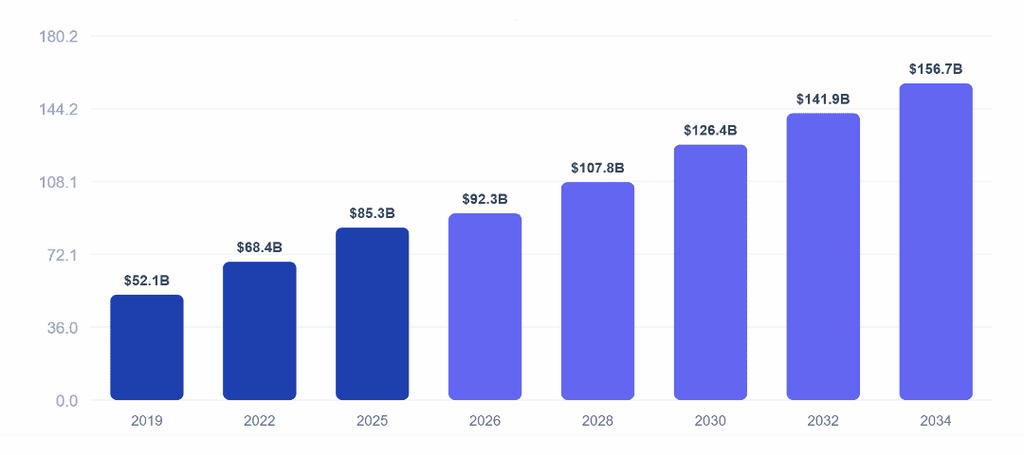
Source: Data Intello
Growing market size of IT outsourcing companies during the forecast period 2019 to 2034
How Do IT Staff Augmentation Services Work?
Here are the main steps of the staff augmentation process.
Requirement Assessment
As the first step, one needs to assess the capacity gap and identify skills that need to be replenished. This could be around speeding up a project, expanding the team, or specialized or niche skill requirements that may not be present in-house. Other requirements could be tight deadlines where hiring local contract IT talent might increase the delivery timeline or temporary workload spike, which do not require a full-fledged team.
The project’s scope, team collaboration, scalability, and flexibility requirements; immediate and future workforce skill gaps; technical requirements; internal and external fit comparison; considerations around budget, cost, intellectual property, and compliance; timelines; structures for project management, reporting, and accountability; objectives; internal team dynamics and offered skills; and specific technical alongside industrial expertise are all discussed.
Vendor Selection
The next step involves choosing the right staffing partner, online talent platform, staffing specialist, or a reliable vendor that understands the business’ operational and technical needs. It must provide pre-vetted talent quickly without compromising quality. Staff augmentation engagements are usually charged as per a fixed-price project or on an hourly basis. Some providers also have a retainer price structure related to monthly-hour fees.
Major questions to evaluate staff augmentation providers include specific services provided, specialty, focus, industrial expertise, talent sourcing and vetting mechanism, pool availability, and levels of skill and diversity. Other considerations include average time to hire, project kickoff, budget alignment, relevant project hiring experience, team admin controls, pricing, and reporting structure.
Furthermore, to answer what is staff augmentation services, it is necessary to consider custom service offerings, priority support, flexible billing and scaling provisions, project and communication management, differentiating factors, client reviews, case studies, industry awards, and maintenance of compliance with ethical and employment law standards.
Talent Onboarding
Once the talent partner draws in its network or pool of pre-vetted professionals, the right third-party candidates with the required background are identified. Here, vetting not only refers to the right technical qualifications but also their efficiency in integrating within the team and cultural fit.
The provided candidate profiles are screened and reviewed as per their experience and domain expertise; shortlisted candidates are interviewed by the IT outsourcing service providers, and externally augmented professionals are then onboarded to join, successfully engage, and work alongside the internal team as per their purpose-matched role.
For onboarding, schedule orientation meetings, introduce hired talent with point of contact, collaboration, and interaction, business’ mission, communication tools, core values, expectations, project milestones, high-level information, vision, and goals.
Management & Support
The business manages delivery, day-to-day tasks and sets priorities through clear communication, shared workflows, tools, and regular check-ins against questions, updates, and conflicts. The internal team stays involved and carries responsibility, while the staffing partner ensures responsive support and ongoing performance monitoring.
Throughout the project lifecycle, the IT outsourcing company and provider tracks the client’s needs, shifting timelines, incremental project updates, actionable advice, and constructive feedback by using one-to-one project management and conversation tools like Tello, Teams, Asana, Hive, JIRA, Notion, Slack, etc.
Performance Evaluation
Apart from monitoring the hired individuals, businesses need to regularly evaluate their staff augmentation strategy to check whether it is in sync with the objectives. Data analytics can be used by internal teams to decode staff augmentation efforts, make data-driven decisions, maximize results, and drive improvements.
Businesses need to track and evaluate staff augmentation practices as per certain metrics, such as project or task completion time, revision rounds for project deliverables, percentage of project completion as per deadline and deliverables, ROI and time savings, team collaboration and engagement scores, and number or percentage of skill gaps filled.
Other metrics include issue resolution rates, response time, staff retention rate, contract renewal rate, conversion to permanent position rate, and total productivity and output as compared to full-time employees so as to accordingly adjust the strategy
Types of IT Staff Augmentation Services
Here are the types of approaches for the staff augmentation process. Businesses can select a suitable model with respect to their budget, requirement, timeline, geography, closeness of collaboration, project duration, core team alignment, and workforce support required.
Strategic Augmentation
Also known as long-term augmentation, this type of staffing is used to fill existing skill gaps and ongoing projects. It allows businesses to embed highly skilled talent for longer durations without payroll. It usually involves integrating external talent into the organization for more than a year as additional support. In this case, the IT personnel would be deeply integrated to understand workflow, business goals, and culture.
Project-Based Augmentation
This type of staffing is used for augmenting a particular skill set, any predefined initiative, or for building a complete temporary team as per the scope of work. The hired individuals closely collaborate with the internal team until the entirety of the specific project is completed. It is applicable when the client does not require long-term support but only a specific part of a project, for example, design, testing, development, prototyping, etc., as per the requirement.
Highly Skilled Augmentation
This refers to a model where an IT software development company or external consultants, expertise, or advanced talent are brought to resolve complex problems, critical challenges in product development, or lead projects
Short-Term Augmentation
This type of staff augmentation can be used to cover sudden in-house employee absence (sabbaticals or parental leave), short sprints, one-off deliverables, temporary workload spikes, or tight deadlines without disrupting the internal team’s workflow. It is usually applicable for brief periods of time, such as few weeks to less than six months for immediate temporary needs. This engagement is usually pre-planned with respect to a particular duration and definitive, pre-defined scope.
On-Demand Augmentation
This is a flexible type of augmentation in which quick talent deployment can be used to scale up or down immediate business requirements. Sectors with variable needs and unexpected demand surges, including IT customer support agents, production issue resolution specialists, and software developers may utilize this model. This type of IT services outsourcing engagement may not have been proactively planned and is basically used to support sudden requirements with varied durations and scopes.
Skill-Based Augmentation
This staffing process is specifically to fill in niche skill gaps or expertise that are not available in the internal team. It can be applied for both short and long-term; per se, a company needs a chatbot developer, as this specialized skill is not present in the in-house web development team.
Commodity-Based Augmentation
In this approach, a quick addition to the existing internal team is considered to meet immediate client needs. It is not necessary for the hired talent to possess specialized skills, but they majorly perform essential tasks. It is ideal when there is a shortage of full-time employees or basic skill roles that need to be filled.
Dedicated Team Augmentation
In this type of staff augmentation, the top IT staff augmentation company or vendor provides a complete, dedicated, full-time working team featuring domain familiarity to work on the client’s project exclusively. Such engagements are for long-term and showcase better productivity, higher client control, objective-based alignment,
Hybrid Team Augmentation
Also known as contact-to-hire staff augmentation, in this type of engagement, specialists work with internal staff on collaborative projects; for example, the internal UI/UX team works with an external web development team. This model offers control (fit evaluation), flexible balance, cost-efficiency, and a blend of strengths of short- and long-term, remote, or dedicated team augmentation for quick business scale-up.
Remote Team Augmentation
In this case, a remote team or a single professional is integrated into the client’s workflow and collaborates with the internal team through regular meetings and tools. The IT outsourcing company enables the client to enable round-the-clock functioning, access top external talent without being bound by geographic limits and make the most of time zone-related differences to keep the project on track.
Off-Shore Augmentation
In offshore staff augmentation, businesses can access global talent pools and scale up quickly at lowered costs. It is especially useful for finding niche talent that cannot be sourced locally. It is ideal for distributed teams and for hiring international and specialized talent for minimizing costs and compliance issues irrespective of time zone alignment and communication.
On-Shore Augmentation
In this case, the external talent is hired from the same geography for rendering work hours in the time zone. It is also necessary for the hired talent to possess local market knowledge, but the only challenge with this kind of augmentation is the high cost involved.
Near Shore Augmentation
In nearshore augmentation, external talent is hired by the IT outsourcing services company from nearby countries and regions, which usually have similar time zones. This model offers ease of collaboration, fewer cultural and language barriers, and costs less than offshore and offshore hiring. It reduces operational friction and balances efficiency.
IT Staff Augmentation
This type of staff augmentation concurs with all the above-mentioned types, given it is related to hiring IT-specific talent. It is the most widely used approach for hiring remote professionals for product builds, QA testers during release cycles, DevOps or cloud specialists for solution infrastructure work, and developers for remote updates.
It also includes hiring UI/UX designers, analysts, product managers, and others to shape user experience and product direction. It is the preferred approach in fast-moving environments, which negate hiring delays while managing individuals and cutting overheads.
AI-native staff augmentation rents a developer alongside generative-driven development technology, which executes a context, planning, confirmation, execution, and validation loop with a replicable, documentable, and trainable coding algorithm backed by engaging multipliers.
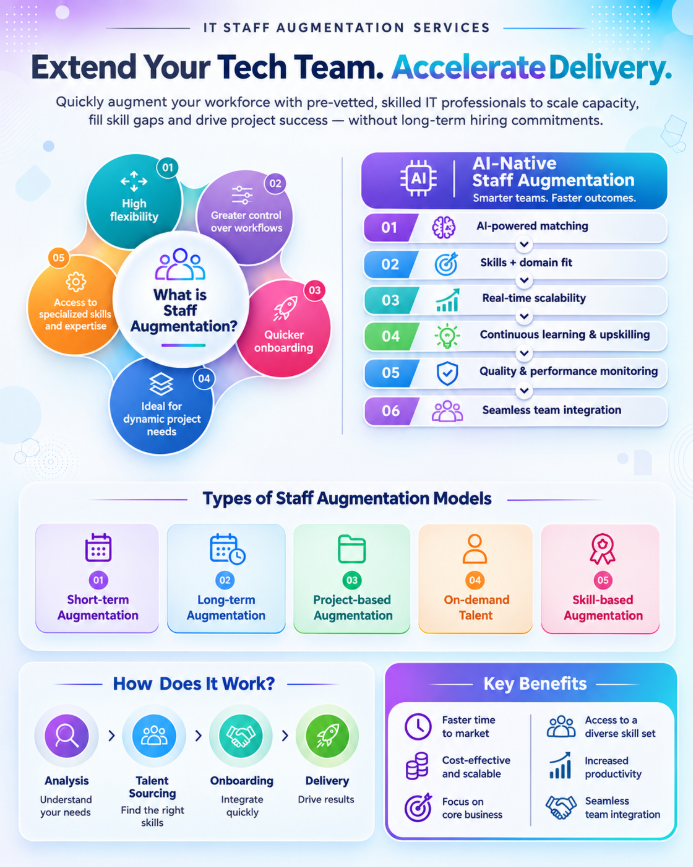
Working, benefits, and types of IT staff augmentation services
IT Staff Augmentation Services vs Other Approaches
Staff Augmentation vs Consulting
In staff augmentation, the client controls daily work, while in consulting, the consultant advises as an indirect control upon which the client takes action. In this case, instead of investing in an individual’s skill as in staff augmentation, the client spends on expert advice and recommendations. The contract structure in this case is usually project-based or retainer compared to time and material per contractor in staff augmentation.
The resultant output, or product/IP ownership, rests with the client, similar to staff augmentation. Hiring risks lie at the medium level and depend on the engagement structure as compared to higher risks involved in staff augmentation, as talent needs to be managed carefully against misclassification.
International hiring is supported with the right IT staff augmentation company and contractor compliance solutions, as are contracts in staff augmentation where the contract reflects the local laws and regulations. It is most suitable for making strategic decisions, transformation planning, or audits as compared to staff augmentation, which is suitable for filling skill gaps in-house controlled projects as an added capacity.
Staff Augmentation vs Managed Services
The managed services providers control the regular tasks against agreed service levels, unlike staff augmentation, where the client controls daily work. In this case, the client spends ongoing operational outcomes over time as compared to an individual’s skill. The contract structure in this case is usually based on the Service Level Agreement (SLA) on an ongoing basis.
The resultant output or product IP ownership rests with whomsoever is mentioned in the contract as compared to the client in staff augmentation. Hiring risks are lower as the managed service provider employs and manages the workforce. International hiring is supported, and the managed provider typically manages compliance. It is most suitable for long-term operational functions that have predefined service standards. As the vendor handles the end-to-end IT functions, although it offers higher convenience, there are lesser chances of integration with the core business strategy.
Staff Augmentation vs Outsourcing
In staff augmentation, the client controls daily work, while in outsourcing, the vendor is responsible for the same. In the former, the client basically spends their budget on the hired talent’s time and skills during team integration, while in the latter the client purchases a complete function or deliverable. The contract structure in this case is usually based on the Statement of Work (SOW) or fixed price.
The resultant output or product IP ownership rests with the vendor until delivery as compared to the full cycle-client ownership in the case of staff augmentation. Hiring risks are considerably lower as the vendor employs them as compared to other approaches. International hiring is made possible in this type of augmentation as the vendor manages the hired workforce.
It is most suitable for delegating entire functions or completing projects and deliverables through external or remote teams. In staff augmentation, the integration level is high as external talent works alongside internal teams, whereas it is less in outsourcing, where the provider independently handles delivery. Thus, the main difference lies in terms of commitment, speed, and flexibility.
Staff augmentation is a more flexible model, as it is easier to scale up or down as compared to IT services outsourcing, which depends on contract scope and related renegotiation. In the case of staff augmentation, businesses have more direct control over workflows and priorities as compared to lesser control over day-to-day execution in the case of outsourcing. The external team handles the entire project with a few points of contact; thus, although it frees up internal teams, it has less flexibility and control.
Staff Augmentation vs Offshoring with EOR
Businesses looking to expand internationally without legal entities can take assistance from finance and legal offshore teams. They need to have an employer of record (EOR) for tapping into the local network of professionals, reducing regulatory changes, setting up infrastructure, and preparing funding rounds. In offshoring with EOR, dedicated teams can be built for the client as compared to adding temporary SOW resources to the team in case of staff augmentation.
The team’s continuity remains high and long-term in the former case as compared to low continuity in the latter. Businesses have full control over individuals or teams and manage the delivery ownership in both the cases. Compliance and payroll are managed internally or separately in case of IT development outsourcing or staff augmentation while they are fully handled by the EOR in offshoring with the EOR.
Staff augmentation offers flexibility but is harder to manage at scale while offshoring with EOR is structured and easier to scale. Offshoring with EOR is ideal for building stable, long-term global teams and related use cases, while staff augmentation is ideal for short-term gaps and urgent projects.
Both offer faster hiring speed, but staff augmentation is majorly for short-term needs while offshoring is preferred for long-term roles. Staff augmentation requires higher management effort, as every resource is managed, while offshoring with EOR requires lower management effort given that the EOR handles all the compliance and admin tasks. Cost-efficiency is moderate in the former case while it is very high in the latter.
Staff Augmentation vs Others
Other options include in-house hiring, which offers cultural alignments and the highest control but involves lesser scaling flexibility, higher onboarding expenses, and longer recruitment process outsourcing cycles. Freelancing platforms are another quick solution but are risky in terms of complex and long-term projects, as the talent may not be vetted and offer limited accountability and are thus best for smaller tasks.
In in-house hiring, costs involved are high as compared to moderate costs in staff augmentation and lower costs in the case of freelancers. In-house hiring offers absolute project control to the client, while freelancers and staff augmentation offer moderate to high control. The speed to hire and scalability are lower in-house hiring, while they are high in the case of freelancers and staff augmentation.
Best Practices for IT Staff Augmentation Services
To obtain long-term benefits, implementing this process requires proactive, step-by-step, agile planning to launch and define a staff augmentation strategy. Here are the best practices for IT staff augmentation.
- As discussed earlier, the first step is to identify staffing needs and choose the right hiring services provider. This is followed by onboarding and integrating augmented staff and managing and monitoring their performance.
- Ultimately, the performance is evaluated against certain KPIs and adjusted accordingly to suit needs. The client needs to fix integration issues and disconnected individualism and enable clear communication tools and set the frequency of the same for effective collaboration.
- To avoid delayed business outcomes, project deliveries, and inconsistent experiences, establish defined, developed, and documented processes for onboarding, access management, feedback mechanisms, and project standards.
- The IT software development company ought to thoroughly assess the team and the hired individual’s skills, feedback handling, collaboration, challenge resolution, and communicative progression techniques. One can also offer training and talent development to build their skills specific to business needs.
- Keep focusing on identifying continual process and collaboration improvements over time by leveraging data analytics for business outcomes and augmented staff tracking.
- Measure staff augmentation success with respect to certain criteria, such as deliverable quality. business impact, timelines, budget adherence, efficiency, productivity, skill gap closure, etc.
- It is best to build a simple structured team that stays, learns about the business, improves over time, and becomes an operational part instead of rotating temporary resources.
Challenges of IT Staff Augmentation Services
Although staff augmentation is suitable for short bursts, there are certain practical challenges associated with it as and when team size increases and projects turn to grow more complex.
- Data Security: Sensitive data and IP might be put at risk if using external staff; thus, confidentiality agreements and predefined protocols and NDAs must be established for data handling and protection.
- Talent Retention: Offering quick rewards and building sustainable relationships is necessary to avoid losing skilled short-term staff and delaying ongoing projects against long-term team building.
- Knowledge Transfer: It may be difficult for short-term employees hired through any IT staff augmentation company to apprehend current projects, causing slow work and communication issues, a gap to be filled through documentation and information sharing.
- Cultural Fit: External talent with different backgrounds may not be able to adjust to the company’s culture, leading to team friction and increased fit-in time, which can be resolved through proper onboarding.
- Remote Management: Teamwork may be flawed in the case of remotely working external talent due to time zones and communication gaps, which require the use of suitable project management tools.
- Quality Control: Stronger onboarding, clarified processes, and regular feedback loops are necessary for output consistency irrespective of differences in workforce and standards.
- Scaling Overhead: It is difficult to manage a larger, augmented team, as it requires increased efforts in terms of alignment, coordination, and supervision.
Benefits of Staff Augmentation Services
There are various advantages to staff augmentation, such as the following.
- Specialized Skills: It is easier to get access to specialist, niche, or technical skills for short-term needs through this hiring model where permanent hiring is not required.
- Flexibility: It is easy to adjust team size by hiring individual developers or even an augmented team to deliver a project or launch a product minus a long recruitment cycle or FTE role commitment.
- Quick Hiring: It renders faster hiring and delivery support, thus reducing delays, filling gaps, and running projects without any delays such as in traditional recruitment cycles.
- Lower Overhead: Compared to permanent hiring, staffing through an IT staff augmentation company leads to lesser administrative work, and costs around long-term payments, benefits, and internal recruitment processes are involved.
- Talent Pool: While FTEs focus on core business functions, they give access to a wider, global, and remote talent pool, and the client is not limited to local hiring where the niche skills may be difficult to find.
- Scalability: ROI and new technological adoption can be increased, while workloads can be easily changed as per the scale up and down of demand, as there are no long-term commitments involved.
- Cost-Effectivity: As overheads, full-time salaries, internal processes, training, and onboarding costs are reduced, businesses can stay on budget to cover tight deadlines and the project’s scope of work.
- Integral Control: The client stays in control of workflows, tools, timelines, directions, business goals, and the entire project as the augmented staff brings the know-how to the table.
- Low Hiring Risks: Global talent can be tested in real-world conditions before turning long-term, which simplifies adjustments, complex contracts, and compliance issues.
- Faster Delivery: It makes navigating tighter schedules, meeting targets, knowledge exchange, and deadlines easier and renders faster and more agile execution as well as time to market.
Embark on a Smarter Hiring Path Forward with KritiKal
In this blog, we observed that staff augmentation is used by businesses globally to improve their turnaround and project deliveries using external talent. KritiKal Solutions is one such staff augmentation provider and IT outsourcing services company that assists businesses with their short-term hiring requirements.
Client organizations can easily reduce expenses and foster their operations in the competitive business landscape with our talent and team-building services and pool of available talent. Our staffing services meet the exact requirements of the client as per the given project and objectives.
We assist you in filling skill gaps, accessing global talent, covering tight deadlines, reinforcing and rapidly expanding in-house teams, and accomplishing and managing temporary projects. Our large network of talented resources easily aligns with your business culture, renders the required expertise under flexible and scalable options.
Furthermore, we are backed by an extensive technical ecosystem of elastic staffing partnerships with MNCs to make the right talent available at the right time as per your needs. We overcome staffing challenges, like team integration issues, lack of internal knowledge, scaling, handoff, and onboarding support, time zone alignment, governance, accountability, communication barriers, and security concerns through effective tools, policies, quality control, and transparent pricing.
Be it any situation, such as delays in full-time hiring, new project launches, short-term skill shortages, global market expansion, or seasonal hiring surges, we assist you in removing such barriers. Our team has a track record of multi-domain hiring, quick vetting process and has supplied various experts across developers, designers, data analytics, data warehouse modernization, app migration, digital transformation, GenAI, etc. Please get in touch with us at sales@kritikalsolutions.com to know more about our staffing and talent and team-building solutions.

Upinder Singh Marwah currently works as the Business Head – Talent Acquisition at KritiKal Solutions. He has over 27 years of diverse experience in handling talent and team building functions, crafting and executing go-to-market strategies for driving sales and distribution of innovative products and optimizing business outcomes. With expertise in sales management, Six Sigma, strategic leadership, risk mitigation, capacity building, project execution, and process re-engineering, he has delivered impactful results.