

 Global
  United States
What is a Smart Water Quality Monitoring System?
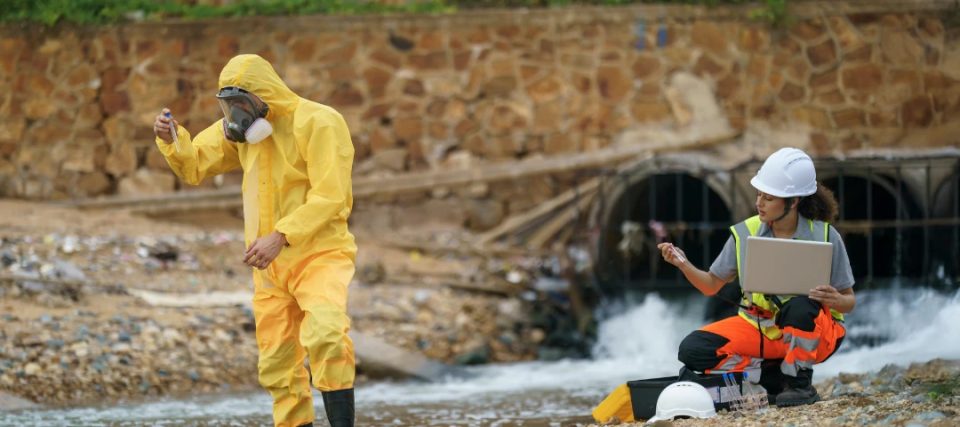
Water is the fundamental human need and is most essential for life as a driver of industrial applications, public health, environmental sustainability, and agriculture. Rapid industrialization, increasing population and subsequent urbanization, global warming, pollution, and climatic stress constantly threaten the quality of water bodies. Depleting quality can be hazardous in nature, as it leads to food poisoning, respiratory issues, skin diseases, diarrhea, and many other health-related problems apart from endangering aquatic ecosystems and life. Conventional methods of assessing water quality without using devices engineered by electronics manufacturing services require hours of manual effort, laboratory testing, and result analysis. Therefore, this does not support real time decision-making and quick responses to water body contamination.
An innovative IoT-based water quality monitoring system can tackle such issues and offer assessments in real-time. It can continuously track key parameters such as potential of hydrogen (pH), turbidity, total dissolved solids (TDS), and temperature, among others. This automated, intelligent system transmits data through sensor networks and wireless communication technologies. Deployed by IoT consulting services, it enables early detection of water contamination using cloud computing, AI (artificial intelligence), and visual analytics. Thus, providing a holistic view of water quality assessment for measuring, understanding, and managing the quality of water resources.
The current global market for smart water quality management was estimated to be around US $19.01 billion as of 2024 and is expected to surge and reach an approximate value of US $61.7 billion by 2034, increasing at a CAGR of 12.5% during this forecast period. The value of the worldwide market for systems used for monitoring water quality was estimated to be US $6.464 billion in 2025 and is surging at a CAGR of about 7.89% to reach an approximate value of US $13.82 billion by 2035. Let us now further explore in this blog, the components, such as cloud IoT solutions and architecture of these systems, their functioning, their development cycle, and the advantages and challenges of deploying these.
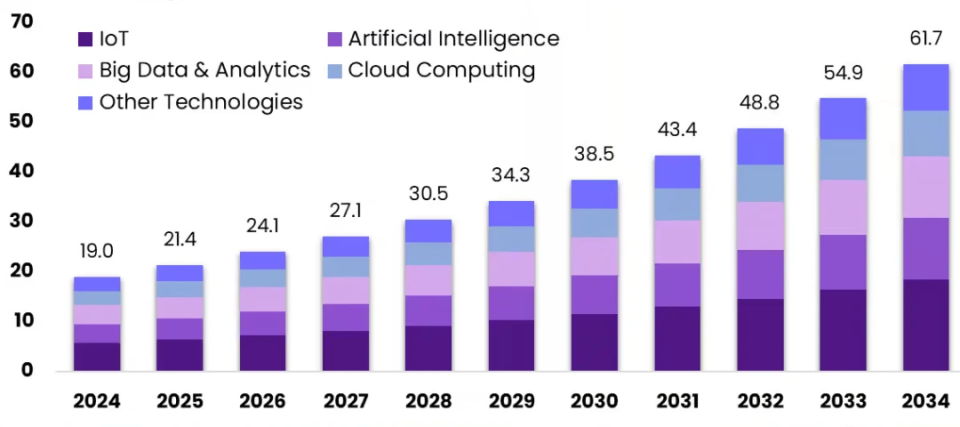
Source: Market.us
Growing market size of smart water management using water quality sensor and tech from 2024 to 2034
Key Components of Water Quality Monitoring System
These systems require complex circuit board assembly services for hardware and software, engineered through hardware development services, which we will study in detail further in this section as we break down their components.
Sensors
Sensors measure different types of parameters of quality and convert the physical and chemical properties or values retrieved into simplified, measurable electrical signals. Each of these parameters provides an overview of insight into water safety, and thus it is important to be measured. The following are the various specialized sensing or lab-on-chip technologies utilized by these systems.
- pH Probe: It measures the pH of the water subject and indicates acidity or alkalinity levels. The ideal pH of safe water quality ranges from 6.5 to 8.5, which is neutral to slightly alkaline, whereas that of wastewater ranges from 5.5 to 9, which is more acidic or alkaline in nature. Extreme measurements of wastewater pH usually indicate that it is industrial discharge or chemically contaminated. It can be corrosive and can harm aquatic ecosystems and even pipelines, as indicated by the pH probe against aquatic health and disinfection efficiency.
- Optical Turbidity Sensor: It basically measures the turbidity of the water, which is cloudiness due to suspended particles, sediments, contamination, or matter. Ideal turbidity of safe or normal water quality ranges from less than 1 NTU (Nephelometric Turbidity Unit) in the case of drinking water to less than 5 NTU in the case of surface water. On the other hand, in the case of wastewater, it may range from 10 to more than 1000 NTU. High turbidity levels indicate that light is blocked from penetrating the water body and is capable of harboring pollutants and pathogens.
- Thermistor or RTD: An RTD (Resistant Temperature Detector) or thermistor is used to measure temperature, which is necessary as it directly affects sensor calibration and chemical reactions. The temperature of ideally safe water quality can range between 10 and 25°C, whereas, that of wastewater is higher, that is, in the range of 20 to 40°C. Elevated temperatures indicate abnormal conditions, reduced levels of dissolved oxygen, and accelerated biological reactions leading to stressed aquatic life.
- Dissolved Oxygen Probe: A DO probe in the water quality monitoring system measures dissolved oxygen levels, as it is key to the sustainability of aquatic life like fish and microorganisms. DO in normal or chemically safe water ranges from 6 to 9 mg/L (milligrams per liter), whereas in the case of wastewater, it ranges from 0 to 3 mg/L. Here, lower DO levels indicate wastewater intrusion and higher levels of organic pollution, which can lead to a greater number of aquatic life deaths.
- Conductivity Sensor: It measures conductivity, detects salinity, and ion concentration of the water body, where high conductivity reflects the presence of excess salts, pollution, industrial effluents, or chemicals. Normal water conductivity ranges from 50 to 500 µS/cm (microsiemens per centimeter), whereas wastewater conductivity levels range from 1000 to more than 10,000 µS/cm.
- TDS Sensor: This water quality sensor measures Total Dissolved Solids (metals, ions, salts, minerals, and organic compounds) as an evaluation of water purity, as high TDS levels affect irrigation, sustainability, health, taste and indicate high levels of contamination. Acceptable levels of TDS in drinking water are usually less than 500 mg/L, while in wastewater it can range from 1000 to more than 30,000 mg/L.
- ORP Sensor: Oxidation-Reduction Potential measurement indicates disinfection potential, where lower ORP suggests reduced sustainable conditions, higher organic load, and lower chances of disinfection. Such as in the case of wastewater, which ranges from –300 to +100 mV (millivolts) as compared to +300 to +700 mV in the case of safe water quality.
- Ion-selective Electrodes: These advanced systems can be used to track specific pollutants or harmful chemicals like nitrates (NO₃⁻ from fertilizers, <10 mg/L in normal water vs. 20-100+ mg/L in wastewater), fluoride (0.5-1.5 mg/L vs. >2 mg/L), chlorine (Cl), pesticides, or traces of heavy metals like lead (Pb), cadmium (Cd), or mercury (Hg). High nitrate levels detected by a water quality sensor cause eutrophication and are dangerous for infants (blue baby syndrome), whereas excess fluoride leads to skeletal and dental fluorosis. Even at low concentrations, heavy metals are considered highly toxic and a bioaccumulation risk.
Microcontrollers
Edge devices and platforms, such as Arduino, ESP32, Raspberry Pi, and STM32 poll, read electrical signals sent from the sensors, perform basic filtering, preprocess raw information (sensor fusion, noise reduction), manage communication modules, power, and transmit data.
Connectivity Modules
The data communication between the sensing point of the device and the cloud or central server is managed by these modules. This is powered using various wireless technologies that are used as per their power consumption, range, cost, and data frequency requirements, such as the following.
- Wi-Fi: Wireless Fidelity with high bandwidth for local range within urban areas with infrastructure.
- LoRAWAN: Long Range Wide Area Network with low bandwidth for rural or remote locations.
- NB-IoT: Narrow Band Internet of Things with low bandwidth and for very long-range telecommunication service provider-backed IoT networking through IoT development services.
- GSM: Global System for Mobile Communications, such as 4G and 5G for cellular range with moderate bandwidth and wide coverage.
- Bluetooth: For a short range of communication, providing moderate bandwidth inclusive of services across local access points.
Power Units
Power efficiency is an important consideration as monitoring nodes may be deployed in remote areas. These units can be battery-powered, energy harvesters, or powered by solar panels alongside battery backup. The industrial product design of these units is done by accounting for sleep modes and power-efficient communication to maximize uptime.
Backend & Cloud
Data is transmitted by microcontrollers to cloud services platforms like AWS IoT, Azure IoT, and Google Cloud IoT to store, process, and analyze it. These provide scalable infrastructures with built-in security and in-depth analytics of retrieved data. The components mainly include time-series databases for sensor logs and APIs for ingestion and queries. Furthermore, there may be embedded compute nodes that run visual analytics powered by AI models for predictive maintenance, real-time alerts, and more.
Frontend & Application
This includes dashboards as human machine interface development or other customized visual interfaces that transform raw data into actionable insights. This user management application is basically for operators to view real-time graphs, charts, alerts, warnings, historical data trends, downloads, reporting tools, and map visualizations of sensor locations.
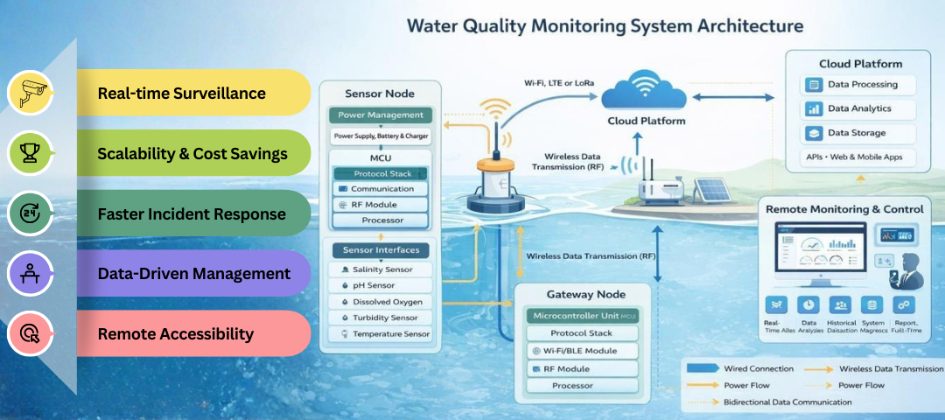
High-level architecture diagram and advantages of IoT-based water quality monitoring system
Architecture of Smart Water Quality Monitoring System
Given below is the architecture and various layers of these systems.
Physical Layer
The sensing layer is where the sensors discussed above capture raw environmental data and generate analog signals accordingly. These signals are digitized via ADC (Analog-to-Digital Converter), and the embedded firmware engineered through firmware development services controls the sampling frequency and calibration.
Perception Layer
The edge layer includes the microcontroller or edge compute unit that is responsible for reading streams, noise monitoring using digital filters, performing threshold detection, and running lightweight models for anomaly detection. Intelligence deployed at the edge reduces costs around transmission of data and enables swifter local responses.
Communication Layer
The layer handles connectivity protocols and ensures reliable and secure transfer of data developed through digital transformation for manufacturing services. It utilizes common protocols, such as MQTT (Message Queuing Telemetry Transport, lightweight, and IoT-optimized telemetry), HTTP (Hyper Text Transfer Protocol), CoAP (Constrained Application Protocol), etc.
Storage Layer
The data ingestion and storage layer in the smart water quality monitoring system act as cloud brokers that receive data sent by the perception layer. All sensor records are stored in time-series databases, and the data is pre-aggregated by stream processing frameworks.
Analytics Layer
The insights are extracted in the analytics and AI layer, where detection of trends, anomalies, seasonal or subtle pollution patterns using AI pattern recognition, and alerts related to crossing of threshold occur. Such insights can be used for predictive modeling to forecast water quality based on historical trends. Furthermore, it can be deployed for sensor drift correction, that is, for compensating sensor degradation with the help of learned models. A few examples of AI/ML techniques used for such applications include random forests, types of neural networks, SVM (Support Vector Machine), LSTM (Long Short-Term Memory) models for time-series forecasting, etc.
Application Layer
The interface layer mainly comprises dashboards, mobile alert applications, and APIs using AI integration services with third-party applications to present data to humans and external systems.
Steps for Development of Water Quality Monitoring System
Development of these systems is done through various stages, such as the following.
1. Requirement Analysis: This step revolves around certain considerations for the development of IT solutions for manufacturing, such as water quality standards, the environment of deployment, constraints related to power and connectivity, the requirement of data frequency, and latency needs.
2. Hardware & Firmware: Required hardware or sensors are selected that feature appropriate range and accuracy. Microcontrollers that are compatible with connectivity modules and power supply type (solar, battery, or grid) are chosen as per the application of the system. Power-aware and efficient firmware are selected where embedded programming (C/C++, Python, Raspberry Pi) handles sensor initialization, calibration routines, sampling scheduler, communication stack (MQTT/HTTP), and local preprocessing like filtering, threshold logic, etc.
3. Backend & Frontend: In the next step, connectivity and backend setup are considered with the provision of communication protocols, configuration of the cloud IoT hub, and implementation of secure authentication (TLS, API keys). Next, cloud platforms, AI model deployment and integration (serverless like AWS Lambda), data ingestion pipelines (MQTT brokers), storage systems (InfluxDB, DynamoDB), APIs, and compute services are considered. Further front-end development based on standard frameworks (Angular, React, and Grafana) takes place for dashboard creation for alerts, historical map trends, geospatial maps, and real-time graphs.
4. AI Model Training: If the smart water quality monitoring system features intelligent forecasting or anomaly detection, the analytics and AI model need to be trained using TensorFlow, scikit-learn, PyTorch, etc. This is done by historical water quality dataset collection, data cleaning, normalizing, feature engineering using derived variables, supervised vs unsupervised learning, model training, performance validating, testing, and ultimately, edge or cloud deployment.
5. Testing & Deployment: The solution and its sensors are tested in controlled environments, calibrated using standards (pH reference solution), and wireless communication is validated in real-world conditions. During deployment, nodes are installed at water bodies, treatment plants, or pipelines. Routine maintenance includes sensor cleaning, calibration, firmware updates, and security patches. Alongside deployment, it is made sure that all domain compliances and industrial development regulations are met. This includes compliance standards related to drinking water (WHO, ISO 24512, IS 10500, EPA SDWA), wastewater (EPA CWA, IS 2490, EU WFD), sensors and instrumentation (ISO 5667, ISO 7027, ISO 7888), IoT security (ISO 27001, NIST), data privacy (GDPR), communication (IEEE, 3GPP, LoRaWAN), etc.
Realize Sustainable Initiatives with KritiKal
KritiKal Solutions has developed reliable, long-term solutions, such as automatic waste sorting and remote monitoring of water quality in challenging environments, such as mangroves and water bodies. We have enabled data-driven environmental monitoring and decision-making to support sustainability initiatives and assisted in scalable deployment of the same across remote geographies.
We provided the complete system architecture, end-to-end embedded hardware, PCB (Printed Circuit Board) design, and power management modules for the adept solution. We can assist you in developing low-power firmware, system integration, testing, assuring quality, validating, enclosing, and delivering the prototype of a multi-parametric IoT-based smart water quality monitoring system or medical prototype development. The systems comprise sensor nodes and gateways integrated with the cloud using MQTT/HTTP and can collect environmental data, and measure, and monitor salinity, pH, turbidity, dissolved oxygen, and temperature in real-time.
This helps in reducing manual sampling costs, improving monitoring accuracy, compliance readiness, and supporting sustainability initiatives. It is thus fair to conclude that these systems represent a leap forward in the protection of water resources and their quality. These form an amalgamation of cloud, edge computing, analytics, sensing hardware, connectivity, and AI that come together to provide real-time insights, rapid responses, and better decision-making capabilities. KritiKal can assist you in overcoming challenges, such as sensor reliability, security, rapid technological advancements in edge computing, connectivity, and AI.
This renders our solutions and your product portfolio as future-proof, robust, and accessible. Our solutions not only measure water quality but also provide actionable, valuable, and essential insights to empower utilities, communities, policymakers, and safeguard health, the environment, and the economy in general. Stay a step ahead of water challenges with our intelligent monitoring systems, as they grow more complex in the near future. Please get in touch with us at sales@kritikalsolutions.com to know more about our embedded solutions, products, platforms, and services and realize your business requirements.

Rahul Kumar currently works as a Senior Testing Engineer at KritiKal Solutions. With over a decade of experience as a software testing professional, and expertise around IoT design testing, functional testing, application testing, embedded systems, manual testing, test case designing, and more, he has helped KritiKal in delivering innovative projects to global clients, while ensuring high-quality performance and reliability.