


 Global
  United States

What is IoT Device Management?
The Internet of Things (IoT) forms the basis of contemporary businesses to manage, deploy, and monitor devices powered by integral components that require centralized real-time orchestration. In an enterprise environment, it is necessary to plan the layout alongside designing and building connected devices for better control through assistance from electronics manufacturing services. Here, management of IoT devices refers to such plans, tools, software, platforms, and processes that can be used to remotely register, maintain, provision, and configure the same. Through a clustered, command-driven platform over systems and mobile phones, connected devices are managed and monitored, such that operational control stays up-to-date and secure.
IoT device management deployed through IoT consulting services is useful for IT administrators to access and manage the same over cloud-based central dashboards (such as AWS, Microsoft Azure, Google Cloud Platform, etc.) using a basic internet connection and any device, as discussed before. The current global market for management of IoT devices is estimated to be around US $2.8 billion as of 2023 and is expected to surge and reach an approximate value of US $45 billion by 2033, increasing at a CAGR of 32% during this forecast period. Let us now go through the architecture, components, advantages, considerations, and practices further in this blog.
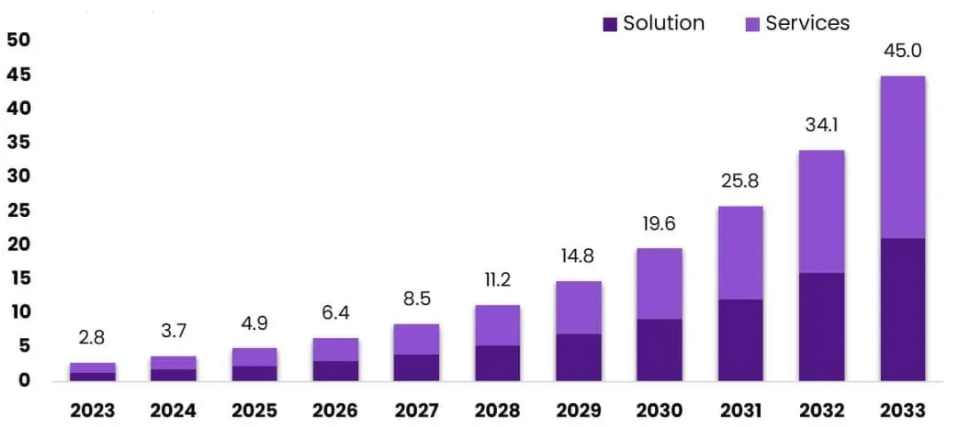
Source: Market.us
Growing market size of IoT device configuration management during the forecast period 2023 to 2033
Fundamental IoT Device Management Features
Given below are the basic functionalities performed by these systems for ensuring seamless operations in a secure manner.
Onboarding
Onboarding devices refers to enrolling new devices within the device management network. It includes provisioning them with credentials and configuring them for connectivity for seamless functioning with the network.
Viewing
The management platform offers a centralized view of all the devices so as to scrutinize the network for device health status. Viewers can observe statistics and key details, troubleshoot potential issues, and manage devices through grouping in offline or online mode over a single interface.
Configuring
IoT configuration management is useful for managing settings and parameters remotely and changing processes throughout the network. This helps ensure that all devices perform optimally and consistently.
Grouping
Grouping devices assist in organizing all devices in the network with respect to their functions, locations, and other criteria. This is useful for restarting, updating, and changing configurations of the entire group remotely to simplify their management.
Diagnosing
The entire IoT-based system developed through hardware development services is diagnosed thoroughly in a continuous manner to flag potential health-related threats and monitor device, yield, and operational performance. It allows a window for remote troubleshooting against issues like error messages, low battery, sensor malfunctioning, etc.
Monitoring
Monitoring and tracking device status gives real-time insights into the device’s health and performance, such as errors, battery-related issues, etc. for early identification and smooth functioning.
Securing
Apart from IoT configuration management, this system’s functions also include remote patching, vulnerability (data leaks, breaches, etc.) monitoring, identifying suspicious activities, and cyber threats.
Upkeeping
The system developed using IoT development services also allows operators to perform remote device updates (security patches, bug fixes, functions, factory resets, reboots, etc.) of newly deployed firmware or software either over specific device groups or throughout the network.
Integrating
The platform gathers information through sensors and transforms the same into a unified format as a subset of digital transformation for manufacturing. It smoothens data analysis, optimizes operations, provides insights, and performs informed decision-making.
Retiring
The lifespan of a device is tracked, and its retirement is facilitated through adept data recycling and wiping. This function is necessary because outdated devices may lead to a vulnerable network or clutter security-wise.
Key Components of IoT Device Management
The whole solution is a complex network of key elements that are required for its smooth operation. Given below is a gist of the main components of IoT-powered device management systems.
User Interface
An intuitive interface deployed through human machine interface development services, acts as the control center for the user of the device network that is a centralized point to monitor real-time connected device health and functioning. Apart from IoT device configuration management, the end-user screen can be used to trigger actions, perform operations, and adjust process settings, including remote reboots.
I/O Devices
The sensors are used to collect data from devices or the shop floor environment and feed it as input to the analyzing system or UI. Actuators can perform certain actions as directed through instructions, for example, controlling relays, lights, valves, and more, while the commands are based on sensory data. These input and output devices can also send feedback to trigger identification of potential device health problems through continuous monitoring.
IoT Cloud
One of the important IoT device management features include cloud IoT solutions, which is basically a huge IoT network in which the UI and all devices and systems fall and are controlled as well. As the command centers on the backend, this network streamlines all aspects of managing devices. They simplify remote maintenance, monitoring, configuration, setup, enrollment, updates, and troubleshooting for thousands of devices simultaneously. A few of the commonly known IoT cloud platforms include AWS IoT Device Management, Azure IoT Hub, Oracle Internet of Things, Bosch IoT Suite, Google Cloud IoT Core, Hologram, IBM Watson IoT Platform, and more.
Analytics
Data analytics are performed on vast amounts of sensory data collected from the devices in the IoT cloud so as to forward the required actions to actuators. This includes identification of patterns, trends, anomalies, process insights into operations, requirements of predictive maintenance, and other data-driven decisions. It is also useful for implementing security features to prevent cyberattacks, remote patches, and FOTA for optimal functioning. All analyzed data is relayed to and fro between sensors and actuators via the platform to monitor health, etc.
Basic Architecture of IoT Device Management
The architecture of IoT-powered device management platforms is a structured framework that holds up the responsibilities performed by the same, such as configuring, updating, provisioning, monitoring, securing, and more. Based on the components discussed in the previous section, given below are the basic architecture or layered components of the system.
1. Edge Layer: The device layer includes physical IoT devices, such as sensors, actuators, microcontrollers, and embedded firmware deployed using firmware development services. To ponder what is IoT device management’s major functions, specifically for this layer, include data collection, localized processing, maintaining communication through the cloud or gateway, retrieval of firmware updates, and commands.
2. Computation Layer: The edge computing layer basically forms the gateway that acts as the intermediary between the devices and the cloud. This layer may or may not be present in all systems, as smaller systems can directly connect to the cloud. Its major functions include protocol translations (such as MQTT to HTTP, etc.), data aggregation and filtering, local decision-making, security enforcement, and offline buffering.
3. Connectivity Layer: This layer handles the communication infrastructure that includes Wi-Fi, cellular communication (4G, 5G, etc.), LoRAWAN, Ethernet, Bluetooth, and more. The commonly used protocols are MQTT, CoAP, HTTP, HTTPS, AMQP, etc.
4. Cloud Layer: This includes the device management platform that performs device registry (metadata, certificates, device identity storage), authentication and authorization (X.509 certification, token-based access, role-based access management), IoT configuration management (remote parameter updates, feature flags), firmware and OTA updates (remote firewall deployment, rollback capability), monitoring and diagnostics (health status, logs, telemetry).
5. Application Layer: It includes the UI and other user-facing systems, such as dashboards, mobile applications, web portals, analytics systems, integration with third-party apps, software, and inter-departmental tools like ERP, CRM, etc.
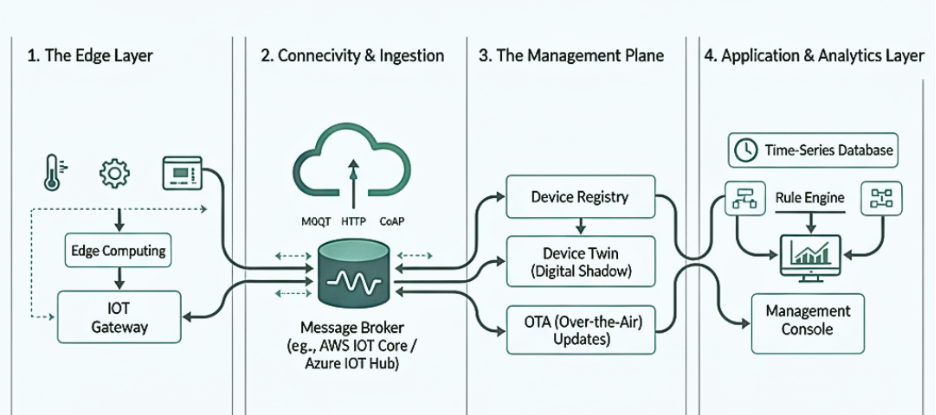
High-level architecture diagram of IoT device configuration management
Benefits of IoT Device Management
There are various advantages to implementing management platforms for IoT-powered devices, such as the following.
1. Security: Since sensitive organizational, client, and device-related data are transmitted, these platforms are useful for implementing data segmentation and encryption at full scale. Admins can manage, update, and upgrade role-based access to connected devices remotely and securely.
2. Updates: The process of updating software and configuring thousands of devices simultaneously is simplified in a phased and controlled manner. This not only saves time and effort but also ensures critical issues get identified immediately.
3. Registration The system also includes tools for quick development, configuration, and deployment of connected devices so that the changes can be seamlessly and swiftly integrated throughout the network. This also simplifies locating, troubleshooting, and retrieving compromised devices using a combination of various attributes.
4. Adaptation: In case business models change as per evolving market needs, the software can adapt with the same by implementing such platforms. Moreover, legacy systems can be evolved to adapt to advanced technology and intelligently pair edge systems with time.
5. Management: Companies can group devices in a hierarchical manner to streamline operational tracking, manage policy access and bandwidth demand, and avoid congestion and outages. One of the notable IoT device management features is that it eases the trouble of managing unstructured and fragmented data through unified analysis.
6. Scale Up: The system also helps in meeting the enterprise quality needs including device additions, data point modifications, transfers between assets, and more, all over a centralized admin interface. This helps organizations create better industrial product design and offer advanced services as per customer needs.
Experience KritiKal’s Top IoT Device Management
KritiKal Solutions offers the development of adept connected device management solutions that feature functions, such as provisioning, monitoring, configuring, updating, and securing across industry-agnostic applications. This can become extremely complex given the use cases, applicable area, and number of devices, and it leads to various drawbacks and challenges. Some commonly observed ones include risks related to access control of unsecured devices, network and bandwidth strain congestion caused by device proliferation, firmware coordination, excess power consumption and costs, compatibility issues, legacy device integration, data management, and constraints in cybersecurity, network connectivity, and analysis of unstructured and fragmented sensory input data.
Our services can assist in addressing these bottlenecks through centralized monitoring, FOTA updates, secure authentication, IoT configuration management, asset tracking, seamless execution of workflow, telemetry analysis, remote maintenance, and lifecycle management. We understand their implementation can vary as per their wide use in smart home automation, smart city infrastructure, industrial IoT healthcare, connected logistics, agriculture, vehicles, rail and heating systems, noise monitoring systems, industry 4.0 gateway environments, etc., and thus, design and develop our solutions accordingly.
We offer the best practices in their development, including security maintenance throughout the product lifecycle using Zero Trust principles, two-factor authentication, IAM, secure provisioning, remote monitoring, regular patching, standardized configuration, asset inventory management, out-of-band (OOB) access for round-the-clock remote management, automated MTTR for reduced complexity, scalable architectures for device growth handling, and whatnot.
Through our expertise in the implementation of device management protocols, such as MQTT/MQTT-SN, LwM2M, OMA-DM, and TR-069, as per a given device and network, we can assist you in transforming device ecosystems into a centralized, secure, and data-driven environment that seamlessly enables predictive maintenance, improved uptime, operational optimization, and enhanced decision-making across industry-agnostic applications in industrial, commercial, and consumer domains. Please get in touch with us at sales@kritikalsolutions.com to know more about our embedded and software-based products, platforms, services and realize your business requirements.

Rakesh Kanakraj Shroff currently works as an Architect– Embedded Systems at KritiKal Solutions. He has a vast experience of over 20 years on various domains including automotive (AD-ADAS), industrial, and analytical. He is proficiently skilled in system engineering, design and development of embedded software, hardware, sensors, optics, electrical, and electronic systems. With his ability to efficiently handle teams and extensive experience as a developer, tester, and system engineer, he has assisted KritiKal in delivering various projects to some major clients.
Comment (1)
Comments are closed.
Understanding IoT Applications: A Visual Diagram Explained | TechAnnouncer
March 16, 2026[…] process much smoother and reduces the chances of setting something up incorrectly. Proper IoT device management relies heavily on these clear […]