

 Global
  United States

What is Creative Content Automation?
The age of artificial intelligence that is AI in social media marketing in combination with creative workflows and content generation brings forth various applications in the fabrication of marketing assets. This technology streamlines and scales the brand and its portfolio while proliferating consistency in its value despite the addition of variations. It helps in automating repetitive tasks involved in the process of creatives and content creation. This aids marketing teams to focus on strategic innovation and decision-making in lieu of manual or conventional production work. Basically, a content and creative automation platform utilizes input data feeds, algorithms powered by AI, and different types of templates to generate variants of core concepts.
Such platforms are powered by generative AI services and agentic AI solutions to reduce production time by transforming the concepts in a manner that makes them suitable for channels established for different purposes. The automation solution enables delivery of personalized viewer content, reduces overall production time, and yields altered versions of core concepts with respect to size, format, brand hues, etc. This approach leverages adaptation of AI in multiple industries and allows room for mass marketing content creation and scaling of organizational offerings. It represents the intersection of intelligent automation and ideation to execution processes without numerous iterations.
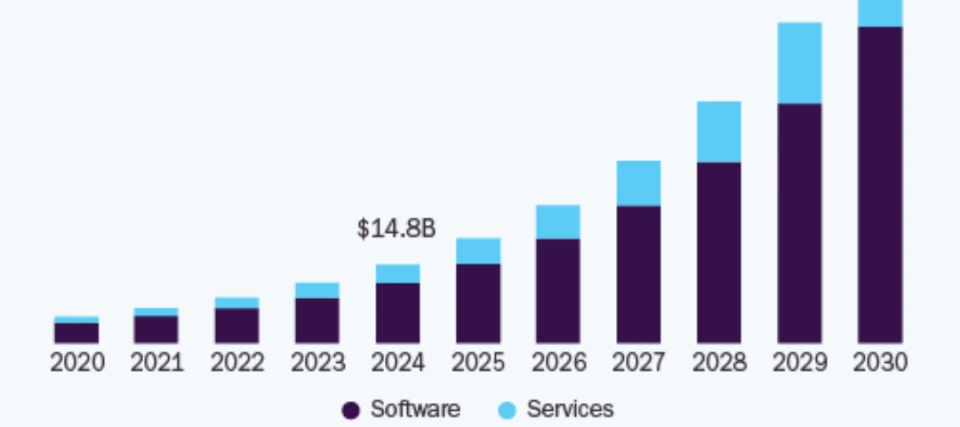
The current global market for AI in the creative automation market was estimated to be around US $14.8 billion as of 2024 and is expected to surge and reach an approximate value of US $80.12 billion by 2030, increasing at a CAGR of 32.5% during this forecast period. Let us now go through the importance of AI development services in this domain further in this blog.
Source: Grand View Research
Growing market size of creative automation platform during the forecast period 2020 to 2030
How Does the Creative Automation Platform Work?
As discussed briefly earlier, these platforms or systems utilize dynamic templates and content modules that are populated using rule-based logic or algorithms and data feeds. The conceptual output can be targeted for different contexts, audiences, channels, and quantities. For instance, a company needs to penetrate the market in a new geography without having to recreate its marketing assets in the local language. The creative automation for content creation tool can prove to be adeptly useful in creating numerous versions of the same creative in different aspect ratios and multilingual dialects of the call to action.
The creatives backed by generative AI for cybersecurity can be variants in terms of runtime duration or showcase altered product or solution features offered by the business. While adapting video advertisements to locally enriching interests and ensuring to maintain brand consistency as briefed in the above section, the AI component also analyzes campaign data, audience preferences, and viewer history to suggest changes. This can lead to optimized implementations through necessary suggestions as per the preferences and enhanced effectiveness of the content being published automatically.
Platforms for creative content automation incorporate AI enhancements, capabilities, and agentic AI architecture in addition to basic template systems for intelligent decision-making. Here, the decisions may revolve around elements in the content, audience segment preferences and behaviors, creative direction, adaptations in design, data points, and more in relation to the performance data collected and analyzed by AI algorithms. This not only addresses evolving customer expectations and supports contextual and relevant marketing but also aids in retrieval-augmented generation and personalized content at scale.
AI analyzes specific user or audience segment data and makes the creative to be generated resonate with their individualistic needs. As per the historical browsing data, it generates modified product images and messages that can adapt to the viewer’s current position in the entire buyer’s journey. Visual elements are altered to reflect the local user’s choices and sync with their preferences and cultural context, alongside calls to action that are personalized in accordance with previous interactions. Furthermore, these platforms are connected to official data sources, such as Customer Relationship Management (CRM) systems, Enterprise Resource Planning (ERP) software, third-party customer data, in-depth marketing analytics, etc. Automated ad creation helps in integrating dynamic content that readily adjusts with individual user’s characteristics and assists brands in enhancing engagement. Also, this level of personalization by AI model deployment was earlier difficult to achieve given the campaign tool costs, resource expenses for manual creative generation in bulk, and targets specifically aligned with segments of higher value and number. Here the gist of the working of these systems comprising of various agents:
- Data Aggregation Agent: This component pulls store location, product, event, weather, and audience insights. It also ensures that the ads are generated in the right local language for that region.
- Designer Agent: This agent designs the ads in terms of overall content, design, etc. It seamlessly integrates the client-provided product images, logos, and brand assets into every ad.
- Creator Agent: This component generates text, hashtags, and images. Marketers can also provide a short description or input, and the agents instantly bring it to life.
- Reviewer Agent: This agent ensures brand alignment and compliance.
Publisher Agent: This component instantly posts on the chosen social media platforms.
Source: AWS SageMaker
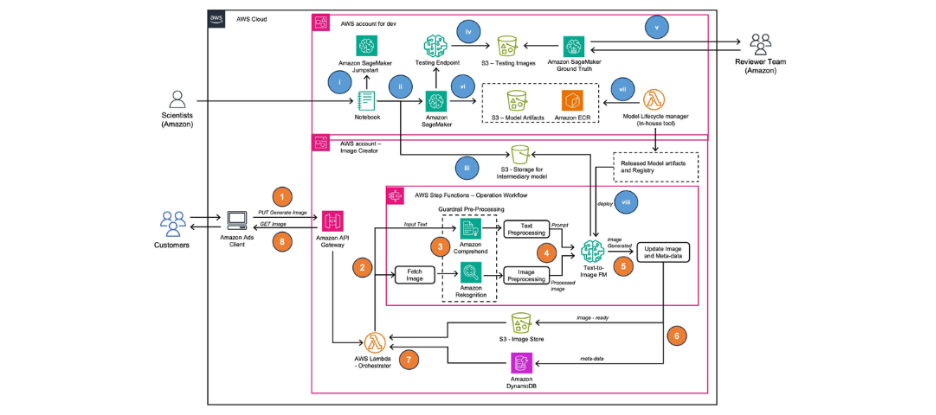
High-level architecture diagram of creative automation for content creation using AWS SageMaker
Advantages of Implementing Creative Automation
There are various advantages to implementing these platforms in creative workflows that can transform the operations and performance of marketing teams, such as the dramatic surge in efficiency of the marketing team and savings in time and resource utilization for variant content iterations. The key benefits are as follows –
Better Localization
Now businesses can generate thousands, if not dozens, of creatives and their variations within a matter of a few hours. Multinational brands can solve the challenge of localizing their content while scaling through AI-augmented software development solutions. They need not adapt their content as per changing markets, languages, formats, and ad regulations, as these are directly driven using local data feeds.
Resource Allocation
Talented individuals, creative professionals, and designers can be utilized for high-value decision-making through automated ad creation. AI applications in real life, such as these help them to be involved in the development of innovative concepts and strategic initiatives in lieu of repetitive production workflows or small alterations in assets, leading to the team’s satisfaction and creative yield.
Production Efficiency
With AI creative automation for content creation, marketing content production is eased, and so is the time and resource utilization capacity, right from weeks to minutes. Businesses can eliminate the marketing execution gap, which refers to misalignment of the marketing team’s objectives, resource availability, and execution capacity.
Cost Savings
The production expenses get lowered as manual work, resource hiring or utilization, and production tools related to designing are eliminated.
Rapid Testing
These systems also increase testing agility, as the solutions facilitate split, bucket, or A/B testing of different types of content, creatives, and their altered variants.
Brand Alignment
These solutions such as generative AI for retail ensure that brand values and guidelines are consistently reflected in all creatives generated, and every asset stringently adheres to these.
Reduced Fatigue
Automating such generation workflows diminishes the chances of ad fatigue as newer creatives can be generated at more frequent intervals involving brighter ideas and refreshing content that is custom-tailored to viewers’ specific contexts and relevant to their needs.
Maintain Creative Oversight with KritiKal
With the current increasing pressure on business teams, creators, and publishers, manual editorial workflows are leading to limited scalability, vendor dependency (localized citations, abstracts, and compliances), social media marketing strategy and administrative overload, burnout, authenticity loss, higher costs, ethical issues, low volume submissions, and content competitiveness. Automating the same can overcome such bottlenecks or constraints and turn them into opportunities through AI-based automated ad creation for in-depth research and assessment on trends from thousands of sources, multi-grade editing, curating, drafting as per required grammar, style, consistency, prioritizing, repurposing, production, brief compilation, and even approval cycles prior to refinement by humans.
Intelligent creative generation systems can handle assets, rights, metadata, brand voice, ethics, quality, performance analytics, and multi-format optimization. Leverage KritiKal’s creative content automation and advertisement generation solutions that soothe and audit workflows through batch work, SEO optimization, personalization, mitigated governance, adjustments according to budget, geotargets, posting times, channels, and real-time insights. Our adaptive, predictive, deeply integrated, tailored systems generate creative based on audience fit, partner ecosystems, cross-platform publishing, and dynamic asset management, without a proportional increase in assets and training.
As the amalgamation of AI and creativity evolves towards multimodal large language model and content creation, predictive strategy, and optimization, let us assist you in balancing out automation with human insights to unlock greater efficiency, impact, and long-term competitive advantage in terms of higher engagement rates and conversion performance. Please reach out to us at sales@kritikalsolutions.com to know more about improving marketing execution through our automated solutions and realizing your business requirements.

Rajaram Tripathy holds the position of Delivery Manager at KritiKal Solutions. He has a vast experience of over 20+ years in managing and delivering projects across various geographies from inception to delivery. He has dedicatedly helped KritiKal in delivering computer vision, cloud-related projects and many more for various SMBs and Fortune500 companies.
Comment (1)
Comments are closed.
Time Leverage for Creators: Multiply Output, Not Hours
May 12, 2026[…] appear in any location, wear any outfit, and maintain perfect consistency across months of content. The global AI creative automation market is projected to grow from $14.8 billion in 2024 to $80.12 b…, which reflects strong momentum in AI-powered scaling […]