

 Global
  United States

What are AI Integration Services?
With the global market functioning at lightning speed, customers anticipate personalized user experiences. This calls for swift and efficient operations powered by automated tasks and digital transformation. The integration of Artificial Intelligence (AI) is useful for personalizing product enablement so that they can easily comprehend, rationalize, and adapt to their environment.
As the solution feels less programmed in nature, it resonates with its embedded AI and the user’s choice at its very fused core. For these reasons, AI development services must be harnessed to explore its factual potential that has the capacity to bring about a competitive edge while delivering exceptional services alongside better decision-making. AI incorporation can unlock new growth and innovation opportunities for businesses.
To put simply, integration of AI involves the addition of AI capabilities directly into existing legacy systems, products, workflows, and applications, such as agentic AI solutions, chatbots, or generative AI services for real-time customer services, redesigning email responses, and much more. It doesn’t replace human talent; rather, uplifts it to function in a smarter way by entwining its analytical prowess to improve various operational performance facets.
The global market for artificial intelligence integration services was estimated to be around US $0.33 billion as of 2019 and is expected to surge and reach an approximate value of US $1.02 billion by 2030, increasing at a CAGR of 25.32% during this forecast period. In this blog, we will bring forth pragmatic and meticulous integration steps to embed this intelligence for enhanced user engagement for businesses to gain a transformative edge.
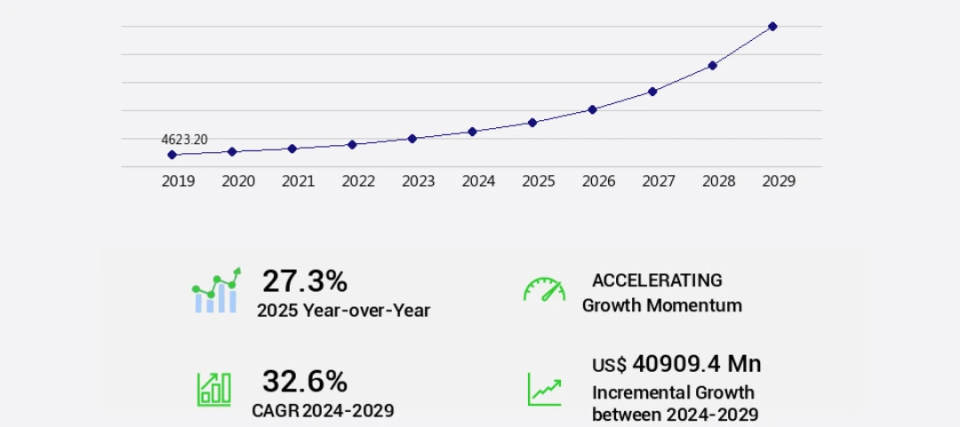
Source: Technavio
Growing market size of generative AI integration company during the forecast period 2019 to 2029
Deployment of AI Integration Services
Alignment of AI with existing business operations requires harmonization of its intelligence with infrastructure and the technological stack inclusive of interface, data lakes, etc., in a seamless manner. It is necessary to avoid partial integration resulting in incoherent workflows while creating a symbiotic relation amongst employees and artificial intelligence.
Here, the former can focus on generating creative insights while the latter handles data-intensive operations, thus augmenting human capabilities like decision-making and strategic planning. The structured roadmap for approaching the transformative journey of AI implementation is rooted in the steps given below.
Problem Identification
The problem that is required to be solved through the incorporation of AI needs to be identified, rather than pursuing AI in general. It is important for stakeholders to highlight the pain points that are gradually posing impending losses in the overall business performance.
These may include common requirements that can be solved using generative AI integration services, such as retrieval augmented generation, personalization of user experience, improving cybersecurity, automating mundane tasks that need working with huge data, streamlining supply chain network and coordination, optimizing inventory, and enhancing demand forecasting. This clarifies decisions around integration touchpoints, requirements around budget, data sources, tangible return on investment, AI methodologies, and operational changes.
Integration Strategy
The devised strategy should outline next steps and tactics, objectives, advanced tools required, data sources, quality assurance goals and procedures, change management, and risk mitigation planning. It is not necessary that a comprehensive plan be devised at the very beginning. Rather, the strategy can evolve with time, as and when the business expectations, processes, workstreams, and resources get eventually aligned with it. Although appointing integration resources or a team in charge of generating centralized oversight does become the need of the hour, such as in developing social media strategy.
Data Checks
The selected team needs to ensure certain factors, such as the quality and availability of internal data in case of embedding AI in food industry prior to integration. They need to check whether the data is high-quality and channel the next steps to maximize value extraction. The current data assets need to be aligned with new infrastructure by consolidating siloed sources into data lakes that are shareable and allow room for unified analysis. The data consistency must be maintained through labeling, formatting, and thorough cleansing, such that internal data exchanges can be easily built.
This allows sharing of data across various systems undergoing change through tools like integration platforms that may be open source in nature. Ultimately, data governance protocols need to be put in place that define access permissions, monitoring processes, security strategies, curation steps, etc., for business processes to stay aligned with evolving regulatory standards from a global point of view.
In case the selected internal data has gaps and critical voids, utilize external third-party ones after carefully vetting usage rights and ethical sourcing. This may include open-source datasets with data related to advanced innovation, trusted data vendors that provide segmented demographics and consumer market trends, and licensed databases that contain niche market information. Furthermore, check for the level of similarities between external and internal data standards and formatting, which can be done using suitable generative AI applications.
Data Storage
Next, the team needs to select an infrastructure that supports data storage, processing operations, analysis; completely supports, flexibly equips; and interfaces with AI incorporation through the required APIs. Common examples of such infrastructure include data lakes, data marts, data warehouses, and hybrid cloud deployments that can be provided by generative AI integration services.
Data lakes offer unlimited storage capacity for unchanged raw data in an affordable manner and can be used to collect extensively varying data before its organization. Data marts are self-driven and are utilized for providing detailed and decentralized analytical insights into processed data for different departments, respectively. Data warehouses are basically suitable for high-performance reporting, business intelligence, visualization, and extensive analytics, such as AI medical diagnostics. Deploying hybrid clouds involves entwining on-site servers with cloud after carefully considering factors like scalability, preferences for control, tolerance for latency, availability of tools, operational costs, and suitable alternatives.
Internal Training
After the above steps are completed, employees need to undergo upskilling training and provide in-depth insights into how AI will empower, impact, and enhance their regular operations in tandem. They should be enabled to interpret AI analytical results for informed decision-making, given new responsibilities apart from mundane tasks automated by AI, explained the fundamentals of the constructive mechanism of working alongside AI, and trained to pivot their job-specific skills using strategic initiatives. Only when successful training and constant evaluation of organizational readiness by embedding agentic AI frameworks in employee training take place will businesses be able to retain motivated and capable resources that work with AI to reach its fullest potential.
Compliance
It must be assured that the operating models are worthy of public trust and function in a fair, secure, legal, transparent, ethical, and compliant manner, as the artificially intelligent systems are directly interacting with the resources. This can be done through algorithmic audits for bias assessment, enablement of explainability features for thorough understanding of AI reasoning, adoption of rigorous cybersecurity protocols and data governance, and fostering business-wide responsible AI development principles and suitable agentic AI architecture.
Model Selection
A suitable form of AI that fits with the devised integration strategy, objectives, data quality, and infrastructure should be selected. This may include Machine Learning (ML), Multimodal Large Language Model (MLLM), Natural Language Processing (NLP), Computer Vision (CV), Generative AI integration services (Gen AI), voice recognition, native multimodal models, and others. ML can unlock analytics insights within extensive datasets, while NLP analyzes textual data, such as surveys, etc. CV is useful for thorough assessment of video feeds and content, while voice recognition is specifically used for interactions within conversational systems.
All these tasks can be interconnected with natively multimodal models as and when key performance indicative metrics are defined to improve the models over time. Sophisticated Deep Learning (DL) neural networks are utilized for personalization, while not-so-advanced and lighter models can be used to address basic challenges. Similarly, Mixture of Experts (MOE) can be utilized in place of a single global model as per evolving requirements.
Model Integration
Ultimately, the LLM can be integrated into the product, workstream, system, or as an AI applications in real life after the preparatory steps have been completed. Initially, pilot testing is conducted using smaller data samples and user groups for functional refinement. Thereafter, supplemental systems are incorporated with the model to reduce the chances of risks and sudden emerging challenges.
The operations are closely monitored as per user feedback, speed, accuracy, utilization rate, and other metrics. Furthermore, swift tweaks and continuous iterations are conducted on the basis of learnings from the results and altering requirements. A gradual integration allows room for familiarity building, controlled experiments, and assured phases of integration.
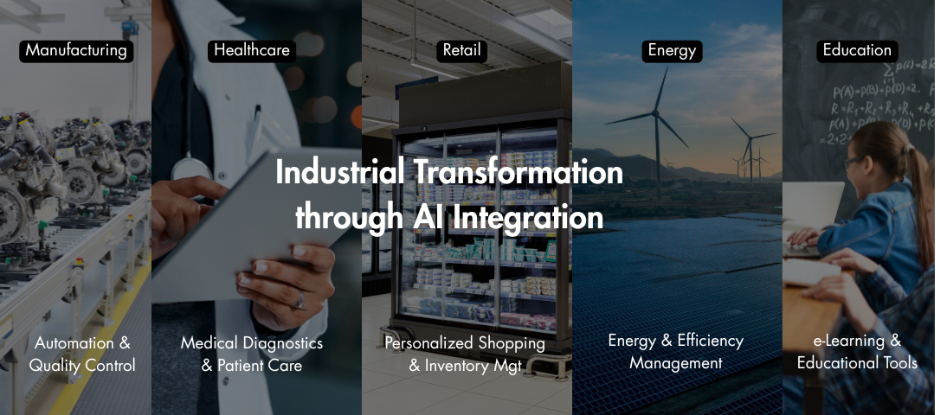
Industry-agnostic use cases of generative AI integration services
Benefits & Challenges of AI Integration Services
AI empowers highly tailored experiences, enables targeted advancements, and streamlines internal functions that help businesses in ovecoming over market competition. Meanwhile, executing incorporation strategies requires careful consideration of upcoming pitfalls and navigation through advanced technologies. Given below are the various benefits as well as constraining challenges of AI implementation.
Benefits
1. Productivity: AI can handle or automate data-intensive and repetitive tasks so that resources can be deployed for performing more creative and humane tasks. Through real-time predictive analytics, it can optimize supply chain and inventory management.
2. Enhancement: AI models perform continuous learning functions for constantly improving generated insights while developing their yield over time. They provide in-depth recommendations on how, where, and why to enhance internal operations and external portfolios.
3. Security: AI algorithms can detect threats, anomalies, and emerging risks through real-time vigilance and continuous monitoring of user behavior across business operations.
4. Personalization: AI logic deployed through artificial intelligence integration services can learn from user choices and offer suggestions and experiences that are tailor-made. This drives better customer engagement, enhanced shopping, and brand loyalty, all within user privacy protocols.
5. Augmentation: It scrutinizes various data sources, performs AI pattern recognition that is difficult for humans to comprehend, and offers informed suggestions for practical decisions.
Challenges
1. Fear of Attrition: AI systems can handle mundane and repetitive tasks within lower time limits and with greater speed. Many times, this can spread fear amongst employees related to job replacement and losses. Although, such expressed concerns must be counselled through effective change management by indicating the benefits of AI-augmented development and productivity, rather than its potential to replace resources.
2. Data Quality: Dependencies of AI models on data quality are non-negotiable, as their performance is directly proportional to the same. Data disorganization, inconsistencies in formatting, gaps in data quality, and siloed data utilized within platforms can lead to inhibited productive analysis.
3. Ethics: The development of AI models raises questions related to responsibility, fairness, and bias, as it directly impacts decision-making around user suggestions, security monitoring, and even credit scoring.
4. Legacy Systems: Infrastructure, if not updated, may lack the capacity to support the incorporation of AI completely, for example, embedding AI in medical imaging. Although APIs enable AI solutions to interface with legacy systems, overlapping tools may showcase some constraints in a full-fledged possibility.
Simplify Enterprise AI Adoption with KritiKal
As a generative AI integration company, KritiKal offers AI integration services to embed intelligent capabilities into routine task automation. We personalize user experiences and improve decision-making by acknowledging and overcoming current barriers related to the same. We craft mitigation plans and align data, models, and workflows by thoughtfully navigating in a manner that empowers employees and users. Our services feature generative AI in cybersecurity through strategic planning and deployment processes. This streamlines and enhances productivity, inventory, operations, security, recommendations, innovation, and leads to the development of self-learning and refining technologies across various industries. Please get in touch with us at sales@kritikalsolutions.com to know more about our software-based and AI-powered products, platforms, services and realize your business requirements.

Deepika Pandey currently works as an Embedded Engineer at KritiKal Solutions. She is proficiently skilled in C, C++, C#, SSL/TLSSSL/TLS, PKI, and more. With her ability to work efficiently in teams and extensive experience of working with embedded systems and cryptography, she has assisted KritiKal in delivering various projects to some major clients.
Comment (1)
Comments are closed.
Ultimate Guide to Artificial Intelligence (AI) Integration Services
April 22, 2026[…] This approach ensures seamless integration without disrupting existing workflows. […]