

 Global
  United States

What is IT Staff Augmentation?
When businesses expand into new markets, they often face challenges related to balancing the speed of project delivery timelines, hiring costs, resource risks, complex technical tasks, and the need for niche domain expertise. As and when operations are scaled across geographies, it becomes difficult to reach customers directly with unique features and services. Not to mention, traditional hiring processes may require months, if not weeks, to be accomplished when directly impacted by a shortage of talent. It becomes difficult to respond swiftly to shifting business needs and evolving technology demands. Also, outsourcing all services limited to a particular geography, domain, or service to third party vendors may at times mean losing authority over project outcomes, delivery quality, and even team productivity.
To overcome all such challenges, staff augmentation services come into play as a strategic day-to-day management resolution. Introduction of highly skilled resources into the team on demand makes scaling and tapping into domain-specific global talent easier. As there is no long-term hiring involved, contract IT staffing serves as an efficient, dynamic, and tactical solution for companies, large multinational corporations, and startups alike. They can maintain complete flexible control over workflows even through fluctuating market demands and new technology adoption. It acts as a conducer for reducing overhead costs, innovating and delivering projects in a faster manner without compromising with quality, and remaining competitive in the market.
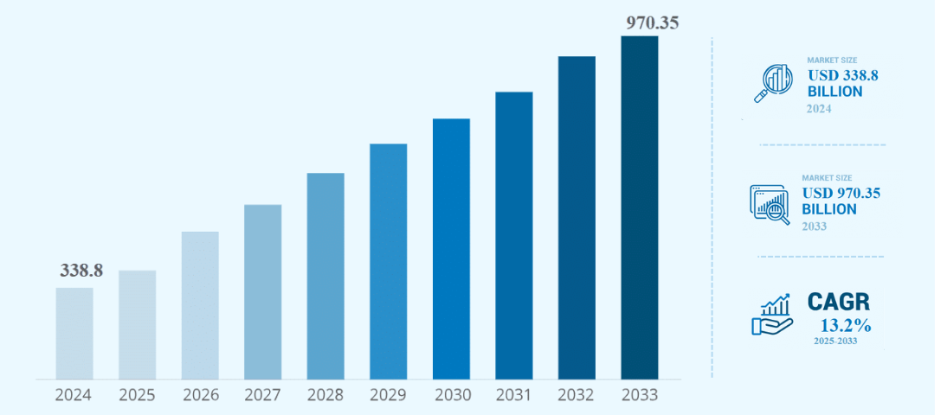
Its model differs from a third party’s managed services or outsourcing a project to an external organization. According to a recent report, this market was sized at ₹3.46 trillion in 2025 and is expected to reach ₹11.21 trillion by 2035, growing at an estimated CAGR of 13.2% during this forecast period. Let us now break down its core concepts, various advantages, how it overcomes challenges such as data security, communication barriers, cultural alignment, best practices, and its different agile models that are commonly observed in the industry to meet evolving customer expectations in this blog.
Source: Business Research Insights
Growing market size of IT staff augmentation companies from 2024 to 2033 forecast period
Types of Staff Augmentation Services
Augmentation models can differ in terms of engagement type, geography of project execution, and also the palette of skillsets required. Given below are the various approaches or types of resource augmentation.
1. Short-Term: This type of approach is ideal for businesses that may be experiencing excessive workload, a new product line launch, tight deadlines, urgent or temporary hiring requirements such as a particular skill set for an additional product feature. It is useful for adding developers or specialists for a limited time, such as weeks or months, without the need for any permanent hiring or long-term commitments.
2. Skill-Based: This type of augmentation model applies when the organization is looking to hire professionals with domain expertise in certain technologies such as artificial intelligence, backend, frontend, or full-stack development, gaming development, cybersecurity, etc.
3. Dedicated Development: In this type of staff augmentation approach, embedded specialists or niche domain experts are added in a full-time mode for carrying out ongoing or long-term projects.
4. Long-Term: If an organization has continuous requirements for certain skills or talent, be it cloud, quality control, or customer support, this approach may be considered ideal. They need not invest excessive hire time, efforts, or costs for recruiting process outsourcing and onboarding team members. Rather, they can conduct knowledge transfer in the same flow for long-term projects to provide ongoing continuity.
5. Nearshore: In the case of time-sensitive projects and scope of work, effective communication and collaboration become necessities. In nearshore technology staff augmentation, talented professionals are recruited or sourced from time zones that lie closer to the geography of project execution or client location.
6. Commodity-Based: This refers to expanding and enhancing a system or project delivery by filling standard job roles at low cost with readily available resources.
7. Highly Skilled: This type of approach is applied in specific emerging complex domains, such as machine learning, blockchain, and more, where advanced expertise plays a major role in project completion.
8. Offshore: Offshore augmentation employs professionals that are in far-off areas to balance risks in terms of culture, communication, and cost savings.
Benefits of IT Staff Augmentation
Given below are the various advantages of resource augmentation.
Focus on Key Business Operations
As hiring activities and execution are diverted to staff augmenting organizations, internal top engineers can clearly concentrate on strategies, client experience, product innovation, and other business-critical activities. The alignment between the external hiring and development team drives shareholder value and long-term business growth.
Minimizing Risks & Long-Term Obligations
Companies can reduce the risks of hiring inept professionals for a job role and reduce the risk of unnecessary expenses and disruption through IT staff augmentation companies. Prior to long-term commitments, they conduct thorough and practical evaluations. This assists in minimizing reduction cycles in case of reduced demands and navigation through risky economic conditions.
Swift Access to Global Talent Pool
At times, businesses are unable to conduct long recruitment cycles if project deadlines are tight. Such challenges can be resolved through resource augmentation, as it provides access to offshore engineers, domain experts, architects, software development services, and embedded developers on demand. They need not wait for months to accomplish new product launches, quick initiatives and innovations, urgent client or board expectations, and bypassing competitors. This also helps with acclimatizing internal teams with distributed and remote work culture, ensuring round-the-clock coverage for critical tasks, and accelerating issue resolution by implementing a follow-the-sun development model.
Faster Time-to-Market & Delivery
It is well-known that as and when product launches, project deadlines, or strategic digital initiatives are delayed, organizations may lose certain revenue opportunities and market share. IT staff augmentation reverses the situation by quickly filling gaps with experienced resources. They in turn assist in accomplishing milestones in a timely manner, keeping up with market players, and meeting customer demands by accelerating execution.
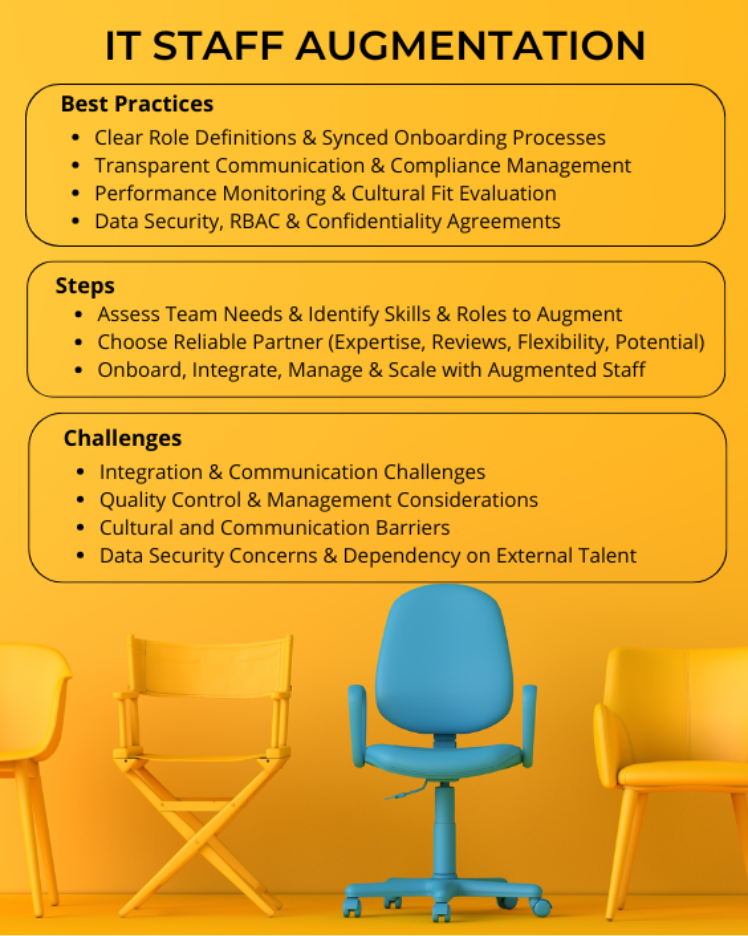
Practical considerations, steps of implementing, and challenges of IT staff augmentation
Reduced Expenses & Stronger Budget Oversight
When an organization hires permanent employees, certain expenses get associated during the process, such as training costs, salaries, health benefits, and even bench time in-between project execution. Technology staff augmentation provides in-depth insights for efficiently managing such costs and lets organizations only expend the required capacity. All collaborating departments gain better control over their budget, can optimize the same, and reduce the risks of overstaffing. The leadership team can allocate resources and funds accordingly while reducing fixed payroll costs.
Skill Enhancement & Knowledge Transfer
As domain experts are hired through staff augmentation, they bring forth experiences from different industries that can enhance the internal development team’s capabilities. They can improve security practices, coding standards, architecture-related decisions, and upskill internal talent without making expenses on external training initiatives.
Substantial Scalability & Flexibility
Team leaders can scale their teams up or down as per fluctuating market conditions or customer demands without causing major disruptions in organizational operations. They need not undergo the risks of overcommitting or lean operations with the flexibility offered by staff augmentation. It is ensured that the resource level keeps up with business priorities, such as the addition of developers during major product release or scaling down during wrap-up.
Decreased Talent Acquisition Overhead
Conventional hiring methods involve weeks to months, as they include various steps, such as job role posting, searching, and filtering of profiles over social media and other platforms. This is followed by extensive interviews involving different backgrounds and technical levels, HR processing, and ultimately onboarding. Resource augmentation bypasses such hiring bottlenecks and presents hired experts within days by handling them swiftly and seamlessly. This not only reduces hiring friction and the burden of internal hiring teams with regard to short-term crises but also empowers them to concentrate on long-term resource strategies.
Sustained Management of Projects & Teams
Often in the case of outsourcing, internal teams or the hiring organization may lose control over hired resources. This does not happen in resource augmentation, as internal project managers, tech team leads, sales, and product owners still monitor deliverables, define task priorities, and manage daily actions. This helps in preserving organizational culture, internal standards, and required project delivery methodologies for achieving stated timelines.
Leverage KritiKal’s Staff Augmentation Services
KritiKal Solutions comprehends the complexities, ins and outs of resource augmentation and has extended its services to organizations with requirements of global talent that align with their vision and plan of execution. Our resource augmentation strategy expands technical teams by integrating specialized professionals and experts on a temporary basis. We deliver niche skills without any expenses or delays that one may experience in permanent hiring or outsourcing. We make external professionals seamlessly embed into existing workflows, and the project can be easily managed on a day-to-day basis.
We understand that growing a team means much more than increasing the headcount; rather, it is closely associated with agility, skill gaps, overall business growth, budget constraints, and completing scheduled project deadlines. We lay down the pathway to a global talent pool that can assist you in overcoming challenges of ever-emerging technologies, including AI/ML, DevOps, cloud computing, cybersecurity, etc. We ensure your core staff and team leaders remain completely focused on strategic operations as we handle the scaling, contracts, operational, and legal nuances related to the team, supporting you every step of the way. Please do reach out to us at sales@kritikalsolutions.com to know more about our services and to realize your hiring requirements.

Chirag Dalal currently works as Assistant Manager – Talent and Team Building (TTB) at KritiKal Solutions. He has over 5 years of experience in tech hiring, talent strategy, and building high-performance engineering teams. With expertise in sourcing and onboarding specialized tech talent, he helps organizations scale and deliver impactful results.